
The Mughal Legacy,
500 Years On
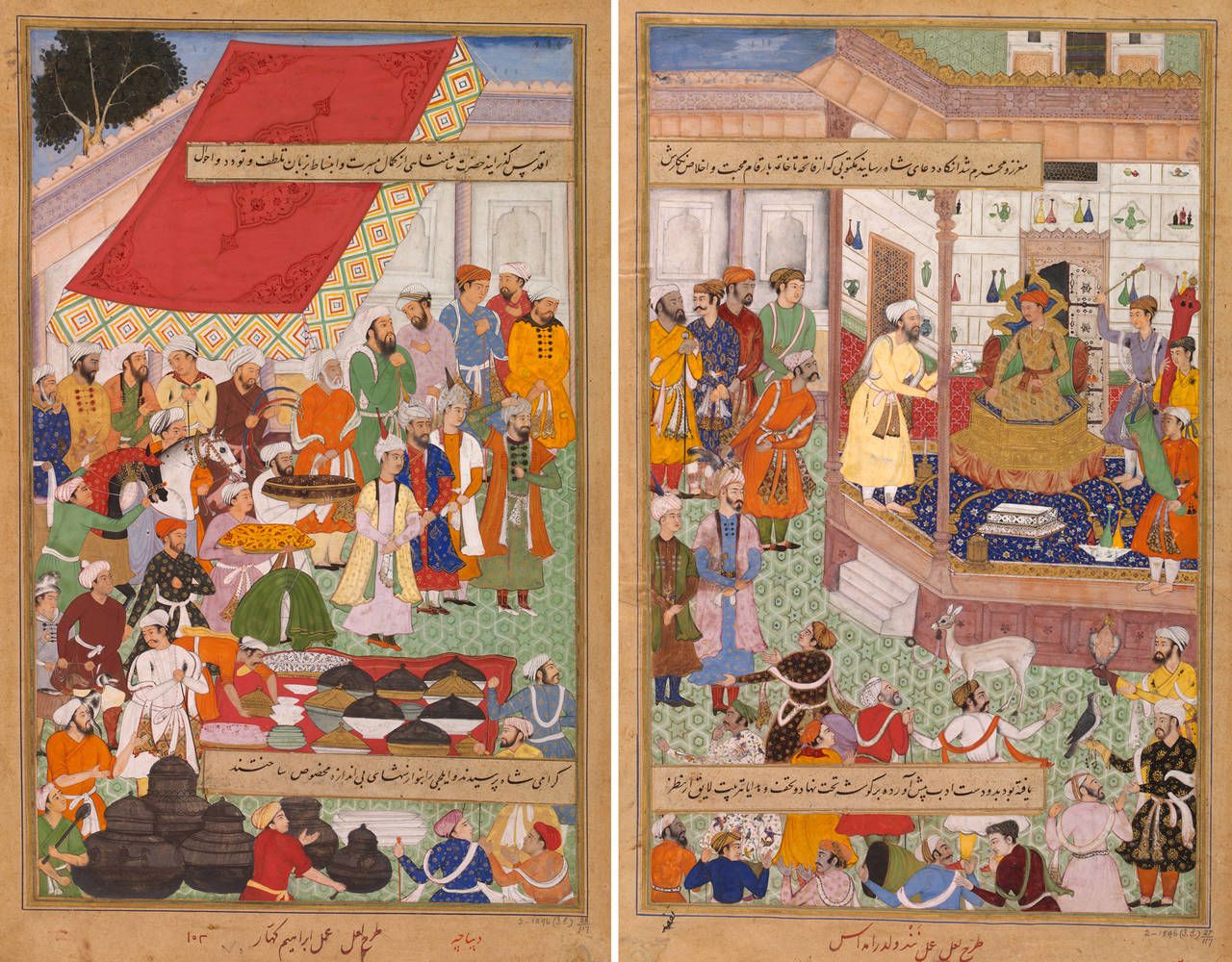

In 1526, Babur won against Ibrahim Lodi on the plains of Haryana, and the Mughal empire was born. It would last more than 300 years, all the way through to 1857.
Echoes still linger, in India’s bureaucracy and jewellery, art, food and fashion. In the way our capital city looks, and the shape of the civil services.
Read on for essays on food, art, fashion and more by Rana Safvi, Vir Sanghvi, Swapna Liddle, Muzaffar Ali and Dhamini Ratnam.
Reign Check
Rana Safvi

Across languages and centuries, the word “mogul” has come to signify opulence, power and a commanding presence. Media mogul, we say; or industry mogul, for a kind of force that shapes the world. It’s one of the littlest ways in which the Mughal dynasty lives on.
The word has its roots in the sheer opulence of their rule in India, which lasted from 1526 to 1857.
The Mughals were among history’s most passionate patrons of the arts, commissioning jewellery, manuscripts, paintings, architecture and decorative objects of breathtaking ambition. Some of the most treasured pieces in museum collections around the world trace their origins to this dynasty.
It is an indication of just how exceptional they were in this regard that, when emerald-lensed spectacles turned up at the auction house Sotheby’s in 2021, the consensus was it had to be Mughal. No one else would have had the means or audacity to take emeralds that large and cut (not polish) them until they were the right size for an auspicious talisman.

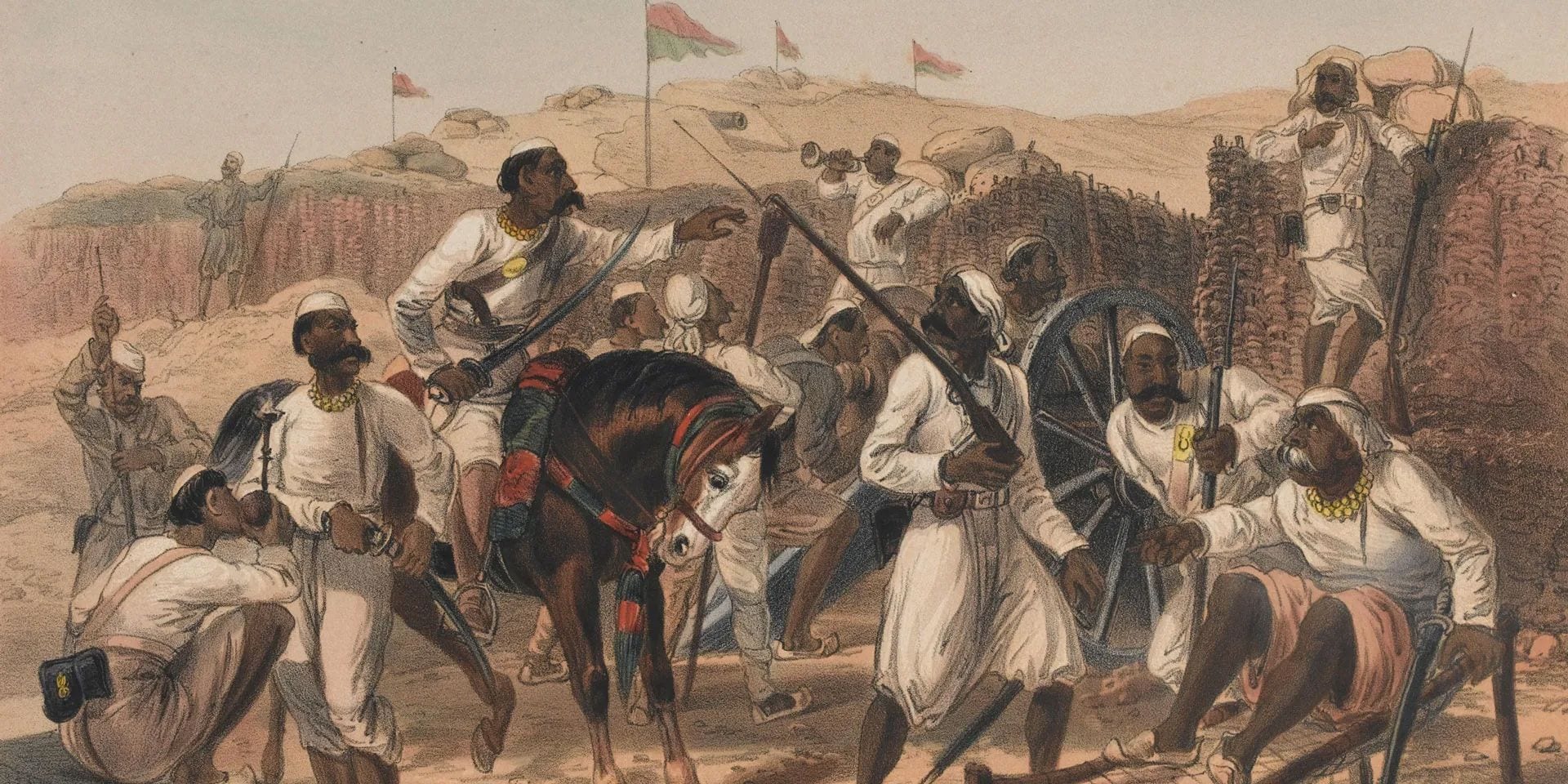
The Revolt of 1857, as represented in an engraving by Granger. (Wikimedia)
The Revolt of 1857, as represented in an engraving by Granger. (Wikimedia)
But opulence is merely the surface.
The deeper story is what the Mughals wove into the fabric of everyday life: into governance, cuisine, language, social ritual, and into the very way artists, poets and citizens imagined their world.
Mughal visual culture was born in the imperial ateliers of Humayun. This second Mughal emperor (after his father Babur), ruled from 1530 to 1540, lost to the Afghan Sher Shah Suri, was exiled to Persia, and returned victorious to reign from 1555 to 1556.
When he returned from Persia, he brought with him the master artists Mir Sayyid Ali and Abd us-Samad. They began to work alongside Hindu masters such as Basawan, Daswanth and Kesu Das. What emerged from this collaboration was entirely new. Persian compositional discipline met Indian vibrancy, resulting in bold, warm colour palettes with an earthy vitality and spatial depth.


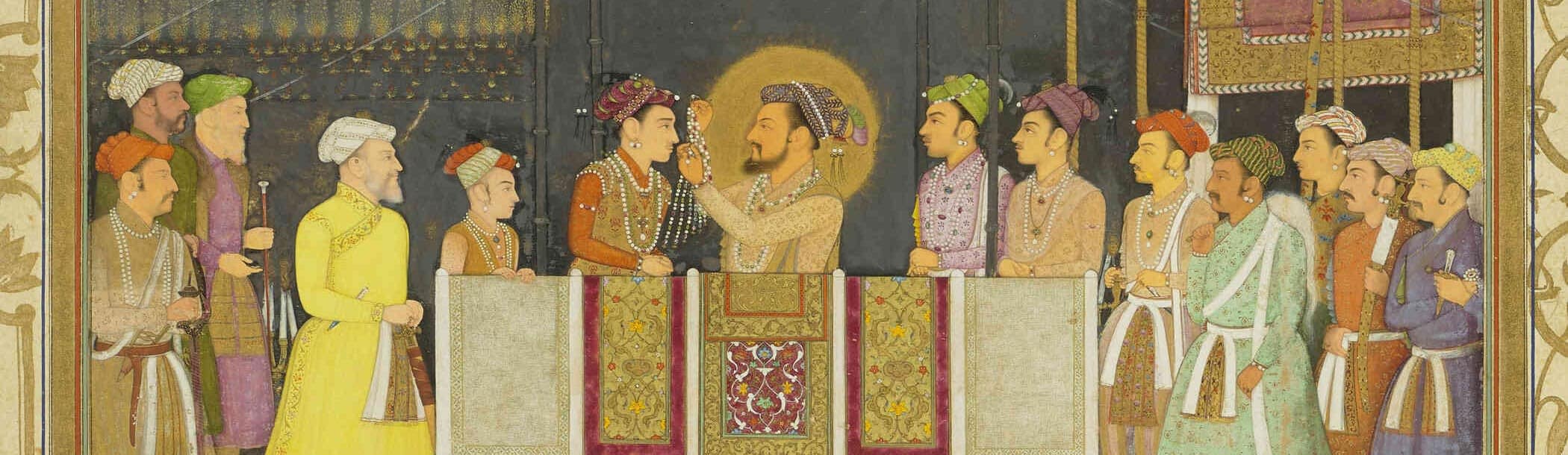
Emperor Jahangir (r. 1605-1627) weighs his son Prince Khurram (the future emperor Shah Jahan) against silver and gold, in a page from the Tuzuk-i-Jahangiri, c. 1610. (Wikimedia)
Emperor Jahangir (r. 1605-1627) weighs his son Prince Khurram (the future emperor Shah Jahan) against silver and gold, in a page from the Tuzuk-i-Jahangiri, c. 1610. (Wikimedia)
Portraiture, barely present in pre-Mughal India, became a high art. Illustrated manuscripts such as the Akbarnama and Baburnama became landmark records of this synthesis. Jahangir (r. 1605-1627; the fourth of a long line of Mughal emperors) took it further still: his obsessive interest in natural history produced court painters such as Ustad Mansur, who documented birds, animals and plants with a scientific precision that rivalled European botanical illustration of the period. Contemporary artists continue to subvert and reinvent this visual language in their work.
In architecture, the Mughals brought Indo-Islamic tradition to its apex. Persian geometry and Timurid grandeur fused with Hindu and Rajput craft: lotus motifs on Islamic arches, elephant figures on marble screens, the bulbous double dome crowned by a lotus finial, and the addition of jharokhas and jaalis. The Taj Mahal is the culmination of this grammar, and remains, globally, a visual symbol of India itself.
And no, Shah Jahan (r. 1628-1658; Jahangir’s son and successor) did not sever the hands of the artisans. The same design and construction team went on to build Delhi’s Red Fort.
Mughal patronage extended into crafts that surround us today.
The pashmina shawl industry in Kashmir flourished under Mughal attention. Crafts as wide-ranging as koftgari metalwork from Rajasthan (used on traditional weaponry) and ornamental metal bidri tableware from Bidar in Karnataka were all elevated to standards that Indian craftsmanship would measure itself against for centuries.
Modern Indian governance still works, in significant ways, in the shape the Mughals gave it, transmitted and hardened through the British Raj, but legible in its origins. The expectation that authority must be recorded, verified, and justified on paper; the movement of every file through a chain of approvals and noting; land revenue departments resting on measured fields, recorded ownership, and regular assessment — these patterns were first consolidated under Sher Shah Suri (1486-1545) of the Sur dynasty and refined under Akbar (r. 1556-1605; the third Mughal emperor).

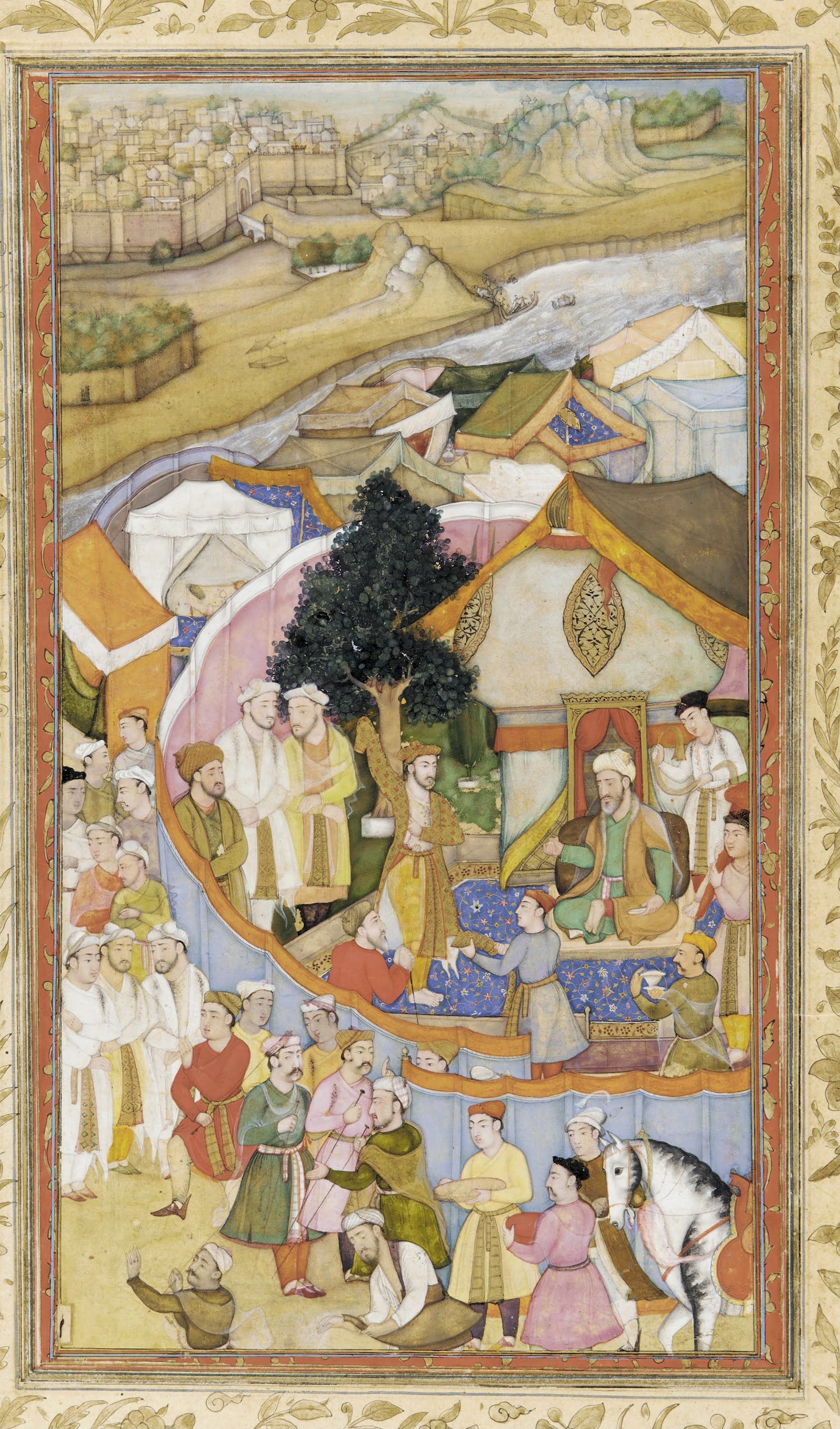
A rival surrenders to Akbar, at the latter's royal tent, in 1575. (Wikimedia)
A rival surrenders to Akbar, at the latter's royal tent, in 1575. (Wikimedia)
The civil service’s graded ranks and seniority echo the mansabdari (literally, “rank-holder”) system of military and administrative hierarchy, introduced by Akbar. Even the citizen’s instinct to address the state through a written petition carries forward a Mughal habit of governing through documentation rather than oral command.
Much of what ordinary people experience today as bureaucracy is the living descendant of systems that took shape, in this way, in the imperial chancelleries of Agra and Delhi.
The Mughal throne, even in ruin, would function as political glue. It was the umbrella under which the First War of Indian Independence was fought.
In 1857, when sepoys marched on Delhi and rallied around Bahadur Shah Zafar (the last emperor; ruler in name, within British India, from 1837 to 1857), they were not going to him for armies or resources, as he had neither. They went because he was a symbol: of a composite Hindustani order, a world in which different communities had imagined themselves as belonging together.
The British understood this. The exile of Zafar to Rangoon, the systematic dismantling of Mughal courtly culture and the deliberate erasure of imperial memory after 1857 were not incidental. To consolidate colonial rule, historical legitimacy had to be destroyed, not just political power.


Ladies on a Terrace at Night Playing Chaupar (Lucknow or Faizabad, 18th century). (Christie's)
Ladies on a Terrace at Night Playing Chaupar (Lucknow or Faizabad, 18th century). (Christie's)
Nationalists recognised this mission, and responded in kind. Jawaharlal Nehru’s Discovery of India (1946) held up the Mughal synthesis as proof of India’s civilisational genius, its capacity to absorb, transform, and make its own whatever came to it.
Today the Mughals are sometimes portrayed as invaders, foreign, apart, imposed. The charge does not survive scrutiny. They ruled India for over three centuries. They were born here, married here, died here, and are buried here. Their buildings are among India’s most recognised monuments. Their administrative habits run through Indian institutions.
The language that developed under them, called Hindavi then and Hindustani now, is still the language of a large section of the Indian populace. Patriotic poetry in Urdu defined the freedom movement, from Sarfaroshi Ki Tamanna (Desire for Sacrifice; 1921) by Bismil Azimabadi to Inquilab Zindabad (Long Live the Revolution; 1921), the cry raised by Hasrat Mohani which resonates to this day.
The legacy of the Mughals does not require a museum or a monument to persist. It surrounds us in ways we rarely pause to name: in the files that move through government offices, the ingredients in a slow-cooked stew, the swell of a dome, the courtesy of a formal letter, and in a ghazal’s ache.
The empire ended. The world it made did not.
(Rana Safvi is a historian, researcher and author, most recently, of A Firestorm in Paradise: A Novel on the 1857 Uprising; 2024)
Royal Flush: Art of the Empire
Dhamini Ratnam
Five hundred years is a long period over which to assess an art practice, especially when one is reviewing it not just by composition and symbology, but also through the social and cultural contexts in which it existed.
When it comes to Mughal art, two things stand out. First, the unabashed exchange that occurred between Iranian, European and local art styles, visible in the gilded pages of folios brought out by the royal library (kitabkhana), the relief work etched into forts and tombs across northern parts of the subcontinent, and the miniature paintings that this era is most famous for.
The second thing that stands out is that Mughal art practice created a wholly Indian canon that has retained an unshakeable hold over our imaginations, even five centuries later.
Although the Mughal dynasty lasted more than 300 years, the arts flourished primarily during the reigns of three successive emperors, Akbar, Jahangir and Shah Jahan, from about 1560 to 1650. Those decades produced art, architecture, literature, poetry, landscaping, food, clothing styles, textile work and craft innovations that defined the taste of generations to follow.
When Ebba Koch, the preeminent historian on Mughal art and architecture, visited the Kala Burj or Black Pavilion at the Lahore Fort, built during Shah Jahan’s reign (1628-1658), she found to her great delight angels drawn with a distinct “Mughalisation”, where European-Christian figures were “given the liberty to escape from their original context in order to express a concept deeply rooted in the Islamic tradition of rulership,” as she wrote in an essay later published in her well-known tome, Mughal Art and Imperial Ideology (2001).

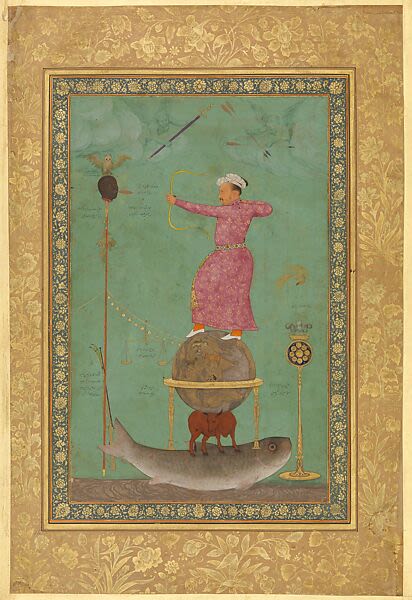
A 1620 painting by court artist Abu’l Hasan shows Jahangir standing on a globe shooting at the head of an enemy. (Metropolitan Museum of Art)
A 1620 painting by court artist Abu’l Hasan shows Jahangir standing on a globe shooting at the head of an enemy. (Metropolitan Museum of Art)
Koch visited in the winter of 1980, after the department of archaeology had uncovered wall paintings that had been hidden under a British-era whitewash.
“The angels belong to the most original and lively creations that Mughal art has brought forth in this genre. They do not follow the traditional Iranian-Mughal type of the winged being dressed in a long floating garment, but are clearly derived from a European prototype, namely the boyish nude putto image which had been revived in the Italian Quattrocento (Renaissance) in conscious imitation of classical model,” she wrote.
Of those that are still visible, one holds a red scroll with nasta‘liq characters, another wears earrings and a European hat. Yet another holds a turban of the distinctive shape worn by Shah Jahan’s great-grandfather Humayun and his royal brothers, a century earlier.
Koch identified this genre as the Mughal allegory, which, she noted, was created by Shah Jahan’s father Jahangir and his court artists, to propagate depictions of enduring rulership by employing such hybrid forms.
“The angel cycle of the Kala Burj is a vivid demonstration of this process. It shows, simultaneously, all the above mentioned stages of angel depiction, from the only slightly transformed Mughal copy of European models to Europeanized Mughal images, all characteristic products of the creative dialogue between Mughal and European art in the time of Jahangir,” Koch wrote.

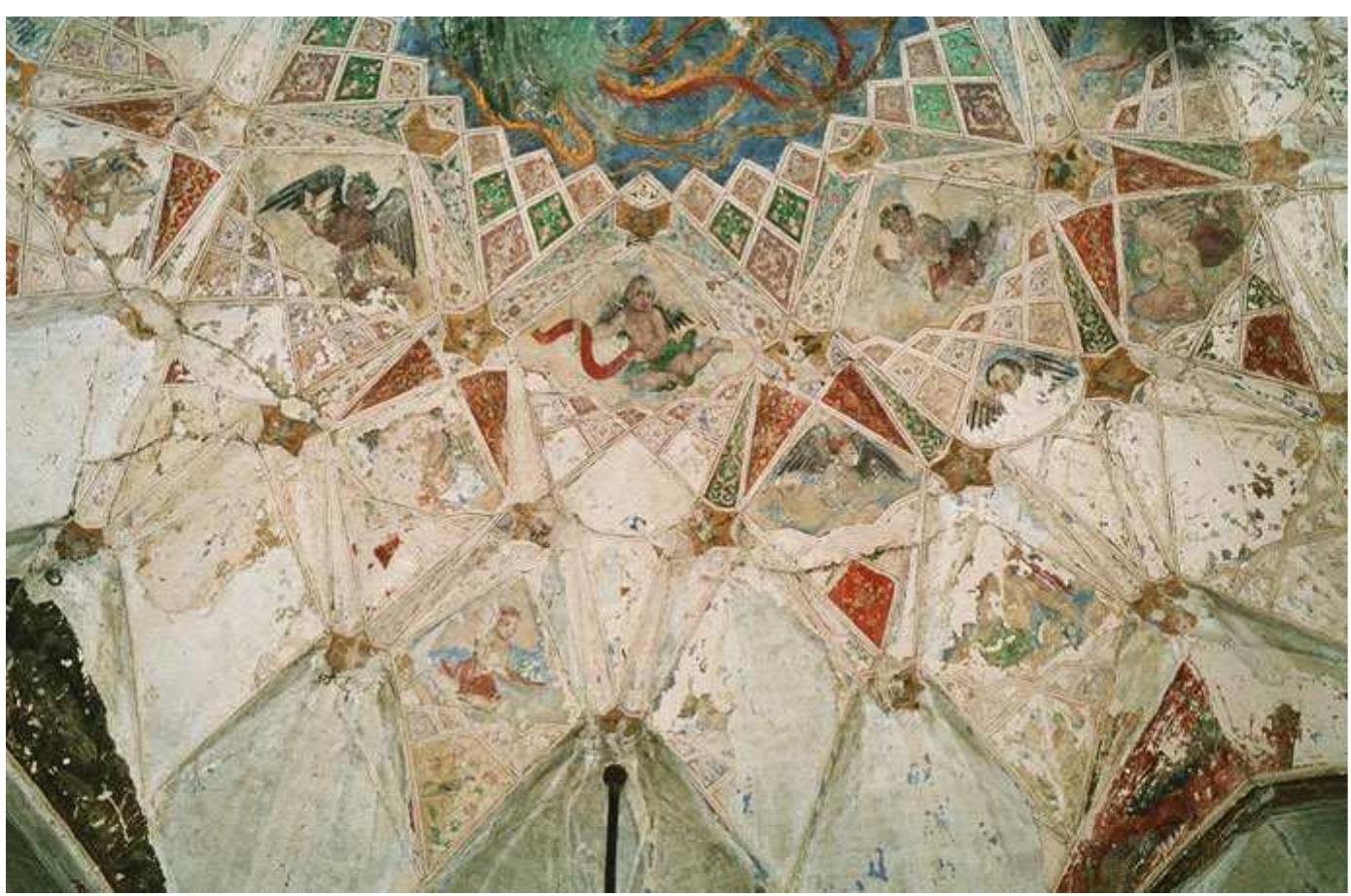
Angels drawn with a distinct ‘Mughalisation’ at Lahore Fort, built during Shah Jahan’s reign (1628-1658). (Ebba Koch’s paper Solomonic Angels in a Mughal Sky)
Angels drawn with a distinct ‘Mughalisation’ at Lahore Fort, built during Shah Jahan’s reign (1628-1658). (Ebba Koch’s paper Solomonic Angels in a Mughal Sky)
But Jahangir, though an iconophile, was not the first Mughal to succumb to the charms of European art.
In 1580, largely on account of Akbar’s universal approach to all religions, a group of Jesuits travelled to the royal court and presented him with a copy of the Antwerp Polyglot Bible, a multilingual edition that contained illustrations and other pictorial material. Akbar took note of the power of illustration.
By the time of Jahangir’s rule (1605-1627), an early work created c. 1620 shows the emperor standing on a globe shooting at the head of an enemy, the Maratha statesman Malik Ambar. The artwork is replete with symbols of animals and motifs that deify the emperor. Made by master painter Abu’l Hasan, whose naturalistic painting style was greatly valued by Jahangir, the painting did not simply tell a story; it served as a narrative of the emperor’s reign. Hasan made other works building on this one, such as Jehangir and Christ, a painting aimed at emphasising divine kinship. Others followed, such as Jahangir Standing on a Globe by the court painter Bichitr, in which the emperor is depicted with winged angels holding a crown over his head.
Each emperor had his favourite artist, whose style shaped not only the royal ateliers but also aided the king in enshrining and communicating a unique imperial ideology.
When the second Mughal emperor Humayun (r. 1530-1540, and 1555-1556) defeated the Sur dynasty and returned to India after a 15-year exile in Persia, he brought Persian painters Mir Sayyid Ali and Abd us-Samad with him.
When Akbar (r. 1556-1605) succeeded his father, he commissioned the Hamzanama — tales of Hamza ibn Abdul Muttalib, the uncle of Prophet Mohammad — which consisted of 1,400 miniature paintings in paper-lined cloth folios that melded Sayyid Ali and al-Samad’s Persian style with Hindustani artistry. The Hindu artist Basawan, known to be Akbar’s favourite, was renowned for his fine naturalistic style of depicting human faces, in the more-than-100 paintings ascribed to him.

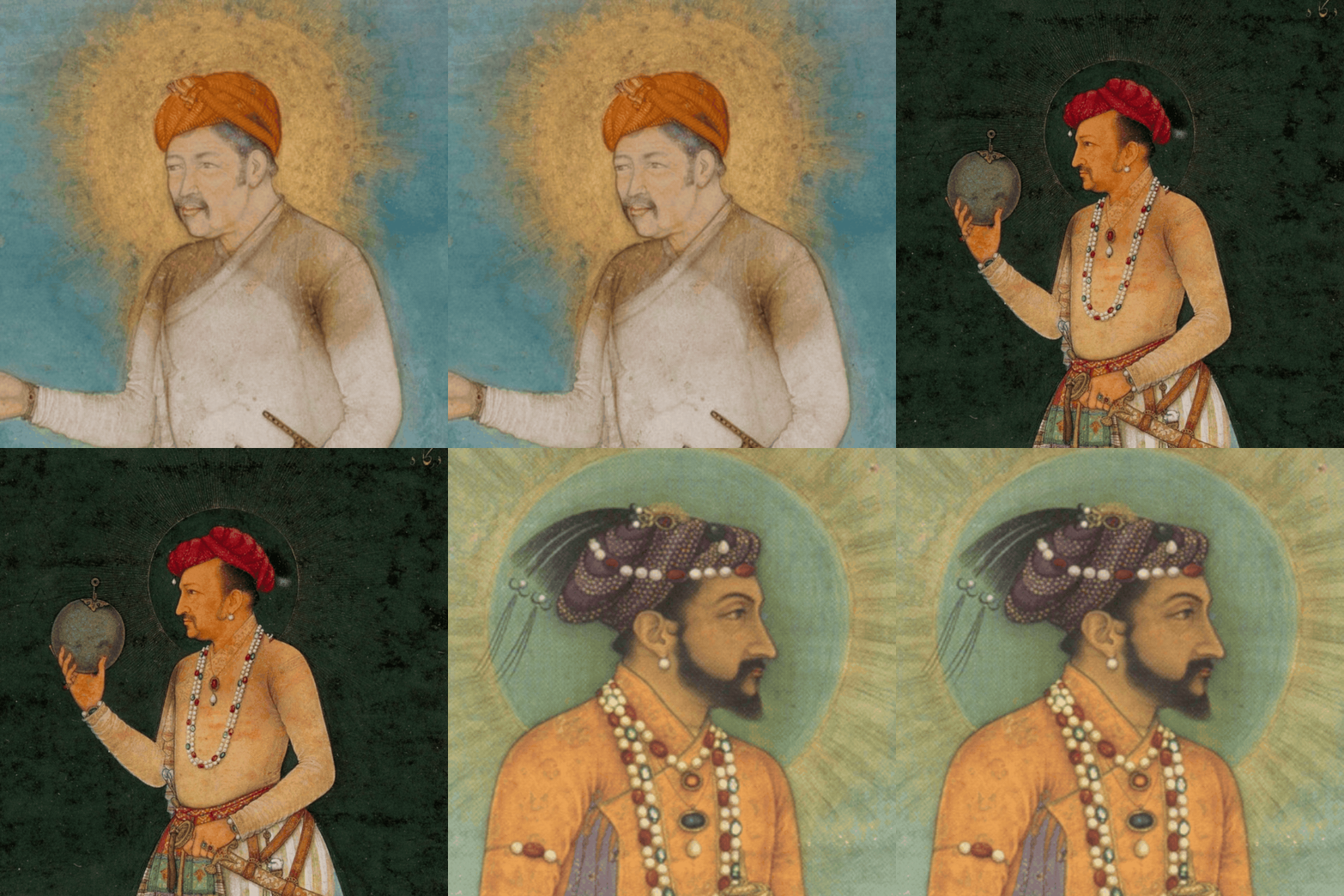
Akbar, Jehangir and Shah Jahan.
Akbar, Jehangir and Shah Jahan.
Akbar’s humanistic beliefs also led him to commission translations of Hindu texts such as the Ramayana and Mahabharat for Muslims subjects to read and learn from. These too were published with brilliant illustrations, like the one in which Krishna kills the demon Nikumbha, a folio in Harivamsa (dated c. 1590), currently in the collection of the Victoria and Albert Museum, London.
Similarly, the court painter Ustad Mansur was Jahangir’s favourite. In 1621, when a delegation presented the emperor with a zebra, an animal he had never seen before, he asked Mansur to make a painting of it, which he went on to personally inscribe with details of the day the animal came to court.
Like his father Akbar and great-grandfather Babur, he too commissioned a biography, with exquisite illustrations of courtly life. Hindu and Muslim painters from Lahore to Kashmir and Gujarat to Gwalior were employed in the royal taswirkhanas of the emperors, and attained the status of masters.
Over the course of this era, all the way to 1857 and the exile of Bahadur Shah Zafar after the First War of Indian Independence, regional centres began to develop new schools of miniature art inspired by Mughal painters: the Kangra in Himachal Pradesh, Basohli in Kashmir, the Rajput school that included the Kota and Kishangarh styles in Rajasthan, as well as the Deccan schools of Ahmednagar, Bijapur, Golconda and Hyderabad. Each school took the style and technique handed down from master artists, but introduced key differences, in subject matter, colour palette, depictions of foliage.
Miniatures continue to hold an important place in our imagination. They fetch high prices in the art market. Last October, for instance, a miniature by Basawan fetched over Rs 119 crore at a Christie’s auction in London. The painting, A Family of Cheetahs in a Rocky Landscape, belonged to the personal collection of Sadruddin Aga Khan, the grand-uncle of the current hereditary imam of Ismaili Muslims, the fifth Aga Khan.
In the painting, we see a family of cheetahs lying on a grassy knoll, with a stream flowing in the background. Basawan, whose naturalistic style influenced a generation of artists, also included pairs of animals and birds in the work, a visual trope common to Persian and Indian traditions, meant to symbolise fertility, fidelity and marital harmony. Indeed, as Akbar’s biographer and confidante Abul Fazl noted in the Akbarnama, cheetahs were a particular favourite of the emperor.
Though the schools that once flourished under royal patronage no longer produce miniatures, they remain an integral part of our past and present.
Red Between The Lines: The Making of Delhi
Swapna Liddle
Having defeated Ibrahim Lodi at Panipat, Babur did not proceed immediately to the Lodi capital at Agra. Instead, he stopped a few days at Delhi, which he referred to in his memoir, Baburnama, as the “capital of Hindustan”.
He was acutely aware that though Ibrahim Lodi’s predecessor, his father Sikandar Lodi, had moved his capital to Agra a little over two decades earlier, Delhi had a long history as the capital of an empire: the Delhi Sultanate. The two cities would alternately serve as Mughal capitals, over the next 331 years. Delhi in particular, which was the seat of the Mughal dynasty in its last couple of centuries, still bears its stamp.
The era of Mughal rule was a formative period in the culture of India, and one aspect of this culture was language. The language spoken in the region around Delhi eventually came to enjoy a very special status. It had been slowly evolving and absorbing words from other languages, particularly from Persian, which was the official administrative language of the vast multi-linguistic Mughal empire.
During Mughal rule, this language, known as “khadi boli” Hindi, emerged as a literary language. Poetry in it was referred to as rekhta.
In the 18th century, as the Mughal empire declined and its sphere of direct control shrank to the region around Delhi, the time was ripe for Hindi to replace Persian as the official language of the Mughal court. It was dignified with the appellation “zaban e urdu e moalla e Shahjahanabad”, or “the language of the exalted court at Shahjahanabad”. This in time was shortened to “zaban e urdu”, and eventually just Urdu.

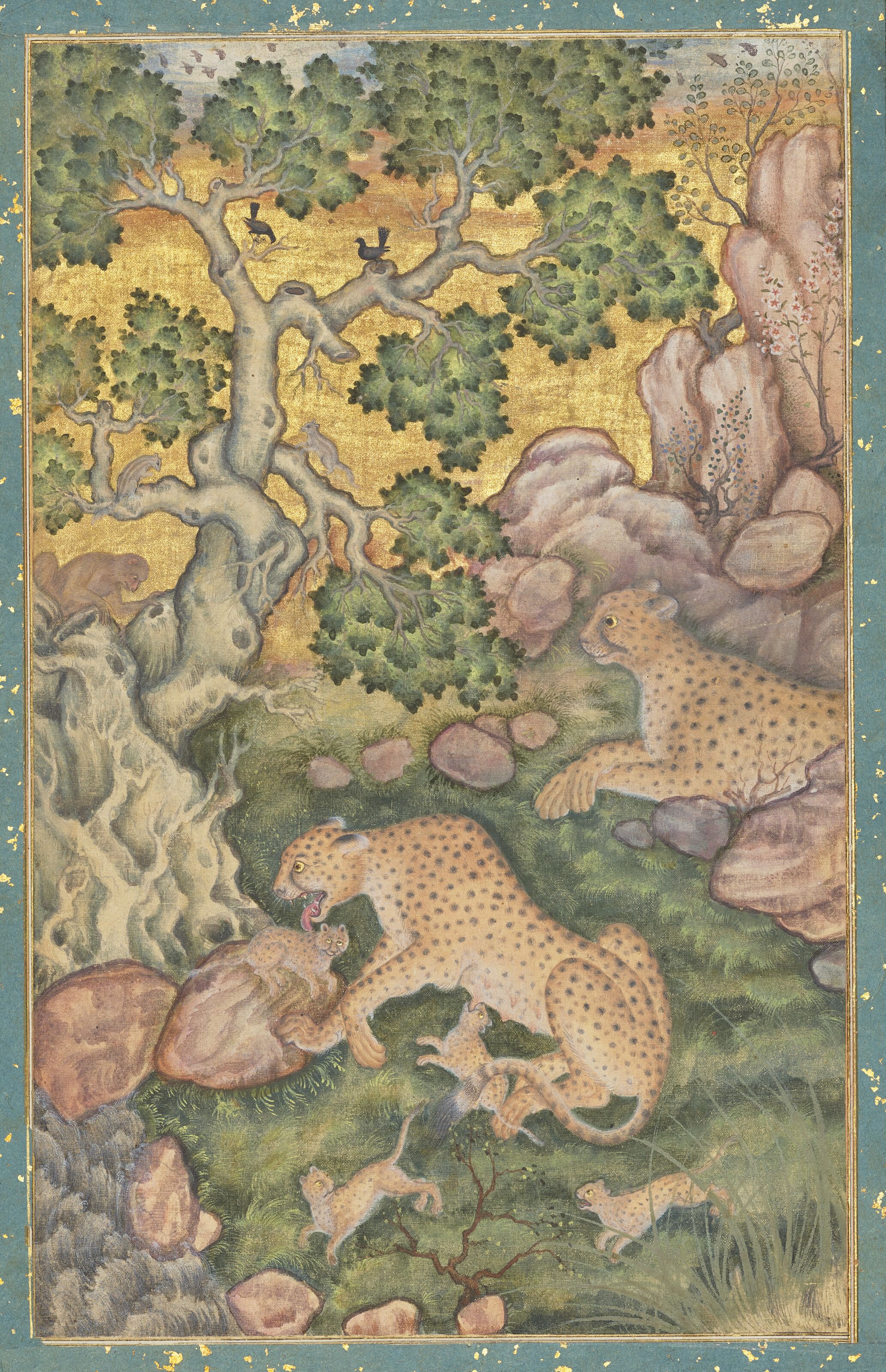
A family of Cheetahs in a Rocky Landscape, a miniature by Akbar’s court artist Basawan. (Christie’s)
A family of Cheetahs in a Rocky Landscape, a miniature by Akbar’s court artist Basawan. (Christie’s)
The patronage of the later Mughals played an important role in the development of Urdu literature, with many leading poets of their time being those from Delhi: Mir Taqi “Mir”, Mirza Muhammad Rafi “Sauda”, Mirza “Ghalib”, “Dagh” Dehlvi and of course the last Mughal emperor himself, Bahadur Shah “Zafar” (this being the pen name under which he wrote his verse).
Developments in the 19th century would lead to the bifurcation of this language into two distinct forms, Hindi and Urdu, the former shedding much of the Persian vocabulary present in the latter. Delhi continued to be an important centre for the literature of both. The popular annual festival Jashn-e-Rekhta, now more than a decade old, celebrates Urdu in the 21st century.
The Mughal empire was a vast multicultural entity, and the diversity of its people was reflected in the society and culture of its capital city too.
Sujan Rai Bhandari, a historian writing in the 17th century, emphasised the convivial cosmopolitanism, noting: “Men of Turkey, Zanzibar, Syria, the English, the Dutch, men of Yemen, Arabia, Iraq, Khorasan, Khwarizm, Turkmenistan, Kabul, Cathay, Khotan, China, Kashgar, Tibet and Kashmir, and other provinces of Hindustan have chosen to reside in this metropolis… and are employed in their respective work and professions. These different classes of people live together like sentences in a passage of prose, and their manners harmonise like the verses of a poem”.

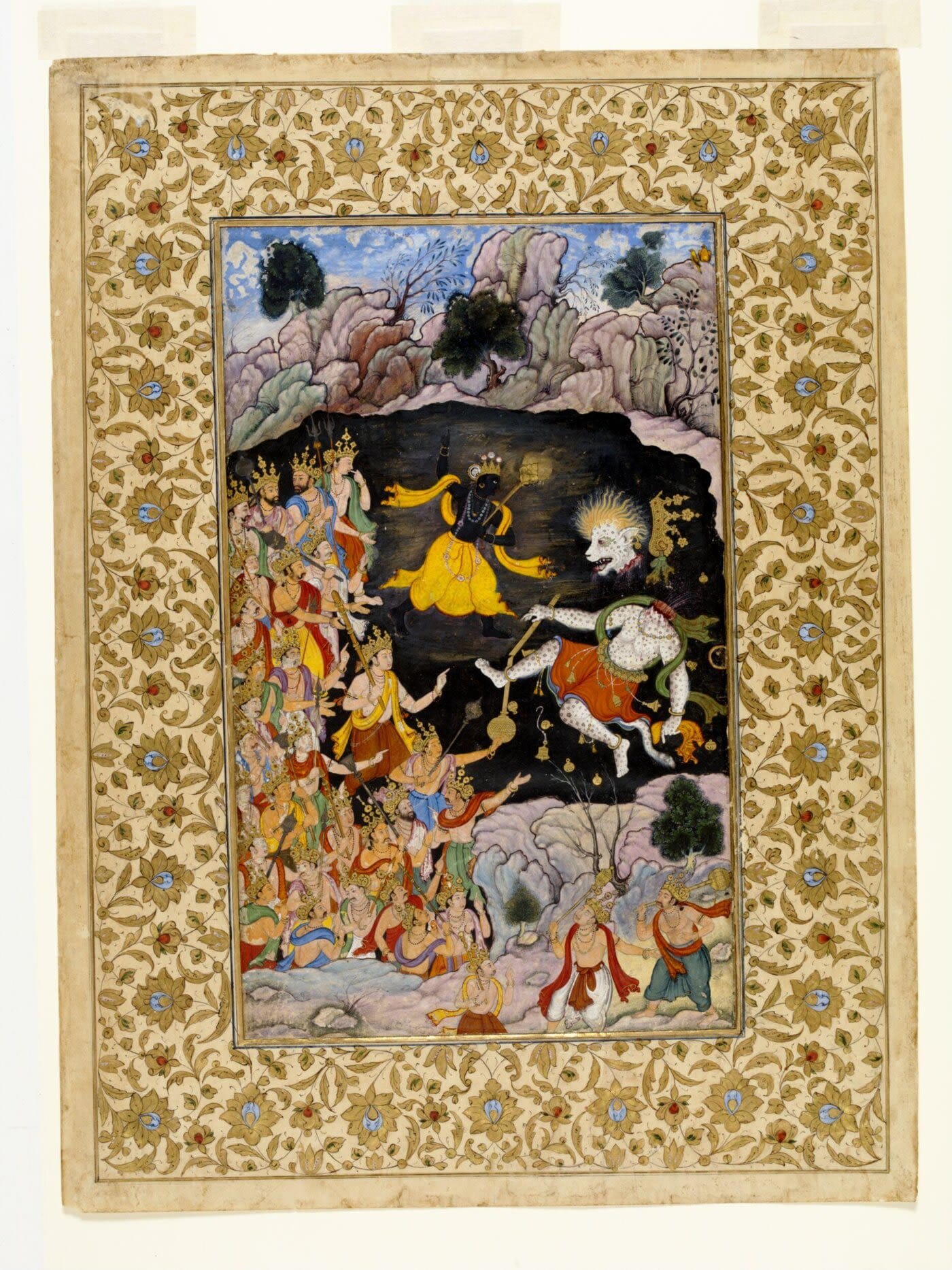
Krishna and Nikumbha as depicted in the Harivamsa (c. 1590), a collection of tales commissioned by Akbar, drawn from the Mahabharat. (V&A Museum)
Krishna and Nikumbha as depicted in the Harivamsa (c. 1590), a collection of tales commissioned by Akbar, drawn from the Mahabharat. (V&A Museum)
The Mughals took active steps to maintain this harmony. The culture of the court and the royal household reflected the diverse traditions of the land, with the celebration of both Hindu and Muslim religious occasions. Annual Ram Leela performances recounted the battle between Ram and Ravana over days, at venues erected on the sands of the Yamuna next to the Red Fort, so the emperor and the rest of the royal family could watch from their windows.
An integral part of the Ram Leela was the tesus: effigies representing the Mahabharat warrior Barbareek (grandson of Bhima). Pahalwans or wrestlers from the many akharas of Delhi, most of them Muslim, would create the tesus — each akhara making its own — and take them out in processions to the accompaniment of music.
One very distinctive Delhi festival originated in the early-19th century: Phoolwalon ki Sair (Procession of Flower-Sellers). This annual monsoon festival, held in Mehrauli in the vicinity of the Qutub Minar, was actively patronised by the last Mughal emperors. The festival of cultural events and recreational activities attracted many from the city, who would then spend several days in Mehrauli.
The core event was the offering of a coverlet of flowers at the dargah of the Sufi saint Qutubuddin Bakhtiyar Kaki, and of pankhas or fans at the temple of Jogmaya (sister of Krishna; a site associated with the Mahabharat).
With the departure of the Mughals, the Ram Leela celebrations moved to other locations, away from the sands below the fort walls, and the tesu became a tradition associated mainly with children. The Phoolwalon ki Sair has continued, with some modifications and some interruptions, a powerful reminder of the syncretic traditions of the city that developed under these emperors.
Another important legacy is the unusually green metropolis that Delhi still is.
One of Babur’s early acts in Agra was the laying out of a garden on the banks of the Yamuna there. Many other gardens followed, until there was a line of these along one bank of the river. The pattern followed in Delhi was slightly different.
When Shah Jahan planned a new city here, Shahjahanabad, in the 1630s, large gardens were incorporated into the main urban area. There were expansive gardens in the northern parts of both the city (north of Chandni Chowk) and the palace citadel, or Red Fort. Gardens were laid out outside the city walls too, and some of these still exist, notably Roshanara Bagh, Shalimar Bagh, Qudsia Bagh and Talkatora Bagh.
This pattern of development informed the subsequent development of Delhi, which remains a city of parks within residential areas, low-rise housing set amid green spaces, and shaded avenues.
The Mughals have also left a powerful architectural legacy, the most prominent examples of which are to be found in the two capitals: Delhi and Agra. The red sandstone-covered walls of the Red Fort at Delhi are to this day a strong symbol of political power, and the site of the prime minister’s annual Independence Day address to the nation. So powerful was this connection between state power and the red walls of the Mughal fort that, when the British built New Delhi, red sandstone was used for the base of the government buildings on Raisina Hill. We continue to use red sandstone, as in the new parliament building.
If anything, we might be overdoing it. In Delhi, red sandstone is shorthand for “power” and “heritage”, and so we use the material unthinkingly, not only for cladding in new buildings but also for paving and boundary walls. There are even red sandstone garbage bins at some monuments. It is possible we are using more of this material than the Mughals did!
Given today’s sustainability concerns, we should probably rethink the rate at which we mine this beautiful resource.
And so it is that, between 1526 and 1857, the Mughals were transformed from Chagatai Turks to Indians, through conscious acculturation, marriage and descent, even as India was in turn transformed during their rule.
(Swapna Liddle is a historian and author of, among other titles, The Broken Script: Delhi Under the East India Company and the Fall of the Mughal Dynasty; 2022)
Stir Trek: What the Mughals Added to Our Palate
Vir Sanghvi
If we are to assess the culinary and gastronomic legacies of the Mughals, we must begin by dispelling two myths.
The first is that today’s so-called Mughlai food is authentic: it really has nothing to do with the Mughal empire, and no self-respecting emperor would have deigned to eat it. Over the past few decades, the term has come to be associated with greasy meat- and chicken-based dishes that are sought to be linked to the Mughals. Few, if any, of those preparations existed in any form during their reign, and though the term “Mughlai” is now a byword for “Muslim”, some of these dishes were created decades after the last of the Mughals had disappeared, by Punjabi Hindu chefs.
For instance, butter chicken, that staple of the modern-day “Mughlai” menu, was created not in the 1600s or 1800s but in the 1950s, in Delhi, by Hindu refugees from West Punjab. No tandoori kabab can ever be of Mughal origin either. Tandoors were not used to cook meat in India during their rule. The practice only became widespread in the 1920s, when a restaurant in Peshawar owned by Mokha Singh invented tandoori chicken.
The second great myth about the Mughals is that they came to a vegetarian Hindu country, subjugated its residents and made them eat beef. This is wrong on so many levels that it is hard to know where to start.
As the food writer Colleen Taylor Sen has demonstrated, as far as back as the Mauryan Empire (c. 321–185 BCE), Indians were eating snakes, rabbits and frogs. We were no strangers to non-vegetarianism. Moreover, the Mughals were not great beef-eaters. There are few beef recipes in the very few cookbooks that survive from that period, and many of the emperors were largely vegetarian. (Avoiding meat was viewed as a mark of discipline and good health.)

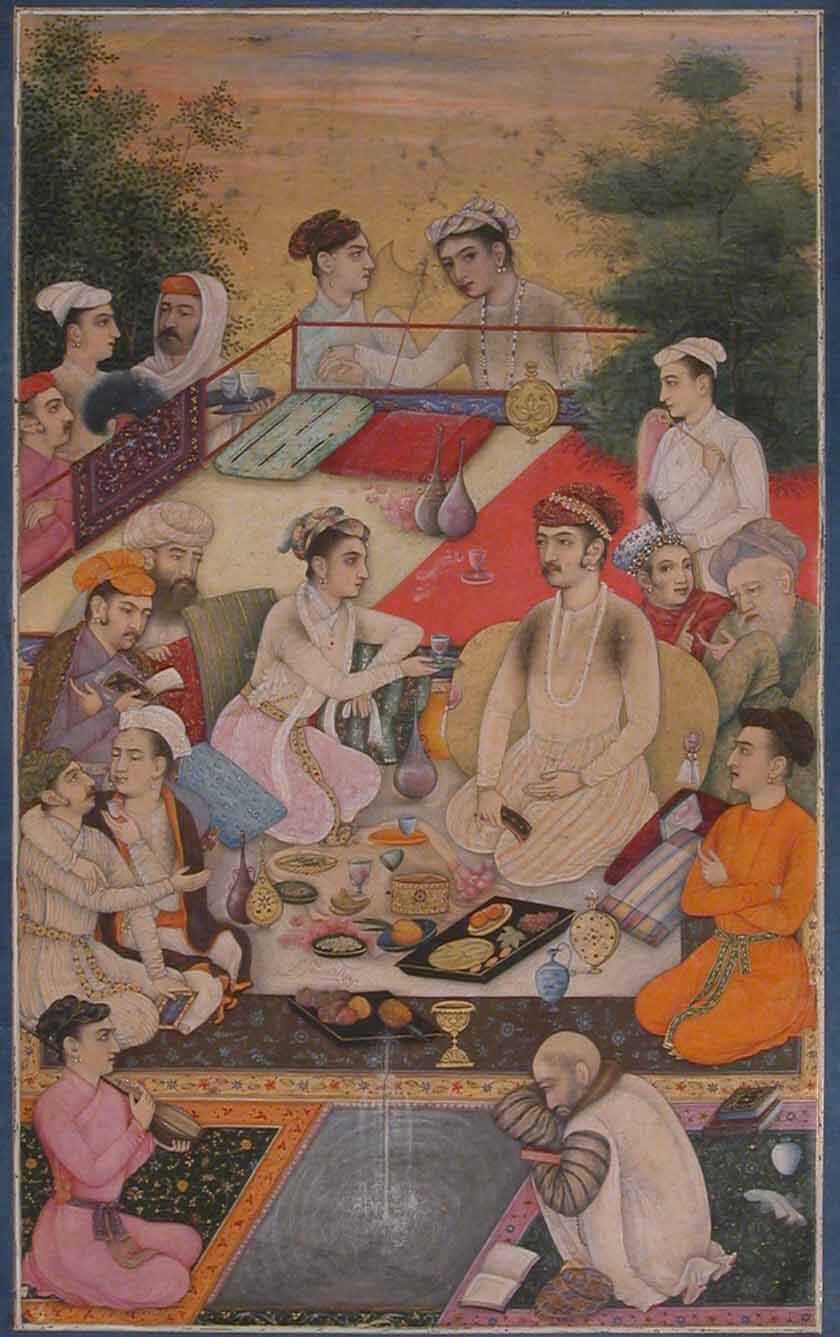
Prince Feasting on a Balcony — Shah Jahan’s Dastarkhan. (Metropolitan Museum of Art)
Prince Feasting on a Balcony — Shah Jahan’s Dastarkhan. (Metropolitan Museum of Art)
The idea implicit in much of the myth-spinning is that India was a Hindu-ruled country until the Mughals got here. This too is untrue. Babur didn’t win against a Hindu king. He won the first battle of Panipat in 1526 against Ibrahim Lodi, whose ancestors had founded the Muslim Lodi dynasty in 1451.
Nor were the Lodis the first Muslim kings in India. Muhammad bin Qasim had captured parts of Sindh as far back as 711 CE. India had experienced centuries of periodic Muslim rule long before the Mughals conquered Delhi.
All this is important because we tend to try to trace every gastronomic connection between India and West Asia to the Mughals, when the truth is that there were such strong links between South and West Asia that many of the dishes and ingredients we try to attribute to their influence — samosas, pulaos, saffron, etc — got here long before Babur was born.
Unfortunately, so poor is our recording of food history that it is hard to ascribe exact dates to the introduction of different foods to the subcontinent. We are forced all too often to rely on foreign sources, and the accounts of visitors and travellers.
For a sense of the changes the Mughals did bring about, we have Babur’s words to go by. He wrote that there were “no good horses, no good dogs, no grapes, muskmelons or first-rate fruits, no ice or cold water”.
This led to one great culinary legacy: a wider array of fruits. The Mughals planted melons, apricots and a range of other produce that India was not familiar with. As Taylor Sen records: “Ice, used for cooling drinks and making frozen desserts, was brought daily from the Himalayas by an elaborate system of couriers.” That, in fact, is how the kulfi tradition sprung up.
Grand Mughal cuisine there still was not. When we write of the glories of their courts, we sometimes forget that Babur was a chieftain from Central Asia, a region with no tradition of gastronomy. It was his son Humayun who began to merge Indian traditions with West Asian influences to create something new.
Even when his rule was interrupted and he was exiled to Persia for 15 years (1540-1555), after a series of battlefield losses to the Afghan Sher Shah Suri, legend has it he introduced the Shah to long-grained Indian rice, which then went on to feature in Persian cuisine.
Because Babur’s descendants recognised that they had no great royal traditions from back home, they embraced Persian culture, making Farsi the court language. Ironically, that would later confuse food historians, who would argue that because dishes had Farsi names they must have had roots in Iran; actually, many of these were invented at the Mughal court.
The Mughals combined Persian influences with the ingredients of their new home and began to incorporate a wide array of spices, for instance, into court cuisine.
Mutton do pyaza, which features in the Ain-i-Akbari (a record of Akbar’s rule in the 16th century), uses spices to enrich what is essentially a simple recipe of meat and onions. Rogan josh, an Iranian dish, became completely Indian in flavour too, after spices were added.
Not that Akbar ate much of either. As time went on, his food habits became more Indianised. He banned cow slaughter, advised against eating garlic and onions, became largely vegetarian and drank Gangajal.
His son Jahangir, whom we would describe today as an alcoholic, discovered a bajra khichdi while travelling through Gujarat and liked it so much that he took the cook back to Delhi with him. Khichdi then became a staple of Mughal court cuisine and his son Shah Jahan’s cooks later made a fancy khichdi that was a signature dish at the court.
Though we like to think of the Mughal food tradition as being one of importing West Asian dishes, its defining characteristic was that it added flavour to these dishes with Indian ingredients and techniques.
A prime example is biryani, which moved away from the fancy Persian pulao tradition to become a moister, spicier meal that could be made easily in large containers. Biryani became the food of soldiers and humbler people, while the delicately flavoured pulao remained a dish of the court.
How good was the food of the Mughal royals? It is hard to say, because few traces of the dishes survive. Biryani may have been invented in Delhi or Agra, in this era, but nobody is quite sure what the original tasted like because the versions that have survived come from post-Mughal courts in Awadh and Hyderabad. Even Calcutta biryani came from the Awadhi court in exile in Metiabruz.
On the other hand, without the Mughal empire there would have been no Nawab of Awadh and no Nizam of Hyderabad. So perhaps that was the greatest culinary contribution of the Mughal emperors. They came to India as foreigners but by the end they had become so Indian that their influence spread to the cuisines of regions as far apart as Telangana, Uttar Pradesh and Bengal.
The empire is gone but the legacy lives on.
Wear Next?: Style's Unbroken Trend
Muzaffar Ali
Five centuries ago, on the plains of modern-day Haryana, Ibrahim Lodi of the Delhi Sultanate met the invading forces of Babur, who won and established the Mughal empire.
The victor, it turned out, had a deep love of nature and a passion for gardens. Originally from Central Asia, Babur missed the cool climes and lush landscape of the valley he grew up in. This prompted him to introduce the formal quadrilateral garden, known as the charbagh, intersected by flowing water channels, dotted with pavilions, fountains and shade-giving trees.
The gardens symbolised paradise as understood in the Islamic tradition. Later Mughal rulers would build more such baghs across India. This is one of the ways in which the quiet continuity of the Mughal era shaped tastes and the evolution of a civilisational aesthetic.
The subcontinent was, at this time, the beating heart of global trade and one of the largest contributors to the world economy. The refined taste and sustained patronage of the Mughal empire’s ateliers meant that this wealth now flowed to all corners, shaping craft, intellect and imagination.
Then, amid the gradual decline of the empire, authority loosened its grip on Delhi.
Culture, no longer anchored to a single imperial centre, began to travel. In that movement, Awadh emerged, not as a successor, but as a site of transformation. This is where the most remarkable impacts on fashion became visible, and enshrined.
Under the Nawabs, who were originally governors within the empire, the rhetoric of power softened into the poetry of living. The ateliers of Awadh did not produce objects. They cultivated sensibilities. Couture found its counterpoint in Kathak. Traditions such as chikankari evolved into an art of restraint, where white thread on white cloth held within it an entire philosophy of subtlety. Zardozi, carrying the legacy of imperial opulence, found in Awadh a new discipline: gold that did not proclaim wealth but suggested it.

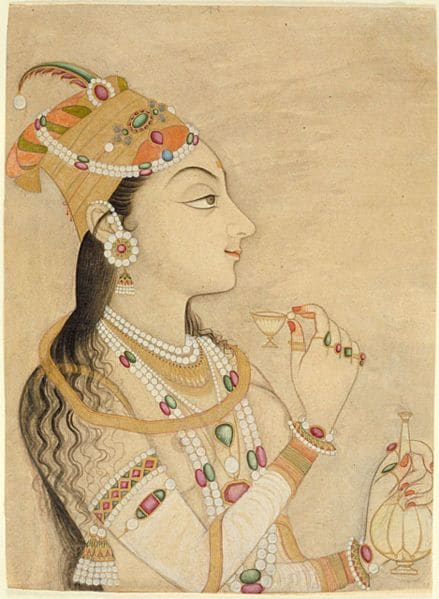
Portrait of Nur Jahan.
Portrait of Nur Jahan.
Fashion in this world was encoded. The fall of a sleeve, the layering of a farshi gharara, the quiet authority of an angarkha, these were not choices but articulations of identity. This refinement found its most complex expression in the feminine.
The angia or choli, until now overlooked, became the silent architect of proportion and poise. It held the entire grammar of the silhouette together: restrained, precise, almost whispered into existence. In Umrao Jaan, the film I directed that told the story of a courtesan and poet in 1850s Lucknow, the neckline, sleeve, fall upon the shoulder… each decision carried the weight of tehzeeb or culture.
This era’s fashion did not chase attention but negotiated dignity. In that discipline lay its seduction. The body was never directly revealed, it was revealed through suggestion. That distinction is the cornerstone of Awadhi grace.
What emerged was a design philosophy rooted in continuity rather than disruption. The garments did not scream for reinvention. They evolved like poetry, line by line, generation by generation. The peshwaz flowed into the gharara, the dupatta conversed with the choli, and together they created a language that was both regional and imperial.
This was the true genius of the Mughal-Awadh synthesis: absorbing Varanasi’s opulence, Kashmir’s subtlety and Lucknow’s refinement into a seamless narrative.
Nothing was abrupt, and everything belonged. That sense of belonging is what modern fashion often abandons in its race for novelty.

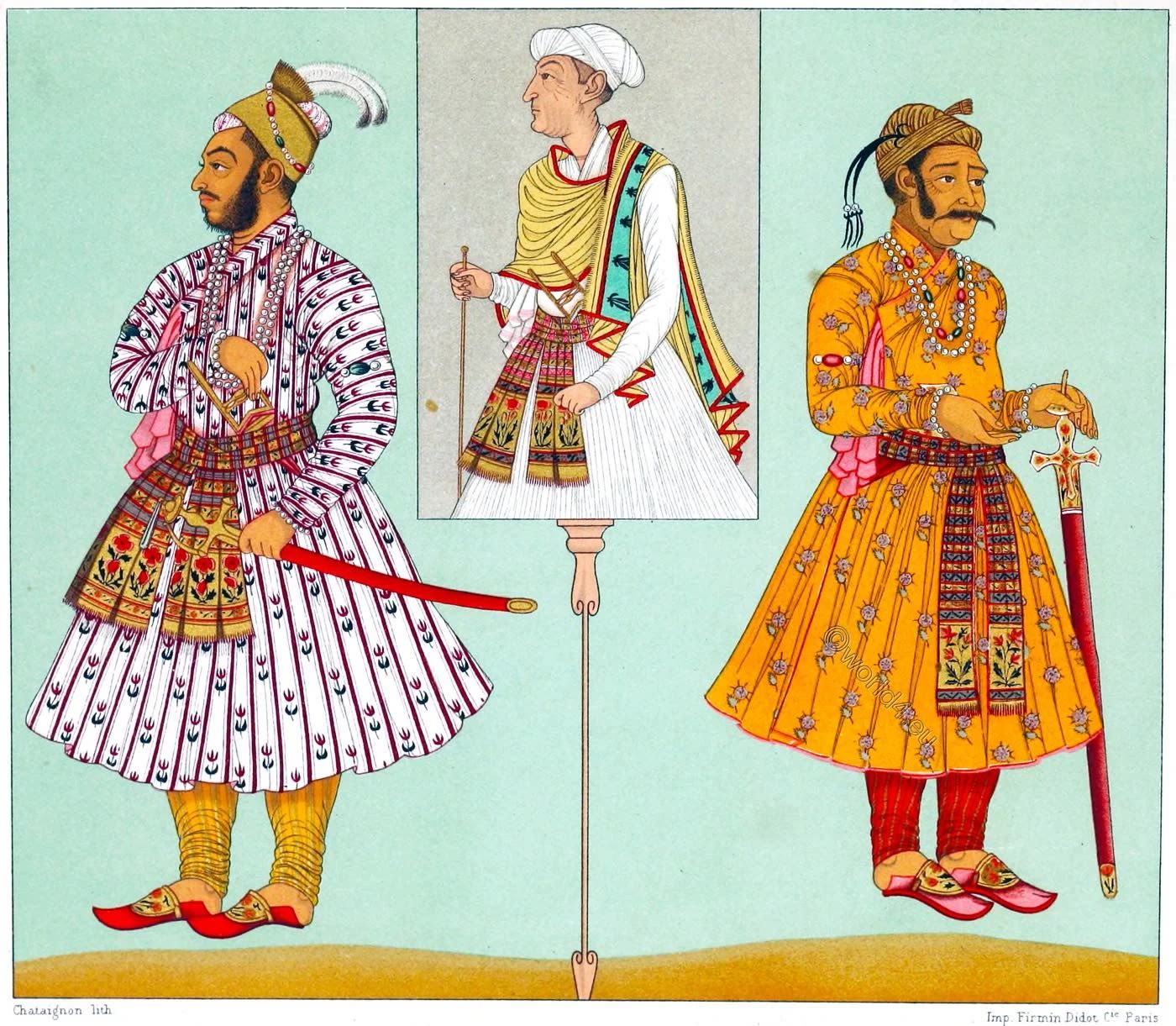
High dignitaries of the Moghul empire; a lithograph by Chataignon from Historical Costumes: Volume I by Auguste Racinet.
High dignitaries of the Moghul empire; a lithograph by Chataignon from Historical Costumes: Volume I by Auguste Racinet.
The legacy endures because it was never merely aesthetic. It was cultural. Craft was not decoration, it was devotion. Zardozi was not indulgence, but identity. Each stitch carried memory, each wire and moti held time.
Fashion in Awadh did not arrive to me as a concept. It arrived in the form of my mother, who embodied it. Tall, composed, she would emerge from her purdah-bound world draped in an effortless authority: a deep green kaamdani dupatta shimmering with quiet opulence, a finely worked chikan kurta, and a light grey farshi gharara that moved like poetry across the floor.
Years later, I found myself transmitting that same grammar of grace.
Umrao Jaan (1981) distilled and revealed this world to a generation that had forgotten all about it. All too often, we lack the patience to listen to what a craft is telling us. Continuity of grace demands surrender to process, history, and the unseen hand. Without that, fashion becomes noise. With it, it becomes timeless.
The passing of my mother (Rani Kaneez Hyder of Kotwara, a former princely state near Lucknow) left a silence, and a resolve. My wife (architect and fashion designer Meera Ali) and I turned to adorning women as I had always envisioned them, not as mannequins but as carriers of narrative, dignity and allure. From Lucknow to Kotwara, what began as personal remembrance, evolved into a living atelier of craft and couture.
Today, it stands as a continuum, an archive. The karigars of Lucknow, custodians of generational skill, do not merely embroider fabric, they compose visual essays. They make works of such finesse that one could imagine even Nur Jahan, emperor Jahangir’s wife, pausing to admire and draw inspiration from them.
Sama Ali, my daughter and a designer, works with us. She makes fairies of brides, inspired by the parikhana, a sort of academy of the arts, set up by the last nawab of Awadh, Wajid Ali Shah. The three of us look at craft as the pinnacle of human effort and add our sensibilities as artists in an effort to sustain it.
In the Mughal imagination, the feminine was both presence and influence.
Women such as Nur Jahan were arbiters of taste and embodiments of refinement.
As a patron of crafts and, in many ways, author of aesthetic direction, Nur Jahan’s intervention in textiles, perfumes and ornaments was not incidental. It shaped courtly ethos in the 17th century. She represents, even today, power and grace converging without contradiction.
But as the locus of culture shifted to Awadh about a century later, the feminine found a different, more layered articulation. No longer confined to the zenana, she emerged in the mehfil, in performance, in poetry, in presence.
This is where Umrao Jaan becomes inevitable: a reconstruction of a lost world, filtered through memory, longing and cinematic interpretation. Based on Umrao Jaan Ada, the 1899 book by Mirza Hadi Ruswa, the film situates its protagonist within the cultural fabric of 19th-century Awadh, when the old world order is about to end.
Umrao emerges not a passive subject of history, but as its interpreter.
Through her, we encounter a realm where art is survival. Where poetry is resistance. Where a courtesan, in the cultivation of herself, embodies an entire aesthetic tradition: music, poetry, etiquette, style, and the distilled essence of a civilisation.
In her, this inheritance finds both voice and vulnerability. The tragedy of her life mirrors the tragedy of Awadh itself.
The fragile ecosystems of patronage collapsed amid British crackdowns, following the First War of Indian Independence in 1857. Courts dissolved, ateliers scattered and, with them, the continuity of refinement fractured.
But beyond loss too, there lies continuity.
In bringing Umrao to the screen, cinema allowed for a reimagining of textures of fabric, light, gesture, and silence. The feminine, once situated within specific historical constraints, could now traverse time. The protagonist, as embodied by Rekha, became both historical and contemporary. Her stillness, her gaze, her articulation of emotion brought an entire lineage of refinement into the 20th century.
It is within this continuum that my work finds its place. At House of Kotwara, the exploration of crafts such as zardozi and chikan is driven not by nostalgia but by a recognition of their inherent philosophy. These are not techniques to be preserved. They are languages to be spoken anew.
The discipline of Awadh, insistence on restraint, valorisation of detail and integration of form and feeling continue to inform this practice. But it must now respond to a different world.
The contemporary moment is marked by fragmentation. Identity is no longer inherited in continuity; it is assembled through encounter. In such a context, the role of design shifts. It must create coherence without imposing uniformity. It must evoke memory without becoming captive to it. This is where the feminine, once again, becomes central.
The figure of Nur Jahan returns, not as history, but as aspiration. She represents a synthesis: authority without rigidity, beauty without excess, power articulated through refinement. To engage with her today is to imagine a future where these values can be reconstituted.
In many ways, the dream of Nur Jahan is the dream of continuity itself, a way of bridging past and present, empire and individuality, memory and creation.
The journey from Mughal court to Awadh, Awadh to Umrao and Umrao to contemporary practice is not linear. It is recursive, layered and often fragmented. Yet, within this complexity, certain principles endure. Refinement is not excess, it is discipline. Beauty is not surface, it is structure. And culture is not static; it is lived.
What was once articulated in marble and manuscript, in embroidery and etiquette, now seeks expression in new forms. The task is not to replicate the past, but to engage with its intelligence, to understand the systems that produced such refinement, and to reinterpret them within the conditions of the present.
The story, then, is not of decline, but of transformation. And in that transformation, grace persists.
(Muzaffar Ali is a painter, fashion designer, filmmaker and director of the 1981 classic Umrao Jaan)
 Built with Shorthand