
FOUR DAYS IN MAY: HOW OPERATION SINDOOR EVOLVED
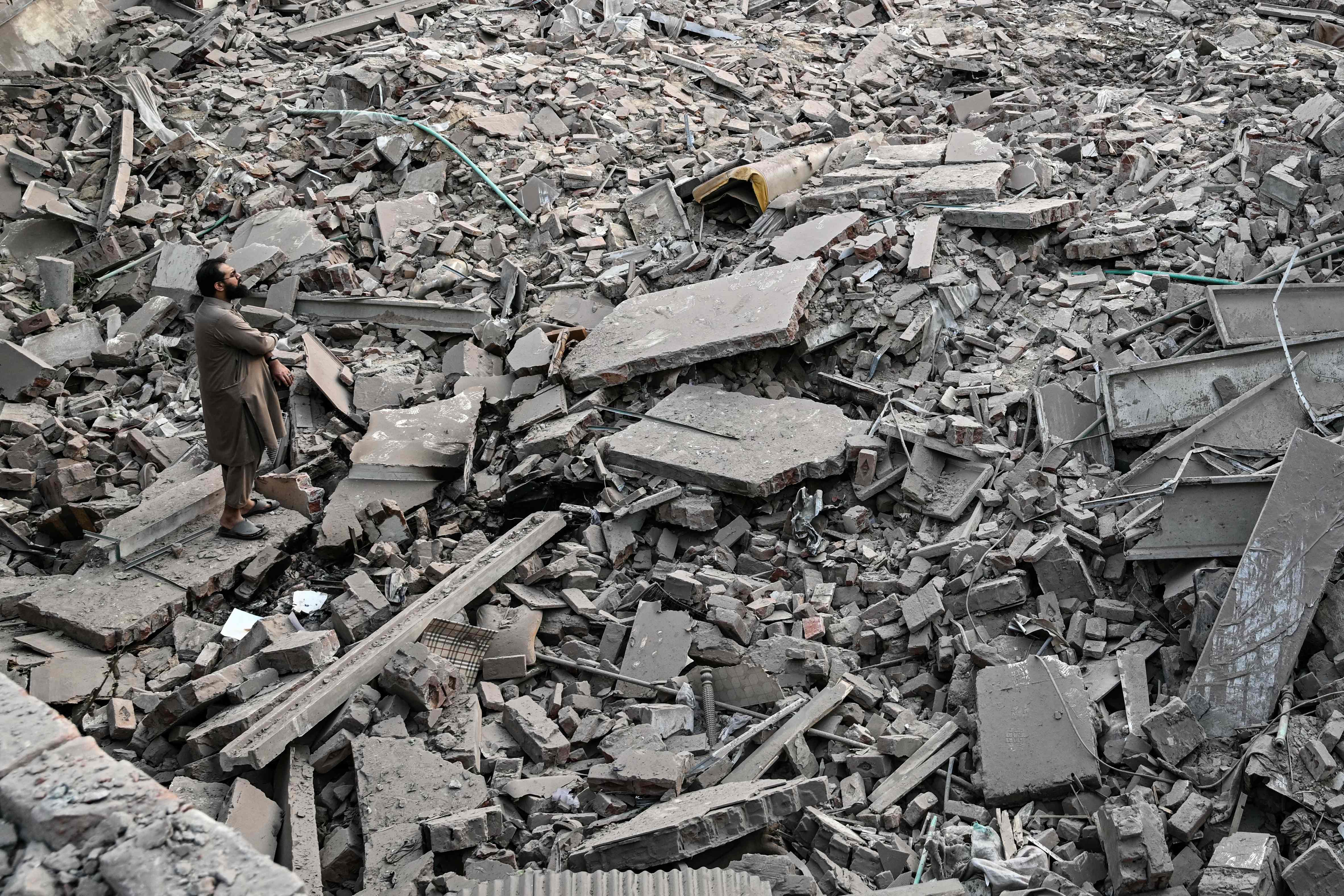

The Indian armed forces on May 7 launched Operation Sindoor, targeting nine terror bases in Pakistan and Pakistan-occupied Kashmir in retaliation for the April 22 Pahalgam terror attack in Kashmir that killed 26 tourists. This triggered four days of strikes and counter-strikes with drones, missiles and long-range weapons before the two sides reached an understanding on stopping firing and military actions on May 10.
Here’s a chronicle of the operation based on reports that appeared in the Hindustan Times over the course of the conflict.
MAY 7


At 1.04am, Indian armed forces launched precision strikes at nine locations conducted with a mix of missiles and smart munitions fired by aircraft and ground forces. The strikes were conducted in just 23 minutes.
The operation targeted five terror training camps across the Line of Control, between 9km and 30km inside PoK, and four targets across the international border 6km-100 km inside Pakistan. This was the first attack on the neighbouring country’s most populous province, Punjab, since the 1971 war.
The armed forces jammed Pakistan’s Chinese air defence systems before carrying out attacks using Scalp deep-strike cruise missiles that allowed Rafale fighter pilots to hit ground targets from standoff ranges. The forces also used the Hammer smart weapon system, BrahMos missiles launched by Sukhoi-30 and guided bomb kits.

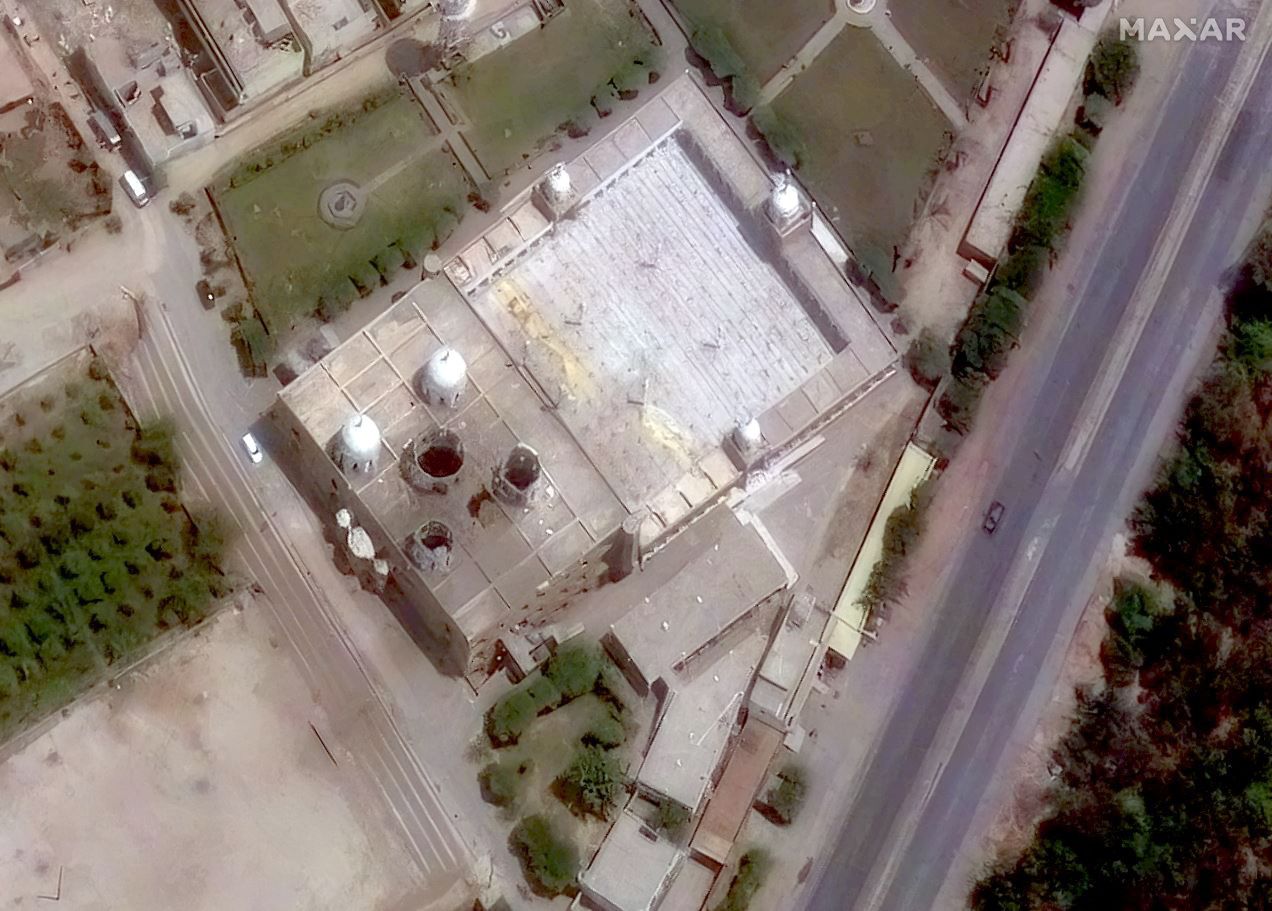
The nine terror camps targeted included Markaz Subhanallah in Bahawalpur, Markaz Taiba near Muridke, Mehmoona Joya in Sialkot, Sawai Nala and Syedna Bilal in Muzaffarabad, Markaz Gulpur and Markaz Abbas in Kotli, Markaz Ahle Hadith in Barnala in Bhimber, and Sarjal in Tehra Kalan, all of which were located near the international border.
IAF took down the terror infrastructure in Markaz Subhanallah and Markaz Taiba; the army targeted the remaining camps using kamikaze drones.

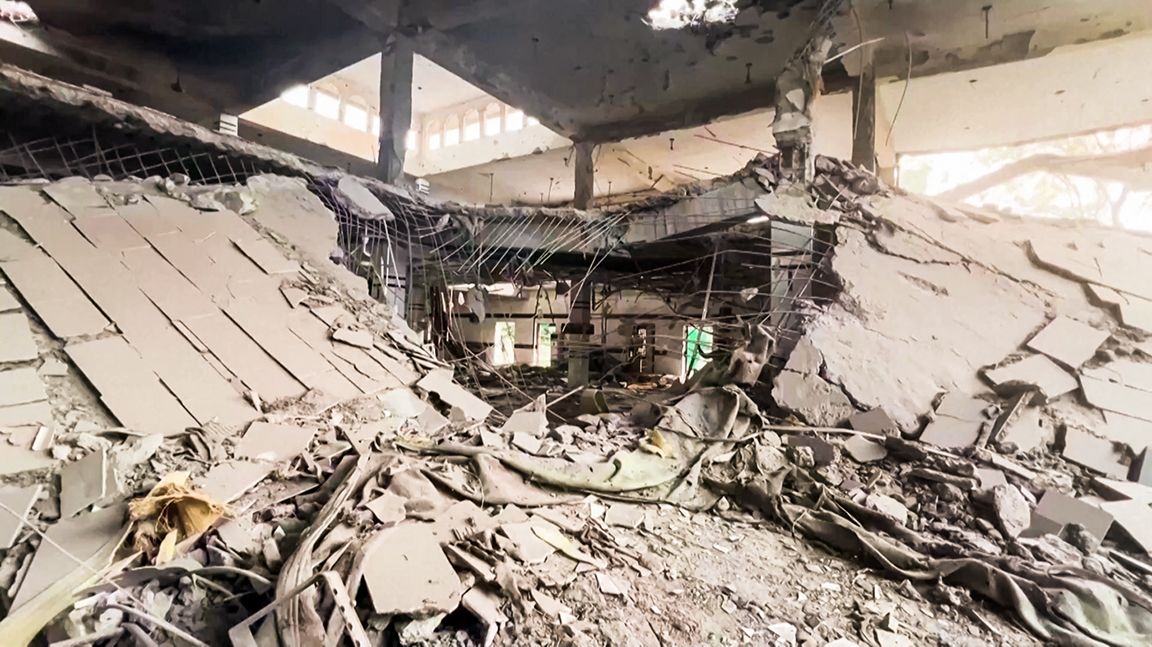
The Markaz Subhanallah camp was the farthest target for the Indian forces and was targeted using the BrahMos missile. Located around 100km from the border, it was the Jaish-e-Mohammed’s (JeM) operational headquarters. It was used for recruitment, training and indoctrinating terrorists. Markaz Taiba was the headquarters of the Lashkar-e-Taiba (LeT), led by Hafiz Saeed. Terrorists trained at this camp were associated with several strikes in India, including the 2008 Mumbai terror attacks.
Operation Sindoor sparked a series of counterattacks from Pakistan along the western border. The Pakistani military initially resorted to artillery shelling along LoC. By 8.30pm on May 7, Islamabad launched aerial attacks using drones and missiles at multiple towns and cities — Awantipora, Srinagar and Jammu in J&K; Amritsar, Kapurthala, Jalandhar, Ludhiana, Adampur, Bathinda, and Pathankot of Punjab; Chandigarh; Phalodi,Uttarlai and Nal of Rajasthan, and Bhuj in Gujarat. India’s air defence systems fended off all of the attacks.
May 8-9


Air raid sirens wailed and blackouts were imposed across a long arc of cities and villages from Jammu to Jaisalmer as Pakistan attempted large-scale aerial intrusions starting 8.30pm on May 8, targeting 36 military and civilian locations. Indian air defence systems repelled the attacks yet again.
Pakistan used at least 400 Turkish-made Asisguard Songar armed drones to swarm India’s western borders.
Eight Pakistani missiles were intercepted in Jammu’s Satwari, Samba, RS Pura, Arnia regions. Drone and missile attacks were also confirmed on military stations in Jammu, Pathankot, Udhampur, Jalandhar. However, these were all thwarted.

India used the Russian-origin S-400 Triumf air defence system, Akash surface-to-air missiles, anti-drone systems and other countermeasures to defeat the incoming threats. India also deployed Kamikaze drones, including the Harops bought from Israel, to target air defence networks in Pakistan. An air defence system at Lahore was neutralised.
Indian forces also resorted to a mix of precision strikes with drones targeting key Pakistani security and intelligence facilities and attacks with heavier long-range weapons such as the BrahMos cruise missile.

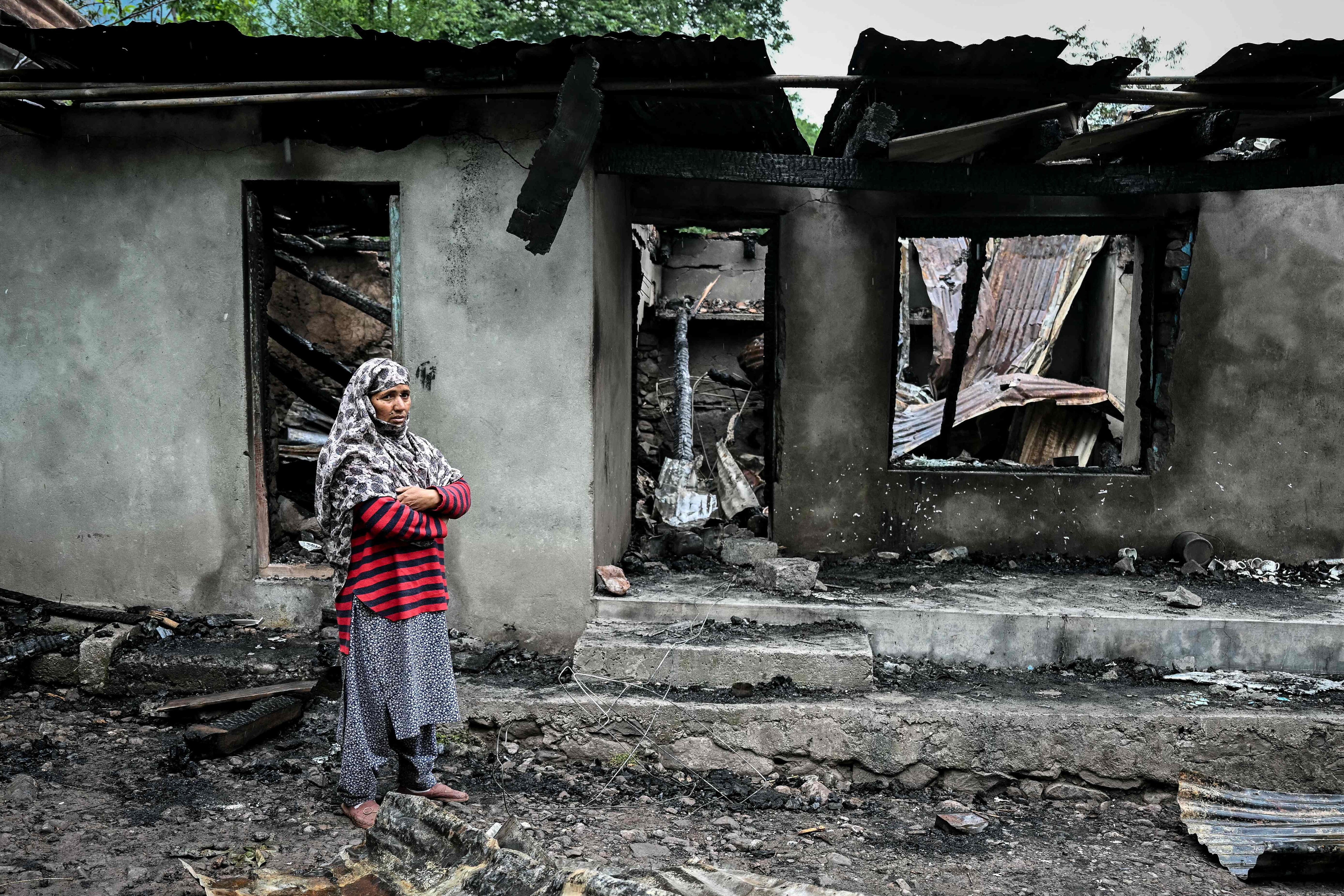
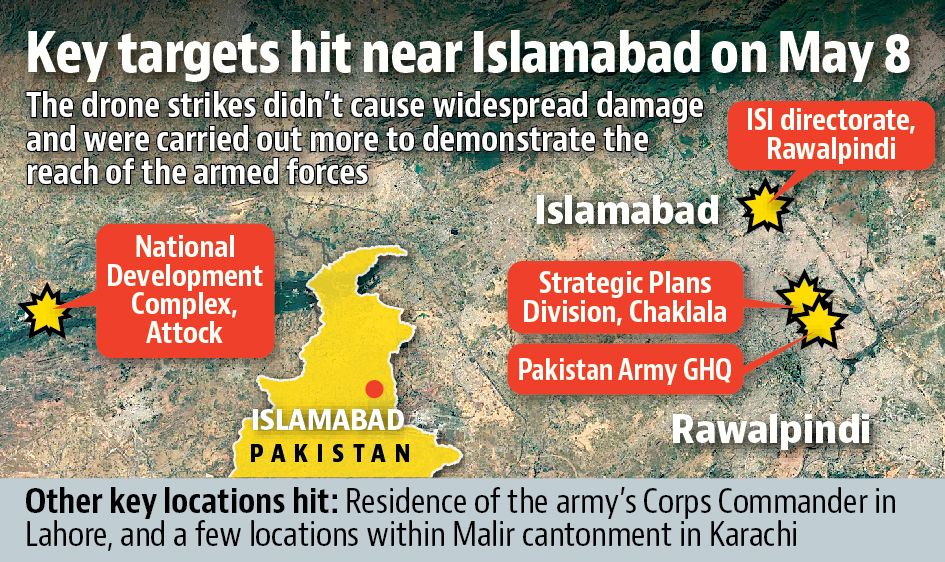
The drone strikes, particularly on May 8, were meant to signal the reach of the weaponry of the armed forces. The use of heavier weaponry, especially the BrahMos, which has a range of about 450km for the air-launched version and about 800km for the land version, was meant to inflict greater damage on terrorist infrastructure and military facilities.
Among the locations that were targeted with drones in the May 8 strikes were the Pakistan Army’s General Headquarters, the Strategic Plans Division (SPD) and a wing of the Inter-Services Intelligence (ISI) dealing with Kashmir in Rawalpindi, the residence of the army’s corps commander in Lahore in Punjab province, and a few locations within Malir cantonment in Karachi in Sindh province.
Several of these strikes – such as the ones in Rawalpindi on the army’s General Headquarters, the Strategic Plans Division, and the Joint Intelligence-North wing of the ISI, which deals with Kashmir, and on the National Defence Complex (NDC) in Attock district.
MAY 9


Around 8.30pm, Pakistan again launched drone attacks at 26 locations along the border. Indian forces shot down the drones, which targeted military and civilian sites, and retaliated proportionately. One of these drones injured three civilians in Punjab's Ferozpur, one of whom later died.
Pakistan escalated the hostilities along the Line of Control as well, and opened heavy artillery fire on multiple forward Indian posts.
In Poonch, which bore the brunt, the heavy cross-border shelling damaged homes and religious sites in Poonch district, with Kupwara and Uri also coming in the line of fire.
MAY 10


Pakistan stepped up attacks around 1.40am, targeting air bases in Punjab, medicare centres and schools in air force bases in Jammu and Kashmir, with Srinagar, Awantipora, Udhampur bearing the brunt.
In retaliation, IAF struck 13 airbases and military installations in Rafiqui, Murid, Chaklala, Rahim Yar Khan, Sukkur, Chunian, Pasrur, Sialkot, Skardu, Sargodha, Jacobabad, Bholari and Malir Cantt in Karachi, marking the worst hit that Pakistan has taken since 1971.


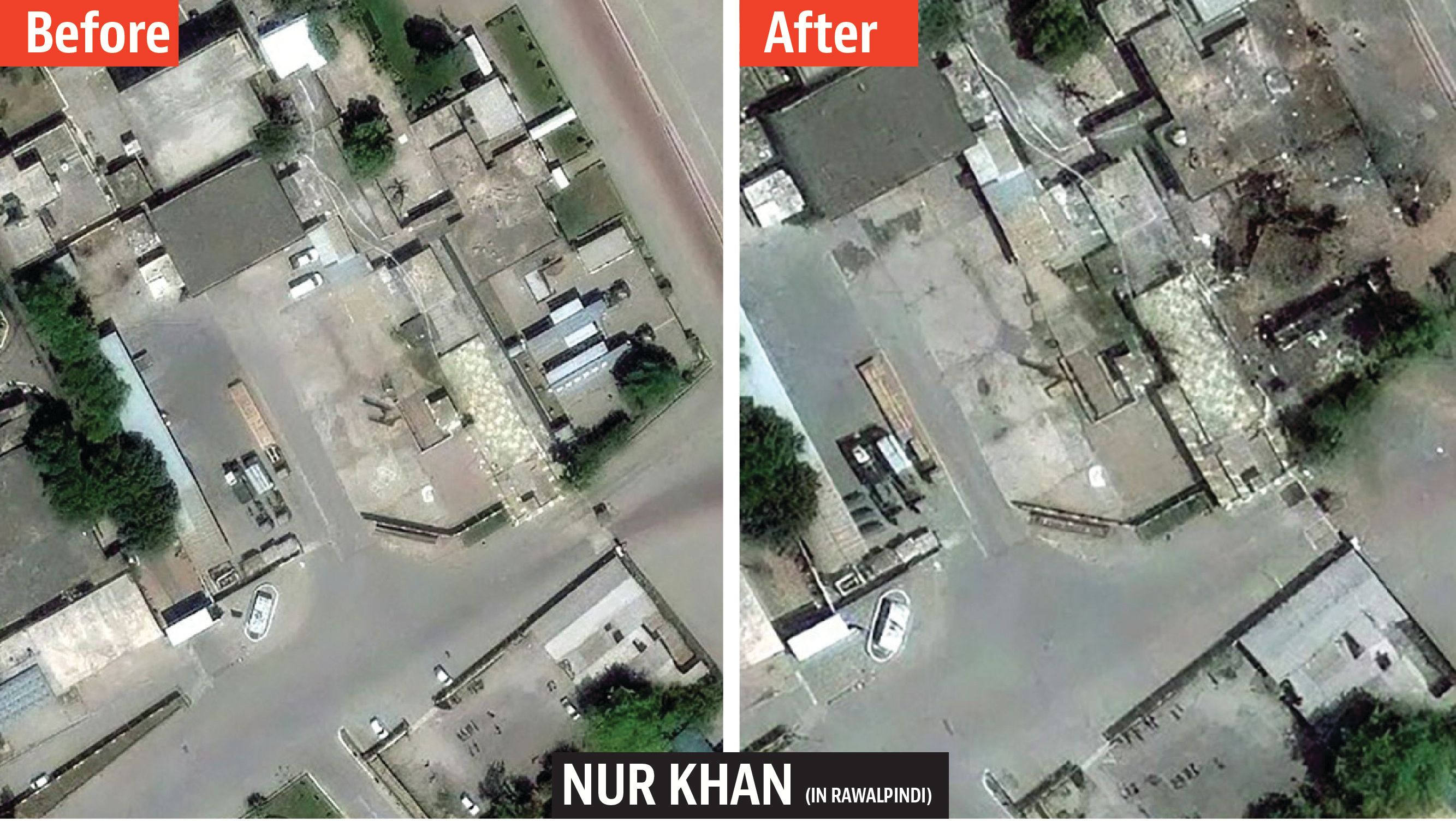
This combination of satellite images shows the Nur Khan Air Base in Rawalpindi, Pakistan on April 25 and damaged buildings at Nur Khan Air Base after Indian strikes on May 10. (Maxar Technologies/AFP)
This combination of satellite images shows the Nur Khan Air Base in Rawalpindi, Pakistan on April 25 and damaged buildings at Nur Khan Air Base after Indian strikes on May 10. (Maxar Technologies/AFP)
The BrahMos missiles were also used to target eight Pakistani bases, including the Nur Khan airbase in Rawalpindi and the Bholari airbase as part of the offensive. The targets IAF hit included runways, hangars, command and control centres, radar bases, missile sites and weapon storage areas.
Pakistan sought to retaliate to the devastating attacks with multiple Bayker YIHA III Kamikaze drones targeted at residential areas in Amritsar at 5am. But the Indian Army’s air defence network detected, tracked and engaged these drones within seconds.


This combination of satellite images shows a structure at Bholari Air Base in Northern Thatta District, Sindh, Pakistan on April 27 and the same structure damaged by Indian air strikes.
This combination of satellite images shows a structure at Bholari Air Base in Northern Thatta District, Sindh, Pakistan on April 27 and the same structure damaged by Indian air strikes.
Within hours of this offensive, the Pakistan high commission reached out to the Indian external affairs ministry at 12.37pm on Saturday, requesting a phone call between the directors general of military operations (DGMOs) of the two nations.
At 3.35pm, the DGMOs spoke on the phone and agreed to stop all firing and military action on land, air and sea from 5pm. Indian foreign secretary Vikram Misri confirmed the understanding at a brief press conference around 6pm.


This combination of satellite images shows a runway at Rahim Yar Khan air base in Southern Punjab, on April 27 and after the air strikes on May 10. (Maxar Technologies/AFP)
This combination of satellite images shows a runway at Rahim Yar Khan air base in Southern Punjab, on April 27 and after the air strikes on May 10. (Maxar Technologies/AFP)
Barely three hours after the ceasefire announcement, shelling from Pakistan resumed near LoC and IB, while reports of drone sightings emerged from several cities, Precautionary blackouts were ordered. The government, at a late-night briefing, said Indian forces were responding and were given instructions to deal strongly with a repetition of such actions. The army said shelling has stopped on the LoC.
(Reporting: Rahul Singh, Rezaul H Laskar, Ravi Krishnan Khajuria, Mir Ehsan, Gaurav Sagar Bhaskar, Maulik Pathak, Mukesh Mathrani; Graphics: Saurya Sengupta, Vaibhav Sharma, Jamie Mullick, Tannu Jain; Graphic design: Mukesh Sharma, Vikas Agarwal; Production: Aloke Tikku)
 Built with Shorthand