There are 150 million Indians on Facebook, over 30,000 of whom have been censored. Should we remain mute spectators?
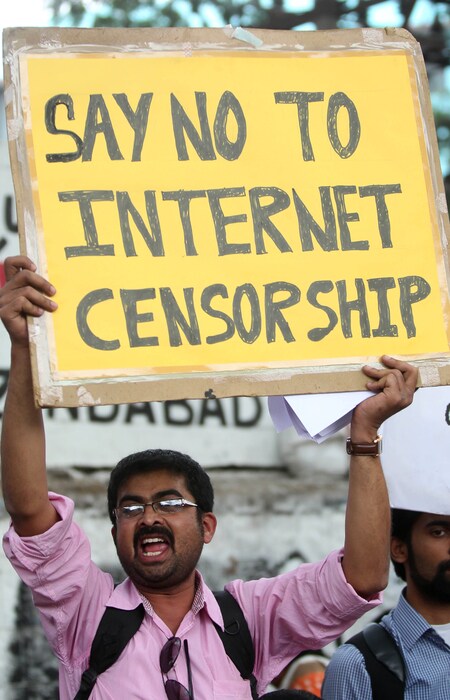
People have had enough; they are protesting online censorship. (Photo by AFP)
New Delhi - Indians love Facebook but the social networking giant is increasingly playing nanny, taking down posts that don’t meet its community standards, a move that has users and activists worried.
India, which has 150 million Facebook users, the second highest in the world after the US, had 30,126 posts taken down in 2015, the company’s transparency report shows. The US reported the most takedowns, followed by France, with India coming in third.
The censorship continues.
Zargar Yasir, a 23-year-old Srinagar-based security analyst, last week found his Facebook account blocked. He had reposted a 2015 blog he wrote about Burhan Wani, a Hizbul Mujahideen commander who was killed in a gunfight on July 8.
Yasir wrote the blog for The Nation, a popular Pakistani paper. It can still be found on The Nation Facebook page and is accessible in India as well.
“Even people within Kashmir have differing views on Wani. Facebook has made me a mute spectator in my own country,” he complained. Wani’s death has triggered a wave of unrest in the Valley that has left 44 people dead.
After HT raised Yasir’s concerns with Facebook, a representative said, “From time to time we make a mistake which is what happened here.” At the time of the publication of this story, Yasir’s account was still blocked. The representative spoke didn’t wish to be identified.
“The right to express oneself is guaranteed to a citizen not by Facebook but by the Indian constitution,” cyber law expert Pavan Duggal said.

The virtual giant
If Facebook were a country, it would be the largest in the world in terms of population. It has more than two billion users against China’s population of 1.36 billion and India’s 1.25 billion.
Mark Zuckerberg’s company says it wants to “make the world more open”. The firm’s user base has been growing steadily in India and so has the number of posts removed for not meeting its self-styled community standards.
Facebook says these guidelines on “what is and is not allowed on the service” helps keep the platform “safe”.
In 2013, Facebook censored 4,765 posts, the company’s transparency report shows. The number grew to 10,792 the next year and almost trebled to 30,126 in 2015.
The spike in French takedowns, to 37,990, in 2015 is an aberration that followed a string of terror attacks. As many as 32,000 takedowns were for a single picture alone. Eighty posts were deleted in 2014 and 35 a year before.
Governments can request posts to be deleted but the company, like most other internet giants, also relies on users to report objectionable content. Facebook acts on users’ complaints when it feels its community standards have been violated.
But, the standards are vague, the process isn’t transparent and goes against principles of natural justice, experts say.
“The FB community guidelines give a feel-good factor. However, they lack the intrinsic parameters of how they are going to be enforced. They lack one fundamental salient feature… a stakeholder’s right to be heard,” Duggal said.
Users like Prateek Sinha, who runs a popular Truth Of Gujarat page, agree. He runs the page to “put some details (about the 2002 riots) in terms of facts and figures in the public domain”.
The page was always controversial. But, Facebook censorship was growing, he said.
“FB started censoring me about three-four months back. The first ban came when a friend created an infographic of RSS leaders -- it was called the Great Nationalists of RSS -- it was very factual.”
The post had pictures and well-known quotes of RSS leaders. “FB took it down and that’s when I was handed my first 24-hour ban,” Sinha said.
He waited out the ban as he struggled to understand the appeal process. “I don’t know what is their (FB) internal process, it’s a complete black hole,” Sinha said.
Red flags
Facebook says it has trained a team of experts to weed out content violating community standards. While the transparency report put a number to governments-directed takedowns, no stats were available for the posts deleted after being flagged by users.
Google and Twitter are more open about such posts. Google reported receiving 3,087 user complaints from India in 2105 and took down 44% of the content reported. The Facebook representative said giving out information on user-driven takedowns was not the company policy.
Facebook resolved user-reported content complaints within 24 hours. Their teams “work around the clock, cover all time zones, and speak dozens of languages,” he said. Facebook turned down HT’s requests to meet these “specialists”.
“Anyone can determine these (guidelines) in their own subjective manner without any accountability,” Duggal said. “The right to interpret the community standards in one instance or the other is the subjective whims of FB.”
But, there is a larger issue here, experts say.
Facebook started as a platform to “connect” friends but has since grown into a unique media distributor, wielding considerable influence not just in social sphere but political and economic as well.
The 2012 election that returned Barack Obama to the White House was branded the Facebook election. Closer home, the social networking site has been successfully mined by politicians to reach out to voters.
The most recent example of Facebook censorship has come from Kashmir.
Apart from Yasir, many Kashmiri activists, too, have complained of censorship. Huma Dar, a teacher at University of California, Berkley, said Facebook banned her after she wrote about Wani.
Legal experts don’t find it unusual. “E-commerce companies tend to normally bend backwards to please the government of the day,” Duggal said.
What is surprising is that countries like Pakistan and Egypt that have seen a lot more turbulence had negligible takedowns. Only six posts were deleted in Pakistan in 2015 against a request for 471 removals. Egypt reported only two such requests.
“No longer can FB say that I’m just any corporate who is providing a social network. One third of the world’s population is on your network. Your community standard should have objective parameters,” Duggal said.
Facebook also owns both WhatsApp and Instagram. It has also made a bid for Snapchat — its domination of the virtual world continues.
But, so is the demand for transparency. Last year, the Supreme Court ruled that BCCI — a private body — had to be transparent because of its monopolistic influence over cricket.
“Facebook is in incomparable position in the online public opinion space,” said lawyer Ninad Laud. He successfully represented Shreya Singhal whose petition saw the Supreme Court strike down the draconian section 66A that policed views on the internet.
Many see internet governance forums as the solution to greater accountability and transparency. However, Electronic Frontier Foundation head Jillian York says, “Internet governance forums… are places where the companies already control a lot of the internet spaces with money.” The foundation tracks online censorship.


