Over 5 lakh engineering graduates unemployable as they lack key skills: Expert
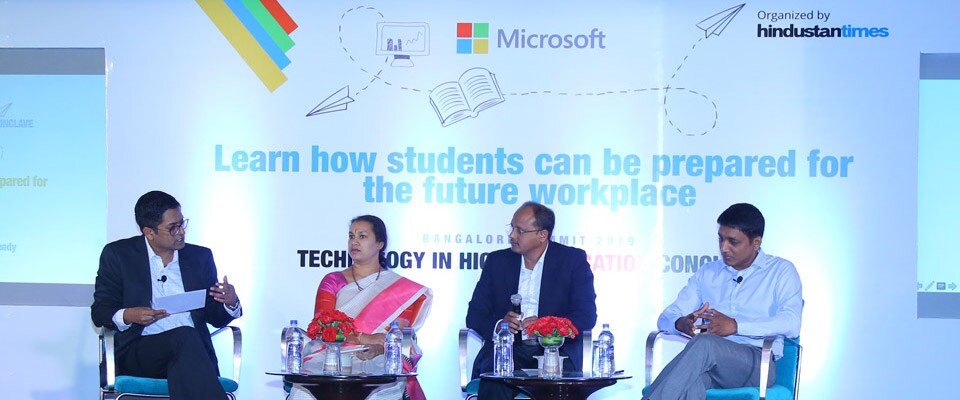
At the Technology in Higher Education Conclave in Bangalore, educationists highlighted why upskilling students in technology is the need of the hour.
By HT Brand Studio | Published: Mar 27, 2018
Sample this: nearly 65% of children now entering primary school will hold jobs that don't even exist today, a World Economic Forum report reveals.
Furthermore, NASSCOM says that of the 4 million jobs in the industry today, the nature of over 60-65% will change in the next 5 years!
What do all these studies signal?
As you must have already guessed, our current workplaces are becoming redundant, and all because of technology. Technological leaps-which would earlier have a decade-long lifecycle-now last for only a few years or months. The only way to keep up with this curve, therefore, is to change the way education is imparted to students, so that they are equipped with the technological skills required to survive in the future workplace.
The same was taken up for discussion at the Technology in Higher Education Conclave-an event co-organized by Hindustan Times and Microsoft in Bangalore on March 27.
Speaking on the occasion, Sami Ulla, CEO, Manipal Academy of Health and Education, Bangalore, highlighted: "About 5,00,000 engineering graduates are out of jobs because they don't have the skills to make them employable. As many as 90 percent of them have come out of curriculums which are not up to the requirements of the industry."
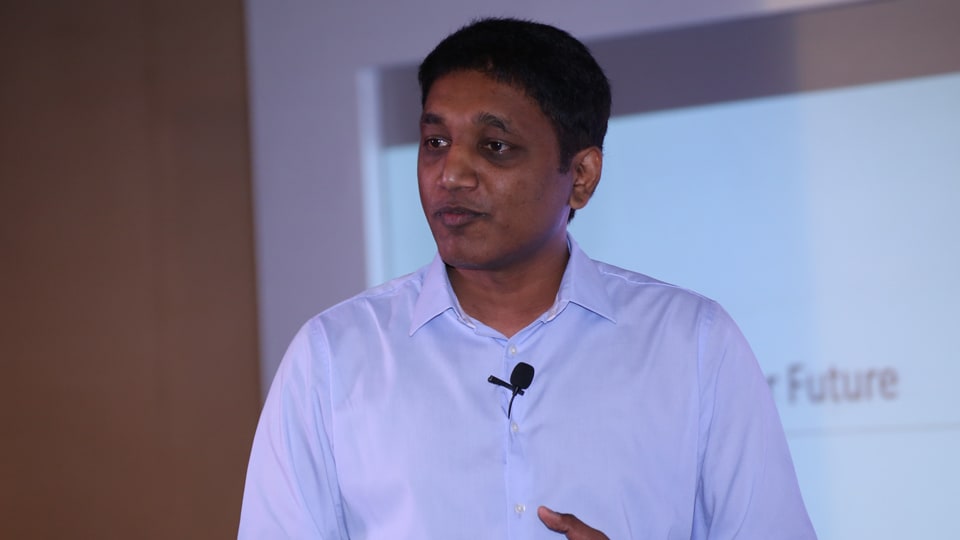
Sandeep Alur, Director-Partner Technology Engagements, Microsoft India, speaks at the summit.
'Technology is no longer boardroom jargon'
The experts also emphasized that although the youth passing out of prestigious institutes are aware of the new technologies, their knowledge is often not what the industry demands.
"Technologies such as AI, blockchain and cloud are no longer boardroom jargon. They are being embraced by the industry. When I speak to students, there is awareness about these terms. They know the what of it, but not the how. These need to be brought to the classrooms now," said Sandeep Alur, Director - Partner, Technology Engagements, Microsoft India.
Today, there is a lot of information available to students on the internet about technology, some even in the form of short-term courses. But these often don't do justice to the learning process. Pointing out this fact, Alur said: "There is no hierarchy in organisations anymore. Everyone needs to be hands-on with technology and even new hires need to be productive from Day 1. Information is everywhere, but there has to be a method to the madness," Alur added.
Another challenge faced by educational institutes is the huge time lag between planning and implementation, the experts emphasized.
"The time taken by the industry for innovation is so rapid. But academicia has bureaucratic processes to change curriculum. By the time we get the change done, it already becomes outdated," said Nisha Joseph Cyriac, Principal, St. Anne's Degree College for Women, Bangalore.
Another critical problem-as stated by the panelists-is that even teachers are not up to date with the latest industry trends. "All faculty needs to work with corporates and learn how the industry works," stressed Ramani Doral, Adjunct Professor (IT), NMIMS, Bangalore.
Race against time
The clock is ticking. The change has to happen fast, or India will be left far behind in the race. "If we don't initiate the change now or by the next year, we will set ourselves up for failure as a country. India is a key supplier of low-cost manpower, and this should serve as a wake-up call for us," said Ashwini Kumar, Solution Specialist Education at Microsoft Kumar.
Dr. A. Vinay Kumar, Director, NMIMS, Bangalore, highlighted that universities are indeed increasingly feeling the need to partner with the industry to keep up with the change.
"University programs were traditionally designed for long-term skilling. Degrees are fast becoming irrelevant and professionals need reskilling. The horizon for this is shrinking and universities are trying to grapple with this. The need of the hour is to offer core skills which allow students to upgrade. No university can provide up-to-date partnerships unless it partners with the industry, he said.
What is, however, more important is giving students the ability to reinvent, the educationists pointed out.
"Curriculums are supposed to be rigid. How we make them more fluid is a challenge that all academicians are facing today," Kumar said.
Taking technology to the classroom
The good news is that the industry is lending a helping hand. Companies such as Microsoft are training teachers in the latest technologies.
"We have noticed that one- or two-day workshops for teachers don't serve the purpose. We are now looking at a blended model where 20 days of training spread over months is imparted on campus by experts from Microsoft who handhold the teachers. This is supplemented with webinars throughout the year," said Nirav Rawell, Opportunity Manager, Microsoft.
Industry trends for hiring are also changing. Companies are already moving away from resumes and looking at LinkedIn profiles which reflect the entire personality of the candidate, and not just her qualifications, the educationists further outlined.
"We are moving away from two things-resumes and end degree certificates. In another five years, these will no longer be used. The assumption is that the qualifications are already there," stressed Kumar.
In this view, imparting soft skills to students is also gaining a lot of importance, and is something that institutes are waking up to now, said Cyriac.
"We realized very late in the day the importance of imparting soft skills to our students and are now trying to include them into the curriculum as credit courses. The biggest challenge here is a shortage of qualified people to come and impart these courses," she added.
A welcome initiative
Showing the way, however, is Microsoft's 'Intelligent Cloud Hub' program.
Under this initiative-which aims to build an AI-ready workforce-the tech giant will set up AI infrastructure and IOT hubs on selected campuses across India. It will also offer AI development tools and Azure AI services such as Microsoft Cognitive Sciences and Bot Services.
Both faculty and students will attend workshops where they will be trained in cloud computing, data sciences, AI, and IoT. They will also have access to the latest content and curriculum in these fields.
Further, institutes will be offered AI-based recommendations for potential areas of research.
To know more about the program, please click here.