
CBSE Class 10 Maths Competency-based Questions for 2023-24 Board Exams
Class 10 2024 board exams will start on February 15th, 2024. CBSE has notified students of the increase of 50% of competency-based questions in the exam pattern. Competency-based typology includes both objective and subjective questions.
CBSE has released a Class 10 additional practice paper for Math to help students understand the pattern and practice the revised typology. To help students perform better in CBSE Class 10 Board exams, we have shortlisted the top most important competency-based questions for students to boost their exam preparations.
What are Competency-based Questions Class 10 Maths for 2023-24 Exams?
A student should be able to align their knowledge with real-life situations and that’s what competency-based questions intend to do. Competency-based questions are introduced to eradicate the cramming method and help students understand the concepts with their applications.
To attempt competency-based questions, a student would need to improve their concept comprehension skills along with learning to understand the topic, and process that information to connect it with real-life situations.
Competency-based questions can be case studies, assertion-reasoning, gap-filling, true-false, and long or short question answers. The section below will include questions as per the latest exam pattern.
Case-Based Questions
The question paper will include three case-based questions carrying 4-5 marks for every question.
Read the following passages and answer the questions that follow:
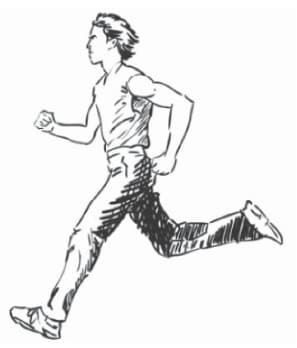
Ques 1. Your friend Veer wants to participate in a 200 m race. He can currently run that distance in 51 seconds and with each day of practice, it takes him 2 seconds less. He wants to do it in 31 seconds.
- Which of the following terms are in A.P. for the given situation?
(a) 251, 53, 55.....
(b) 51, 49, 47.....
(c) -51, -53, -55.....
(d) 51, 55, 59…..
- What is the minimum number of days?
(a) 10
(b) 12
(c) 11
(d) 9
- Which of the following terms is not in the A.P. of the above-given situation?
(a) 41
(b) 30
(c) 37
(d) 39
- If the nth term of an A.P. is given by an = 2n + 3, then the common difference of an A.P. is:
(a) 2
(b) 3
(c) 5
(d) 1
- The value of x, for which 2x, x + 10, 3x + 2 are three consecutive terms of an A.P. is:
(a) 6
(b) -6
(c) 18
(d) -18
[Chapter-5 Arithmetic Progressions]
Ans:
- (b) 51, 49, 47.....
- (c) 11
- (b) 30
- (a) 2
- (a) 6
Ques 2. In a two-dice game, a player throws two dice simultaneously. A player scores the sum of the two dice thrown and gradually reaches a higher score as they continue to roll

- Find the probability that the difference between the numbers on the two dice is 3.
- Find the probability that the product of the numbers on the two dice is more than 18.
[Chapter-14 Probability]
Ans:
- When two dice are thrown simultaneously, all possible outcomes are:
(1, 1), (1, 2), (1, 3), (1, 4), (1, 5), (1, 6),
(2, 1), (2, 2), (2, 3), (2, 4), (2, 5), (2, 6),
(3, 1), (3, 2), (3, 3), (3, 4), (3, 5), (3, 6),
(4, 1), (4, 2), (4, 3), (4, 4), (4, 5), (4, 6),
(5, 1), (5, 2), (5, 3), (5, 4), (5, 5), (5, 6),
(6, 1), (6, 2), (6, 3), (6, 4), (6, 5), (6, 6),
∴ Total number of possible outcomes = 36
If (a, b) are the outcomes of the two dice, then for the difference of numbers on the two dice to be 3, either a – b = 3 or b – a = 3.
Therefore, the favorable outcomes are: (1, 4), (2, 5), (3, 6), (4, 1), (5, 2), (6, 3)
∴ Number of favorable outcomes = 6
∴ The probability that the difference of the numbers on the two dice is 3= 6/36 = 1/6
- Total number of possible outcomes = 36.
Favorable outcomes are (5, 4), (6, 4), (4, 5), (5, 5), (6, 5), (4, 6), (5, 6), (6, 6).
∴ Number of favorable outcomes = 8
∴ The probability of the product of the numbers on the two dice is more than 18
= 8/36 = 2/9
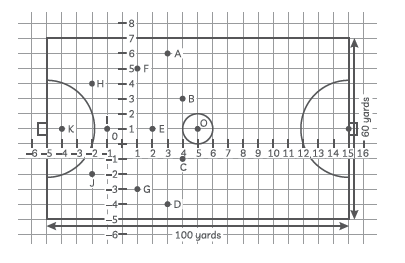
Ques 3. A hockey field is the playing surface for the game of hockey. Historically, the game was played on natural turf (grass) but nowadays it is predominantly played on artificial turf. It is rectangular - 100 yards by 60 yards. Goals consist of two upright posts placed equidistant from the center of the backline, joined at the top by a horizontal crossbar. The inner edges of the posts must be 3.66 meters (4 yards) apart, and the lower edge of the crossbar must be 2.14 meters (7 feet) above the ground. Each team plays with 11 players on the field during the game including the goalie.
Players positions that are included in the game are:
- Forward: As shown by players A, B, C, and D.
- Midfielders: As shown by players E, F, and G.
- Fullbacks: As shown by players H, I, and J.
- Goalie: As shown by player K
Using the picture of a hockey field below, answer the questions that follow:
- The point on the x-axis equidistant from I and E is:
(a) 1/2, 0
(b) 0, -1/2
(c) -1/2, 0
(d) 0, 1/2
- The point on y-axis equidistant from B and C is:
(a) (–1, 0)
(b) (0, –1)
(c) (1, 0)
(d) ( 0, 1)
[Chapter-7 Coordinate Geometry]
Ans:
- (a) 1/2, 0
- (d) (0, 1)
Ques 4. The speed of a motor boat is 20 km/hr. To cover the distance of 15 km, the boat took 1 hour more upstream than downstream.
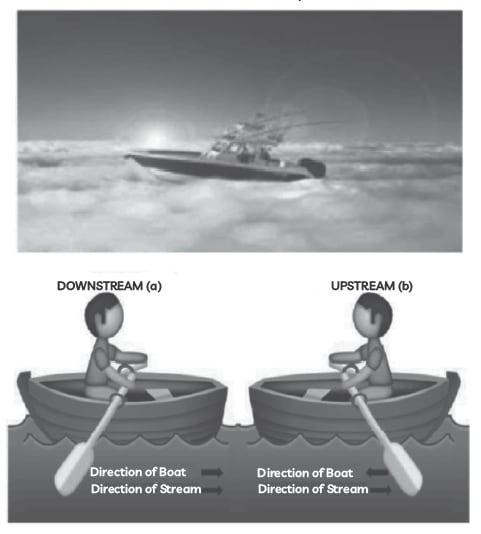
- (A) Let the speed of the stream be x km/hr. The speed of the motorboat upstream will be:
(a) 20 km/hr
(b) (20 + x) km/hr
(c) (20 – x) km/hr
(d) 2 km/hr
- (B) What is the relation between speed, distance, and time?
(a) speed = (distance)/time
(b) distance = (speed)/time
(c) time = speed × distance
(d) speed = distance × time
- (C) Which is the correct quadratic equation for the speed of the current?
(a) x2 + 30x – 200 = 0
(b) x2 + 20x – 400 = 0
(c) x2 + 30x – 400 = 0
(d) x2 – 20x – 400 = 0
- (D) What is the speed of current?
(a) 20 km/hour
(b) 10 km/hour
(c) 15 km/hour
(d) 25 km/hour
- (E) How much time does a boat take downstream?
(a) 90 minutes
(b) 15 minutes
(c) 30 minutes
(d) 45 minutes
[Chapter-4 Quadratic Equations]
Ans:
- (c) (20 – x) km/hr
- (a) Speed = Distance/Time
- (c) x2 + 30x – 400 = 0
- (b) 10 km/hr
- (d) 30 minutes
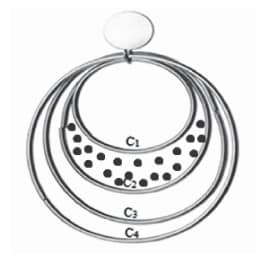
Ques 5. A girl purchased a pair of earrings as shown below. The ring consisted of four circles marked C1, C2, C3, and C4 from the innermost circle to the outermost circle. The diameter of the innermost circle C1 is 14 cm and the radius of each of the next circles is double the radius of the preceding inner circle.
- The area of circle C2 is:
(a) 154 cm2
(b) 308 cm2
(c) 616 cm2
(d) 1232 cm2
- The length of a colorful thread used to decorate the boundary of the outermost circle C4 is:
(a) 352 cm
(b) 704 cm
(c) 176 cm
(d) 88 cm
- Find the ratio of areas of innermost circle C1 and outermost circle C4.
(a) 1: 4
(b) 1: 8
(c) 1: 16
(d) 1: 64
[Chapter-11 Area Related to Circles]
Ans:
- (c) 616 cm2
- (a) 352 cm
- (d) 1: 64
Ques 6. SLV-3 was successfully launched on July 18, 1980, from Sriharikota Range (SHAR), when Rohini satellite, RS-1, was placed in orbit, thereby making India the sixth member of an exclusive club of space-faring nations. SLV-3 employed open loop guidance (with stored pitch program) to steer the vehicle in flight along a predetermined trajectory. The successful culmination of the SLV-3 project showed the way to advanced launch vehicle projects such as the Augmented Satellite Launch Vehicle (ASLV), Polar Satellite Launch Vehicle (PSLV) and the Geosynchronous Satellite Launch Vehicle (GSLV).
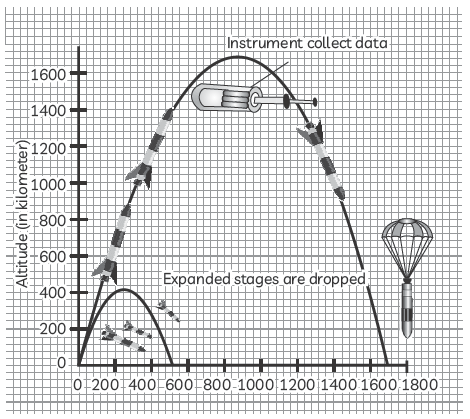
A toy rocket is fired into the air from the top of a tall building. Let its height above the ground after time t seconds be given by the
p(t) = 24t2 – 41t + 12.
- What will be the shape of the graph representing the height of the rocket above the ground?
- Find the number of zeroes in the graph given.
[Chapter-2 Polynomial]
Ans:
- As the height of the rocket above the ground is given by a quadratic polynomial, p(t) = 24t2 – 41t + 12, its graph will be a parabola.
- The graph intersects the x-axis at two points. So, the number of zeroes is 2.
Ques 7. ‘Swachh Bharat Abhiyan’ is a country-wide campaign initiated by our Honourable Prime Minister of India, Mr. Narendra Singh Modi in the year 2014 to eliminate open defecation, improve solid waste management, and accelerate the efforts to achieve universal sanitization.
As part of the ‘Swachh Bharat Abhiyan’, some houses of a locality in Agra decided to clean up and beautify a Primary School of their locality by planting several plants. They involved the school kids and the local community in doing so.
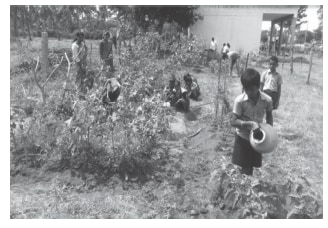
The data indicating the number of plants contributed by different houses is tabulated below:
Number of plants contributed | Number of houses |
1 – 3 | 10 |
4 – 6 | 8 |
7 – 9 | x |
10 – 12 | 7 |
13 – 15 | 12 |
16 – 18 | 4 |
- What is the median class?
- Find the median number of plants contributed.
[Chapter-13 Statistics]
Ans:
Class | Frequency | Cumulative Frequency |
0.5 – 3.5 | 10 | 10 |
3.5 – 6.5 | 8 | 18 |
6.5 – 9.5 | x = 9 | 27 |
9.5 – 12.5 | 7 | 34 |
12.5 – 15.5 | 12 | 46 |
15.5 – 18.5 | 4 | 50 |
N = 50 |
Here, N/2 = 25
Cumulative frequency just greater than 25 is 27 which belongs to class 6.5 – 9.5.
∴ Median class=6.5 – 9.5.
- We know,
Median = l + ((N/2 -cf)/f) x h
Here, l = 6.5, cf = 18, f = 9, h = 3
[from 1.]
∴ Median = 6.5 + ( (25-18)/9) x3
= 6.5 + 7/9 x3
= 6.5 + 2.33
= 8.83
Ques 8. While browsing through the catalogue of wooden shelves, Ravi came across this beautiful triangular-shaped shelf. In the shelf, DE is parallel to the base BC and could be used for displaying small plants and showpieces.
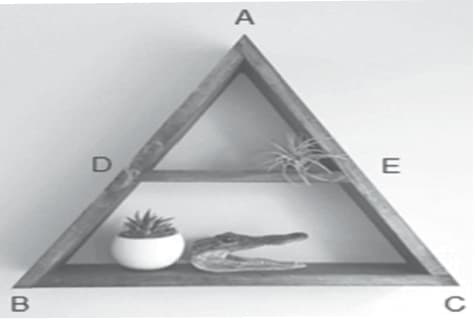
- Find the relation between the sides AD, DB, AE, and EC. Also, mention the theorem used.
- Find the value of x if AD = (x + 3) cm, BD = (3x + 19) cm, AE = x cm and EC = (3x + 4) cm.
- D and E are the points on the sides AB and AC respectively of an ∆ABC. If AB = 9 cm, AC = 18 cm, AD = 2 cm, and AE = 4 cm, then prove that DE||BC.
[Chapter-6 Triangles]
Ans:
- Since DE is parallel to BC, by the Basic Proportionality theorem
AD/BD = AE/CE - Using the basic proportionality theorem, we have
AD/DB = AE/EC
⇒ x+3/3x+19 = x/3x+4
⇒(x + 3)(3x + 4) = x(3x + 19)
⇒ 3x2 + 13x + 12 = 3x2 + 19x
⇒ 13x + 12 = 19x
⇒ –6x = –12
⇒ x = 2 - Given, AB = 9 cm, AC =18 cm, AD = 2 cm and AE = 4 cm
Now, DB = AB – AD = 9 – 2 = 7 cm
EC = AC – AE = 18 – 4 = 14 cm
Now, AD/DB = 2/7
And, AE/EC = 4/14 = 2/7
∴ AD/DB = AE/EC
Therefore, DE||BC
[by Converse of Basic Proportionality Theorem]
Ques 9. An observer on the top of a 30 m tall lighthouse (including the height of the observer) observes a ship at an angle of depression 30° coming towards the base of the lighthouse along a straight line joining the ship and the base of the lighthouse. The angle of depression of the ship changes to 45° after 10 seconds.

- The distance of the ship from the base of the lighthouse when the angle of depression is 30°, is:
(a) 30√3m
(b) 100√3m
(c) 30 m
(d) 10/3 √3m
- The distance between the two positions of the ship after 10 seconds is:
(a) 30 ms-1
(b) 30(√3 – 1)ms-1
(c) 10(√3 +1)ms-1
(d) 30(√3 +1)ms-1
- The speed of the ship is:
(a) 30 ms-1
(b) 30(√3 + 1)ms-1
(c) 3(√3 -1)ms-1
(d) 30(√3 -1)ms-1
[Chapter-9 Some Applications of Trigonometry]
Ans:
- (a) 30√3m
- (b) 30(√3 – 1)ms-1
- (c) 3(√3 -1)ms-1
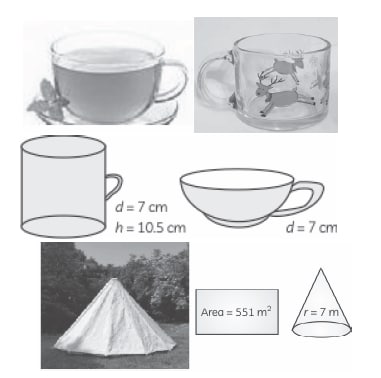
Ques 10. Adventure camps are the perfect place for children to practice decision-making for themselves without parents and teachers guiding their every move. Some students of a school reached for adventure at Sakleshpur. At the camp, the waiters served some students a welcome drink in a cylindrical glass and some students in a hemispherical cup whose dimensions are shown below. After that, they went for a jungle trek. The jungle trek was enjoyable but tiring.
As dusk fell, it was time to take shelter. Each group of four students was given a canvas of an area of 551 m2 Each group had to make a conical tent to accommodate all four students. Assuming that all the waste incurred while cutting and stitching would amount to 1 m2 the students put the tents. The radius of the tent is 7 m.
- The volume of cylindrical glass is:
(a) 295.75 cm3
(b)7415.5 cm3
(c) 384.88 cm3
(d)404.25 cm3
- The volume of the hemispherical cup is:
(a) 179.67 cm3
(b) 89.83 cm3
(c) 172.25 cm3
(d)210.60 cm3
- Which container had more juice and by how much?
(a) Hemispherical cup, 195 cm3
(b) Cylindrical glass, 207 cm3
(c) Hemispherical cup, 280.85 cm3
(d) Cylindrical glass, 314.42 cm3
[Chapter-12 Surface Area and Volume]
Ans:
- (d)404.25 cm3
- (b)89.83 cm3
- (d)Cylindrical glass, 314.42 cm3
Ques 11. Lakshman Jhula is located 5 kilometers north-east of the city of Rishikesh in the Indian state of Uttarakhand. The bridge connects the villages of Tapovan to Jonk. Tapovan is in Tehri Garhwal district, on the west bank of the river, while Jonk is in Pauri Garhwal district, on the east bank. Lakshman Jhula is a pedestrian bridge also used by motorbikes. It is a landmark of Rishikesh. A group of Class X students visited Rishikesh in Uttarakhand on a trip. They observed from a point (P) on a river bridge that the angles of depression of opposite banks of the river are 60° and 30° respectively. The height of the bridge is about 18 meters from the river.
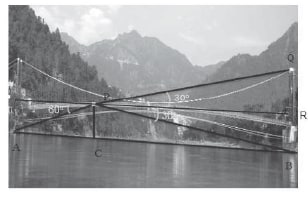
Based on the above information, answer the following questions.
- Find the distance PA.
- Find the distance PB.
OR
Find the height BQ if the angle of the elevation from P to Q is 30°.
[Chapter-8 Introduction to Trigonometry]
Ans:
- sin 60º = PC/PA
- sin 30º = PC/PB
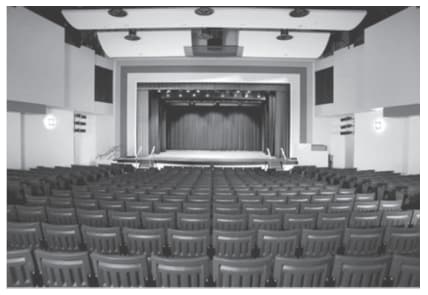
Ques 12. The school principal wants to address the students of classes eighth to tenth on the importance of personal hygiene. He asks the teacher in charge of the school to arrange all the students of eighth, ninth, and tenth classes in a single hall. There are 84 students from the eighth class, 63 students from the ninth, and 42 students from the tenth class.
- What is the minimum number of rows in which the students can be seated such that students belonging to the same class are seated in the same row?
(a) 7
(b) 9
(c) 21
(d) 42
- Realising that the hall can accommodate more students, the school Principal now wants to include 98 students in class seventh also. What will be the number of students and minimum number of rows such that students belonging to the same class are seated in the same row?
A number of students in the same class in one row | Minimum number of rows | |
A | 14 | 21 |
B | 21 | 14 |
C | 41 | 7 |
D | 7 | 41 |
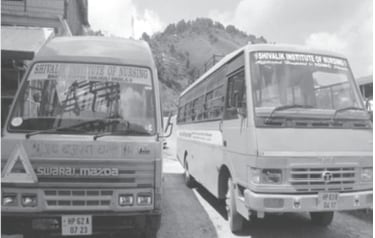
- Suppose the bus in charge of the school has to arrange buses in the morning for a picnic. There are two lines of buses, line A and line B. Buses on line A leave after every 15 minutes while buses on line B leave after every 20 minutes. In a day, how many times do buses on both lines A and B leave together between 8 am and 11 am if firstly, buses leave together at 8 a.m.?
(a) 3
(b) 4
(c) 5
(d) 6
- Three numbers are in the ratio of 3: 4: 5 and their LCM is 2400. The HCF of the numbers is
(a) 40
(b) 60
(c) 80
(d) 120
- The product of the two numbers is 2028 and their HCF is 13. The LCM of the numbers is
(a) 13
(b) 156
(c) 2028
(d) 26364
[Chapter-1 Real Numbers]
Ans:
- (b) 9
D | 7 | 41 |
- (a) 3
- (a) 40
- (b) 156
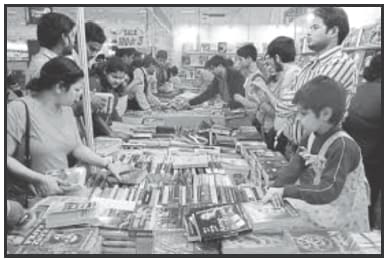
Ques 13. A bookstore shopkeeper gives books on rent for reading. He has a variety of books in his store related to fiction, stories, quizzes, etc. He takes a fixed charge for the first two days and an additional charge for subsequent days. Amruta paid ` 22 for a book and kept it for 6 days; while Radhika paid ` 16 for keeping the book for 4 days. Assume that the fixed charge is ` x and the additional charge (per day) is` y.
- The situation of the amount paid by Radhika, is algebraically represented by:
(a) x – 4y = 16
(b) x + 4y = 16
(c) x – 2y = 16
(d) x + 2y = 16
- The situation of the amount paid by Amruta, is algebraically represented by:
(a) x – 2y = 11
(b) x – 2y = 22
(c) x + 4y = 22
(d) x – 4y = 11
- What are the fixed charges for a book?
(a) ₹9
(b) ₹10
(c) ₹13
(d) ₹15
- What are the additional charges for each subsequent day for a book?
(a) ₹6
(b) ₹5
(c) ₹4
(d) ₹3
- What is the total amount paid by both, if both of them have kept the book for 2 more days?
(a) ₹35
(b) ₹52
(c) ₹50
(d) ₹58
[Chapter- 3 Pair of Equations in Two Variables]
Ans:
- (d) x + 2y = 16
- (c) x + 4y = 22
- (b) ₹10
- (d) ₹3
- (d) ₹50
Ques 14. A Ferris wheel (or a big wheel in the United Kingdom) is an amusement ride consisting of a rotating upright wheel with multiple passenger-carrying components or passenger cars attached to the rim in such a way that as the wheel turns, they are kept upright.
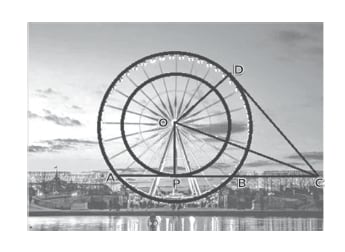
AB is a chord of the outer wheel that touches the inner wheel at P. AB is a chord of the outer wheel that touches the inner wheel at P. The radius of the inner wheel = 8 m and the radius of the outer wheel = 10 m.
- Which of the following is correct?
(a) AP > BP
(b) AP = BP
(c) AP < BP
(d) Insufficient information
- The length of the chord AB of the outer circle is:
(a) 6 m
(b) 8 m
(c) 10 m
(d) 12 m
- The chord AB of the inner wheel is extended to point C. If BC = 9m, the distance of the point C from the center of the wheel is:
(a) 17 m
(b) √181m
(c) 34 m
(d) 8.5 m
[Chapter- 10 Circles]
Ans:
- (b) AP = BP
- (d) 12 m
- (a) 17 m
How to Prepare with These Class 10 Maths Competency-based Questions?
Including competency-based questions is essential not only from the exam’s point-of-view but also for the improvement of analytical and problem-solving skills. Although the concept of competency-based isn’t completely new, students might have doubts about how they can prepare competency-based questions.
Below are a few preparation tips to understand how a student can prepare competency-based questions.
- To solve competency-based questions, students must have an in-depth understanding of the Class 10 Math concepts. Under the concepts thoroughly to develop a strong foundation.
- Cramming isn’t a solution to these types of questions. Try to include practicing competency-based questions in your study routine and practice a large set of problems. You can use books from reliable publishing houses like Educart that provide 100+ CBQs for ultimate practice.
- Subjects like Math, Science, and Social Science include CBQs (Case-Base Questions). The trick is to find the problem from the given case and then understand how the problem can be solved.
Brain quizzes and games can also significantly help in solving competency-based questions. Students can download the chapter-wise competency-based questions from the links below to boost their exam practice. Refer to the table below to download the extra questions.
| Class 10 Maths | Download Chapter-wise PDF |
| Chapter 1 | Real Numbers |
| Chapter 2 | Polynomials |
| Chapter 3 | Pair of Linear Equations in Two Variables |
| Chapter 4 | Quadratic Equations |
| Chapter 5 | Arithmetic Progressions |
| Chapter 6 | Triangles |
| Chapter 7 | Coordinate Geometry |
| Chapter 8 | Introduction to Trigonometry |
| Chapter 9 | Some Applications of Trigonometry |
| Chapter 10 | Circles |
| Chapter 11 | Areas Related to Circles |
| Chapter 12 | Surface Areas and Volumes |
| Chapter 13 | Statistics |
| Chapter 14 | Probability |
Frequently Asked Questions
Ques 1. How many questions in CBSE Class 10 Math will be competency-based?
Ans. CBSE Class 10 Board 2024 will include 50% i.e. almost 30-35 questions in the maths exam.
Ques 2. What are competency-based questions in Class 10 Maths?
Ans. The question paper can include objective and subjective types of competency-based questions like fill-in-the-blanks, case studies, assertion-reasoning, 1-mark answers, and short and long answers.
Ques 3. Is solving competency-based questions difficult for CBSE Class 10 Maths?
Ans. The difficulty level will increase but if practised effectively then students will be able to solve the competency-based questions easily.