
Improve your Board exam score with Top 30 Class 10 Science MCQs from all Chapters
CBSE has released additional practice papers notifying students regarding the increase of competency-based questions in the final examination. The Class 10 exam paper will comprise 50% of the competency-based questions in 5 sections of the Class 10 Science exam.

Class 10 Science paper comprises 20% i.e. 20 objective-based questions in the exam paper. Students can easily score full marks in the MCQ section if they have effectively prepared Class 10 science concepts and topics.
Answering MCQs requires speed and accuracy while solving the answers. The article enlists the top most important objective-based questions to help students prepare more effectively for the CBSE Class 10 board exams.
What are Objective-Based Questions?
Objective-based questions don’t only include MCQs or multiple-choice questions as assumed by many students. Since the notification of 50% competency-based questions, students can find varying objective-based questions. The questions can be both subjective as well objective thus opting for the right one amongst the given options.
Class 10 Science MCQs important questions include typology like assertion-reasoning, true/false, and gap-filling as per the revised CBSE patterns and can be practised from books like Educart.
Standalone MCQs for Class 10 Science
In the following questions, four options are given out of which only one option is correct. Read the question carefully, solve it if needed, and choose the right option.
Ques 1. According to the image showing a food web:

[Chapter-13 Our Environment]
(a) Fox feeds on the hawk to obtain energy.
(b) Hawk feeds on oak acorns to obtain energy.
(c) Squirrels feed on pine borers to obtain energy.
(d) Salamanders feed on pine borers to obtain energy.
Ans: (d) Salamanders feed on pine borers to obtain energy.
Ques 2. Study the following table and choose the correct option:
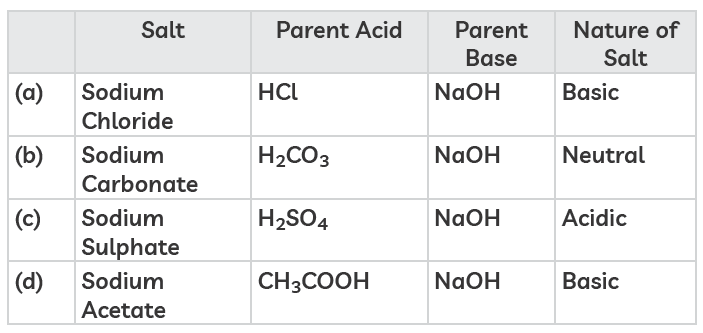
[Chapter-2 Acids, Bases & Salts]
Ans: (d) Salt: Sodium Acetate; Parent Acid: CH3COOH; Parent Base: NaOH; Nature of salt: Basic
Ques 3. The image shows the traits present across generations of a family.
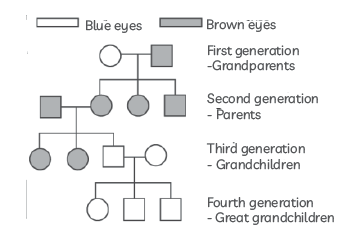
[Chapter-8 Heredity and Evolution]
Based on the image, what can be inferred about the eye colour trait?
(a) Acquired trait because both males and females have it.
(b) Acquired trait because it is expressed in all the generations.
(c) Inherited trait because it is expressed in two different colours.
(d) Inherited trait because it depends on the traits of the preceding generation.
Ans: (d) Inherited trait because it depends on the traits of the preceding generation.
Ques 4. A student carries out the experiment of tracing the path of a ray of light through a rectangular glass slab for two different values of angle of incidence ∠i = 30º and ∠i = 45°. In the two cases, the student is likely to observe the set of values of angle of refraction and angle of emergence as:
[Chapter-9 Light – Reflection and Refraction]
(a) ∠r =30º, ∠e = 20º and ∠r = 45º, ∠e = 28º
(b) ∠r =30º, ∠e = 30º and ∠r = 45º, ∠e = 45º
(c) ∠r =20º, ∠e = 30º and ∠r = 28º, ∠e = 45º
(d) ∠r =20º, ∠e = 20º and ∠r = 28º, ∠e = 28º
Ans: (c) ∠r = 20º, ∠e = 30º and ∠r = 28º, ∠e = 45º
Ques 5. Which of the following is the correct observation of the reaction shown in the following setup?
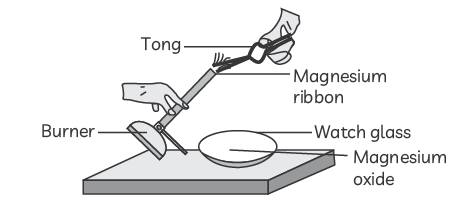
[Chapter-1 Chemical Reaction and Equation]
(a) Brown powder of Magnesium oxide is formed.
(b) Colourless gas which turns lime water milky is evolved.
(c) Magnesium ribbon burns with brilliant white light.
(d) Reddish brown gas with a smell of burning Sulphur has evolved.
Ans: (c) Magnesium ribbon burns with brilliant white light
Ques 6. The image shows the process of vegetative propagation in a plant
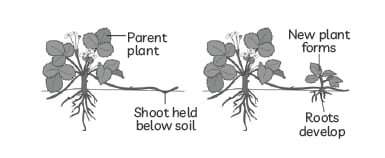
[Chapter-7 How do Organisms Reproduce?]
The shoot of the parent plant is pushed below the soil resulting in the growth of a new plant.
(a) This results in plants of different flowers.
(b) This helps grow plants without adding extra manure.
(c) This eliminates the need to produce plants using seeds.
(d) This allows the growth of plants with new genetic composition.
Ans: (c) This eliminates the need to produce plants using seeds
Ques 7. Identify gas A in the following experiment.
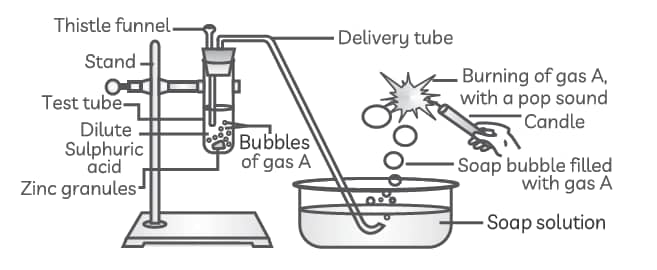
[Chapter-2 Acids, Bases & Salts]
(a) Nitrogen
(b) Hydrogen
(c) Oxygen
(d) Carbon dioxide
Ans: (b) Hydrogen
Ques 8. In one of Mendel’s experiments, tall pea plants with purple flowers were crossed with dwarf plants with white flowers. The flowers of all the plants of his praise were purple. But about half of them were dwarfs. From this, it can be said that the genetic composition of tall parent plants was :
[Chapter-8 Heredity and Evolution]
(a) TTWW
(b) TTww
(c) Tt WW
(d) Tt Ww
Ans: (c) TtWW
Ques 9. Carbon exists in the atmosphere in the form of:
[Chapter-4 Carbon and its Compounds]
(a) only carbon monoxide
(b) carbon monoxide in traces and carbon dioxide
(c) only carbon dioxide
(d) coal
Ans: (b) carbon monoxide in traces and carbon dioxide
Ques 10. The table shows four different materials and their electronic configuration:
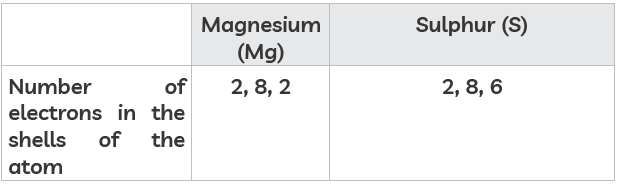
How many atoms of sulphur will react with one atom of magnesium to form a compound?
[Chapter-3 Metals and Non-metals]
(a) One
(b) Two
(c) Three
(d) Four
Ans: (a) One
Ques 11. A constant current flows in a horizontal wire in the plane of the paper from east to west as shown in the figure. The direction of a magnetic field at a point will be north to south:
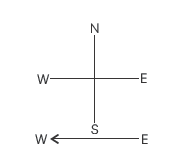
[Chapter- 12 Magnetic Effect of Electric Current]
(a) Directly above the wire
(b) Directly below the wire
(c) At a point located in the plane of the paper on the north side of the wire
(d) At a point located in the plane of the paper on the south side of the wire
Ans: (b) directly below the wire
Ques 12. Plastic insulation surrounds a wire having diameter d and length l as shown above. A decrease in the resistance of the wire would be produced by an increase in the:
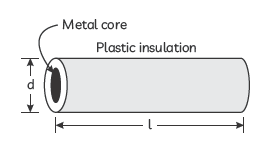
[Chapter-11 Electricity]
(a) length l of the wire
(b) diameter d of the wire
(c) the temperature of the wire
(d) thickness of the plastic insulation
Ans: (b) diameter d of the wire
Ques 13. Identify the correct statements:
(I) The Taste of sugar is sweet.
(II) Gustatory receptors in our tongue are responsible for taste.
(III) Olfactory receptors in our tongue are responsible for smell.
(IV) Receptors communicate information to the mouth so that we can taste things.
[Chapter-6 Control and Coordination]
(a) Only (I)
(b) Both (I) and (II)
(c) (I), (II), and (III)
(d) (I), (III), and (IV)
Ans: (b) Both (I) and (II)
Ques 14. Fe2O3 + 2Al → Al2O3 + 2Fe
What type of reaction is given above?
[Chapter-1 Chemical Reaction and Equation]
(a) Combination reaction
(b) Double displacement reaction
(c) Decomposition reaction
(d) Displacement reaction
Ans: (d) Displacement reaction
Ques 15. If salivary amylase is lacking in the saliva, which of the following events in the mouth cavity will be affected?
[Chapter-7 How Do Organisms Reproduce?]
(a) Proteins breaking down into amino acids
(b) Starch breaking down into sugars
(c) Fats breaking down into fatty acids and glycerol
(d) Absorption of vitamins
Ans: (b) Starch breaking down into sugars
Ques 16. A uniform magnetic field exists in the plane of paper pointing from left to right as shown in the figure.
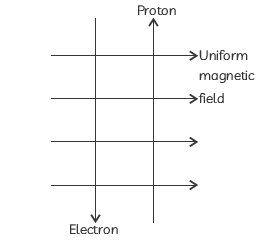
In the field, an electron and a proton move as shown. The electron and the proton experience:
(a) Forces both pointing into the plane of the paper
(b) Forces both pointing out of the plane of the paper
(c) Forces pointing into the plane of the paper and out of the plane of the paper, respectively
(d) Forces pointing opposite and along the direction of the uniform magnetic field respectively
Ans: (a) forces both pointing into the plane of paper
Ques 17. Which of the following is not a physical change?
[Chapter-1 Chemical Reaction and Equation]
(a) Boiling of water to give water vapour
(b) Melting of ice to give water
(c) Dissolution of salt in water
(d) Combustion of Liquefied Petroleum Gas (LPG)
Ans: (d) Combustion of Liquefied Petroleum Gas (LPG)
Ques 18. A student traces the path of a ray of light through a glass prism for different angles of incidence. He analyses each diagram and draws the following conclusion:
(I) On entering the prism, the light ray bends towards its base.
(II) Light ray suffers refraction at the point of incidence and point of emergence while passing through the prism.
(III) An emergent ray bends at a certain angle to the direction of the incident ray.
(IV) While emerging from the prism, the light ray bends towards the vertex of the prism.
Out of the above inferences, the correct ones are:
[Chapter-10 The Human Eye and the Colourful World]
(a) (I), (II), and (III)
(b) (I), (III), and (IV)
(c) (II), (III) and (IV)
(d) (I) and (IV)
Ans: (a) (I), (II) and (III)
Assertion-Reasoning MCQs
In the following questions, two statements in the form of an Assertion (A) and a Reason (R) have been put forward. Read both statements carefully and choose the most appropriate option:
- a. Both assertion (A) and reason (R) are true and reason (R) is the correct explanation of assertion (A).
- b. Both assertion (A) and reason (R) are true but reason (R) is not the correct explanation of assertion (A).
- c. Assertion (A) is true but reason (R) is false.
- d. Assertion (A) is false but reason (R) is true.
Ques 19. Assertion (A): The word AMBULANCE on the hospital vans is written in the form of its mirror image as AMBULANCE in inverted form.
Reason (R): The image formed in a plane mirror is the same size as the object.
[Chapter-9 Light – Reflection and Refraction]
Ans: (b) Both (A) and (R) are true but (R) is not the correct explanation of (A).
Ques 20. Assertion (A): Offspring produced by sexual reproduction show variation.
Reason (R): Each offspring produced by sexual reproduction inherits all the genes from each parent.
[Chapter-8 Heredity and Evolution]
Ans: (c) (A) is true but (R) is false.
Ques 21. Assertion (A): Generally, the color of indicators changes in a particular pH range.
Reason (R): Indicators are weak acids or weak bases and exhibit different colours in molecular form and ionic form.
[Chapter-2 Acids, Bases & Salts]
Ans: (a) Both (A) and (R) are true and R is the correct explanation of (A).
Ques 22. Assertion (A): Ozone shields the surface of the Earth from ultraviolet radiations from the sun.
Reason (R): Ozone at the higher levels of the atmosphere is a product of UV radiations acting on oxygen molecules.
[Chapter-13 Our Environment]
Ans: (a) Both (A) and (R) are true and (R) is the correct explanation of (A).
Ques 23. Assertion (A): A rainbow is always formed in the sky after a rain shower and in the same direction as the sun.
Reason (R): Water droplets act like tiny prisms.
[Chapter-10 Human Eye and the Colourful World]
Ans: (d) (A) is false but (R) is true.
Ques 24. Assertion (A): The metals and alloys are good conductors of electricity.
Reason (R): Bronze is an alloy of copper and tin. It is not a good conductor of electricity.
[Chapter-3 Metals and Non-metals]
Ans: (d) (A) is false, but (R) is true.
Ques 25. Assertion (A): Covalent compounds have low melting and boiling points.
Reason (R): Covalently bonded molecules have weak intermolecular forces.
[Chapter-4 Carbon and its Compounds]
Ans: (a) (A) and (R) are true and (R) is the correct explanation of (A)
Ques 26. Assertion (A): When copper oxide is added to dilute hydrochloric acid, the colour of the solution becomes blue-green.
Reason (R): Blue-green colour of the solution is due to the formation of copper (II) chloride.
[Chapter-1 Chemical Reaction and Equation]
Ans: (a) Both (A) and (R) are true and (R) is the correct explanation of (A).
Ques 27. Assertion (A): Hibiscus is a unisexual flower.
Reason (R): A sexual flower contains both male and female parts.
[Chapter-7 How do Organisms Reproduce?]
Ans: (d) (A) is false but (R) is true.
Ques 28. Assertion (A): In animals, the brain is the main controlling centre for responding to changes in their environment.
Reason (R): The thinking process of the brain is not fast enough in animals.
[Chapter-6 Control and Coordination]
Ans: (d) (A) is false but (R) is true.
Ques 29. Assertion (A): At high temperatures, metal wires have a greater chance of short-circuiting.
Reason (R): Both the resistance and resistivity of a material vary with temperature.
[Chapter-11 Electricity]
Ans: (b)Both (A) and (R) are true but (A) is not the correct explanation of (A).
Ques 30. Assertion (A): Resins and gums are stored in old xylem tissue in plants
Reason (R): Resins and gums facilitate the transport of water molecules.
[Chapter-7 How Do Organisms Reproduce?]
Ans: (c) (A) is true but (R) is false.
How to Practise Class 10 Science MCQ Questions Effectively for the 2024 Exam?
Not only from the exam’s POV but to strengthen the conceptual foundation, practising Class 10 Science MCQs is essential. Objective-based questions can be solved easily if students have a deep understanding of the topics. MCQs often include that one particular line we miss while studying.
Solving objective-based science's most important questions in Class 10 will help in enhancing problem-solving and analytical skills. Students can improve their performance in exams by revising the concepts.
Practising objective-type questions will help significantly in competitive exams since it follows the MCQ pattern and there is a negative marking scheme associated with it. There is no perfect way to attempt the objective-based questions but the strategy below might help students practice the objective-type questions effectively.
Students can download the chapter-wise additional practice questions based on the revised CBSE exam pattern from the table below. The PDF questions and solutions for extra practice are created by our experienced subject matter experts to provide the right study material to students.
| Class 10 Science | Download Chapter-wise PDF |
| Chapter 1 | Chemical Reactions and Equations |
| Chapter 2 | Acids, Bases, and Salts |
| Chapter 3 | Metals and Non-metals |
| Chapter 4 | Carbon and its Compounds |
| Chapter 5 | Life Processes |
| Chapter 6 | Control and Coordination |
| Chapter 7 | How do Organisms Reproduce? |
| Chapter 8 | Heredity and Evolution |
| Chapter 9 | Light – Reflection and Refraction |
| Chapter 10 | The Human Eye and the Colourful World |
| Chapter 11 | Electricity |
| Chapter 12 | Magnetic Effects of Electric Current |
| Chapter 13 | Our Environment |
Frequently Asked Questions
Ques 1. Which chapter has the maximum weightage in CBSE Class 10 Science?
Ans. Chapter 3 Metals & Non-metals and Chapter 9 Light- Reflection and Refraction carry the most weightage in CBSE Board 2024 Math exams.
Ques 2. Will the CBSE Class 10 Science Exam be Hard?
Ans. As per the announcement, the exam will start on February 15, 2024, and the exam paper will have 50% of the competency-based questions. Science isn’t a hard subject if prepared in a structured and effective manner from NCERT and reference books like Educart.
Ques 3. How to practice Class 10 Science MCQ Important Questions?
Ans. Attempt the questions without looking for solutions from the above list. Cross-check the answers and if it is found wrong, then clear the doubts related to the respective topic.