
Educart’s CPD Webinar with Mathew K. Thomas: Designing Effective Blueprints and Question Papers for Competency-Based Assessments

As part of its ongoing efforts to support teachers in adapting to competency-based assessment practices, Educart recently hosted a national-level webinar titled “Designing Good Blueprint and Question Paper” under its CPD (Continuous Professional Development) series on July 26, 2025.
The session was conducted by Mathews K Thomas, a respected NCERT Master Trainer, and moderated by Nishant Singh Lakra, Head of Academics at Educart. With over 196 educators in attendance from across the country, the webinar served as a valuable platform for skill enhancement and peer engagement.
The focus of the session was to help teachers reimagine assessment structures by designing question papers that are balanced, inclusive, and aligned with learning outcomes. From blueprints to Bloom’s Taxonomy, the webinar covered several crucial aspects that contribute to fair and meaningful student evaluation.
Key Highlights of the Session
-
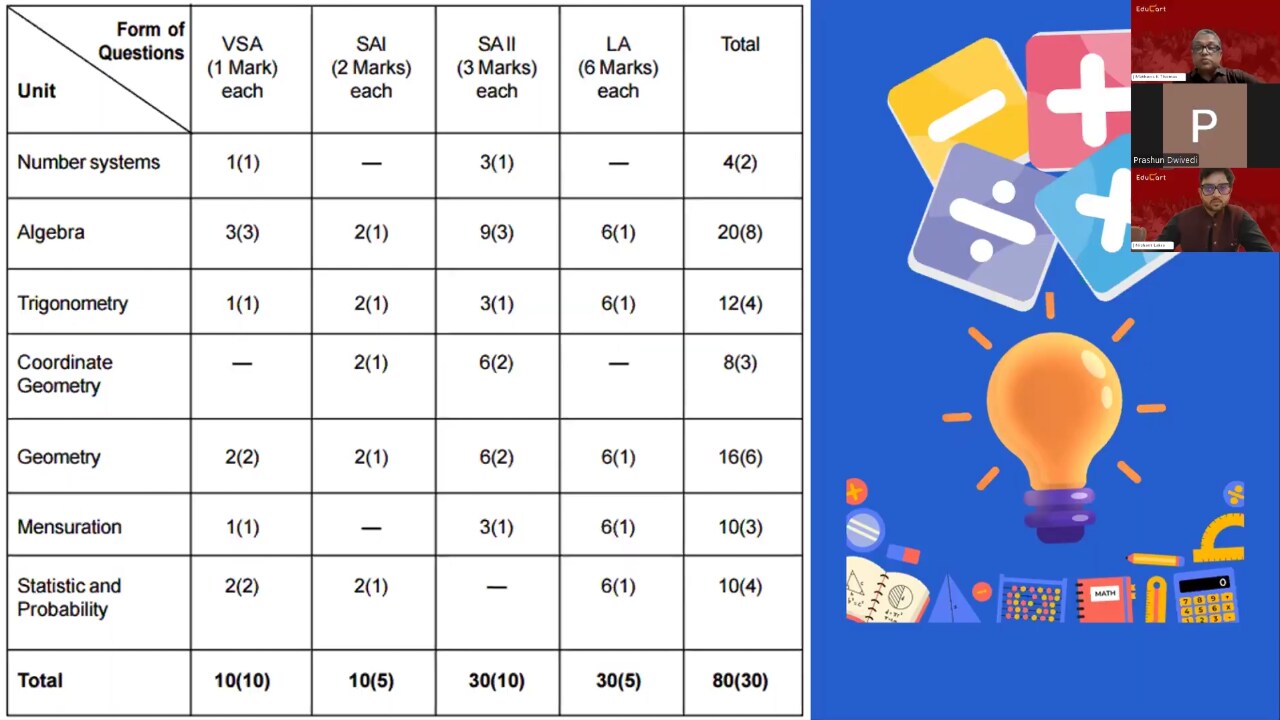
Blueprints as the Foundation of Assessment - Mathews Thomas underscored the need for detailed blueprints in designing assessments, ensuring weightage across difficulty levels and learning domains is maintained. A blueprint, he noted, helps educators maintain coherence and balance in question paper design.
-
Linking Learning Outcomes with Questions - The speaker encouraged teachers to align curriculum goals with learning outcomes by using Bloom’s Taxonomy. This alignment helps create papers that measure analytical and application-based understanding, not just recall.
-
Shifting from Rote to Competency- Based Evaluation - A key takeaway was the importance of moving beyond factual recall. Teachers were guided on framing questions that demand higher-order thinking skills and real-life application of concepts.
-
Use of Internal Assessments for Holistic Evaluation - The session highlighted the effective use of rubrics, portfolios, and subject enrichment activities. These tools were presented as essential for continuous, child-centric assessments that evaluate what students know and can do.
-
Eliminating Bias and Promoting Inclusivity - Teachers were advised to ensure clarity and fairness in question framing. Emphasis was laid on designing papers that consider different learning abilities and reduce ambiguity or cultural bias.
The session concluded with a vibrant Q&A where educators shared challenges and experiences from their classrooms. Through structured inputs and actionable insights, the session empowered teachers to rethink their approach to paper setting moving from traditional formats to more inclusive, thoughtful, and competency-oriented designs.
Educart’s CPD Webinar Series continues to provide educators with practical training in line with NEP 2020 goals. By building teacher capacity in assessment design, the initiative supports classrooms where assessments are not just tools of measurement, but opportunities for deeper learning and reflection.