
National Webinar Equips Teachers with Practical SQAAF Implementation Strategies

New Delhi, January 10, 2026 - Educart organized a national CPD webinar on "Building a Clear Understanding of SQAAF" attended by over 130 educators from across the country. The session addressed the School Quality Assessment and Assurance Framework in alignment with NEP 2020 and NCF 2023.
Dr. Gayatri Kanwar, Deputy District Training Coordinator (CBSE), conducted the webinar, with Mr. Nishant Lakra serving as session moderator.
Understanding SQAAF
Dr. Kanwar explained that SQAAF is a comprehensive framework designed to help schools shift toward holistic, student-centric education. It evaluates the complete educational experience - curriculum planning, teaching methods, student assessment, and learning environments - rather than focusing solely on academic results.
The framework moves schools from input-based thinking (what we teach) to outcome-oriented thinking (what students actually learn and can do). This fundamental shift requires teachers and school leaders to rethink their approach to education, moving beyond traditional metrics toward more meaningful measures of student growth and learning.
Dr. Kanwar emphasized that understanding SQAAF isn't merely about meeting external requirements or compliance. It's about creating better learning experiences for students and supporting teachers in delivering more effective education. The framework provides schools with a structured approach to evaluate and improve quality across multiple dimensions, examining not just what is taught but how curriculum is delivered, what teaching methods are employed, how students are assessed, and whether learning environments genuinely support holistic development.
The 7 Domains and Key Focus Areas
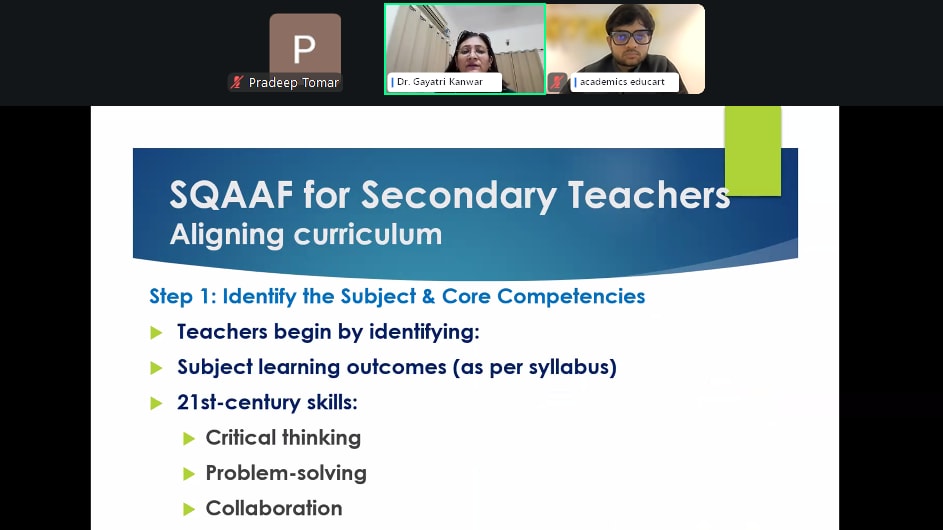
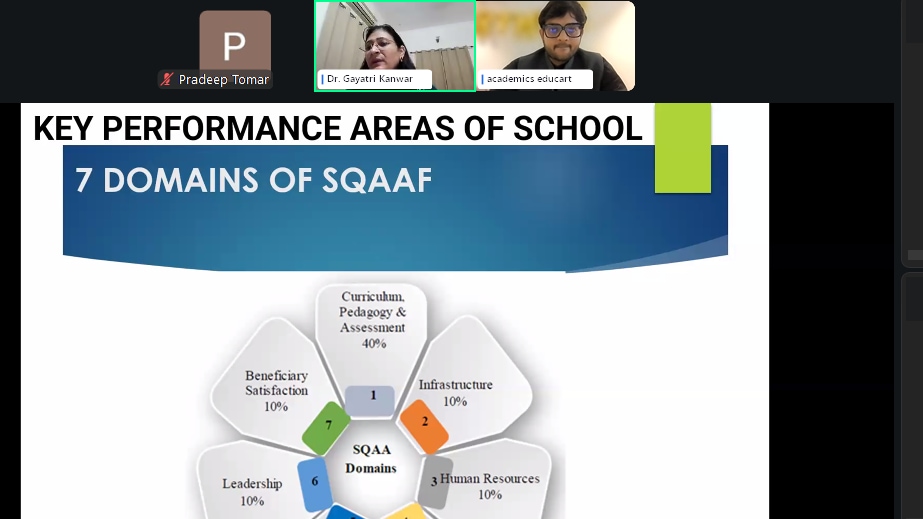
SQAAF examines seven domains of school quality, each with assigned weightage that determines their emphasis in the overall framework. The session focused on three domains with direct classroom impact: Curriculum, Pedagogy, and Assessment.
Curriculum Planning with SDGs
Dr. Kanwar outlined a structured curriculum planning process that starts with clearly defined learning outcomes aligned with CBSE standards and NCF 2023 competencies. The approach involves:
- Mapping learning progression across the academic year
- Integrating real-world applications
- Weaving values education and citizenship development into subject content
Many teachers noted they typically plan lesson by lesson without this broader framework.
Active Learning Strategies
The framework emphasizes active, experiential learning. Dr. Kanwar outlined key strategies:
Inquiry-based learning has students discover answers through guided exploration rather than direct instruction.
Project work applies knowledge to extended tasks requiring research, creativity, and collaboration.
Case studies present realistic scenarios requiring analysis and problem-solving.
Debates and discussions develop communication skills and critical thinking.
While active learning may seem slower initially, it builds deeper understanding that reduces the need for repeated review.
Assessment for Learning
Dr. Kanwar emphasized shifting from "what to learn" to "how students learn" and "what students can do." This requires varied assessment methods: observations, discussions, project presentations, portfolios, and self-assessments.
She stressed meaningful feedback (what students did well and where they need improvement) and feedforward (specific guidance on next steps). Both must be timely, specific, and actionable.
Assessment for learning creates a continuous cycle: assess understanding, provide targeted feedback, adjust instruction, reassess growth, and continue.
Practical Implementation
Dr. Kanwar provided practical guidance on translating policy into classroom practice. She advised teachers to start by understanding core principles behind policies, identify current practices that align with policy goals, recognize practices that need to change, plan incremental rather than overnight changes, and collaborate with colleagues to share strategies and support each other through transitions.
Participants raised questions about managing SQAAF requirements alongside existing workload. Dr. Kanwar acknowledged this as a real challenge but noted that better curriculum planning reduces daily preparation stress, assessment for learning prevents extensive reteaching, and active learning develops independent students who need less constant direction.
Teachers requested subject-specific examples, which Dr. Kanwar provided while encouraging peer sharing. On gaining school leadership support, she advised communicating how changes align with policy requirements and improve outcomes. When administrators understand that new practices support SQAAF compliance while benefiting students, they're more likely to provide necessary support.
Outcome
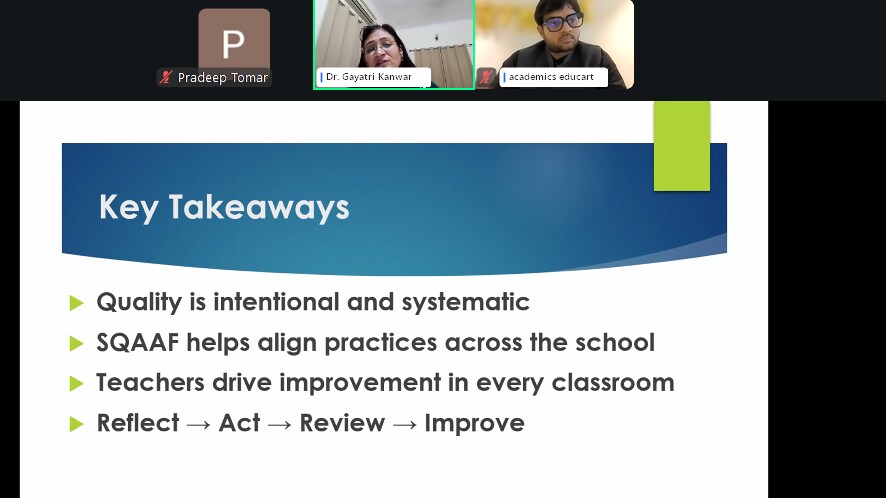
Participants gained concrete strategies for curriculum planning, active learning implementation, and assessment for learning practices that they could begin applying immediately.
The webinar successfully empowered educators with clarity on SQAAF's structure and domains, practical approaches to align their teaching with NEP 2020 and NCF 2023 principles, and confidence to begin implementing changes in their schools. Rather than feeling overwhelmed by another policy requirement, teachers understood SQAAF as a framework that could help them teach more effectively and support students more meaningfully.
Dr. Kanwar's expertise, combined with her accessible presentation style, made complex policy frameworks understandable and actionable. The session demonstrated Educart's commitment to supporting teachers through India's educational transformation, recognizing that policies create impact only when educators understand and can implement them in real classroom settings.