The Rise of Dummy Schools in India: A Double-Edged Sword
With the recent NTA NEET exam scam, serious concerns are surfacing regarding the Indian Education System and the future of our country. As the nexus of coaching centres and dummy schools comes into the spotlight, it compels us to reflect on deeper issues within the schooling structure, particularly the devaluation of the school assessment system.
Additionally, the rising suicide cases in India's coaching capital, Kota, Rajasthan, have raised further concerns associated with dummy schools. Every year, when the results season is around the corner, many cases of suicide are reported primarily from Kota, with the cases increasing every year. Last year, in 2023, nearly 29 aspirants took their lives, and this year, so far, 9 suicide cases have been reported from Kota.

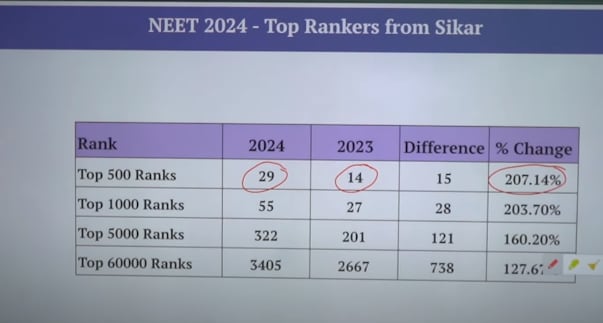
A recent survey conducted after the NEET 2024 revised result reveals that Kota, the coaching hub of India, is losing its sheen due to increased suicide cases and decreasing performance, and the new talk of the town is an outlier district in Sikar, Rajasthan. Ahmedabad and Namakkal (non-coaching cities) have also produced remarkable results. But Sikar has astonished everyone by outperforming Kota twice in a row with 7.48% of students, i.e., a total of 30,204 students securing 650+ marks this year.
The gravity of the current situation leads us to an important question: Are dummy schools a culprit in this ongoing scenario, or are they a boon for students?
Let's analyse this in detail, starting from the basics—what dummy schools are and how they can impact students' careers and personalities in both positive and negative ways—so you can analyse and decide whether it is a culprit or a blessing for lakhs of students enrolled in such a system.

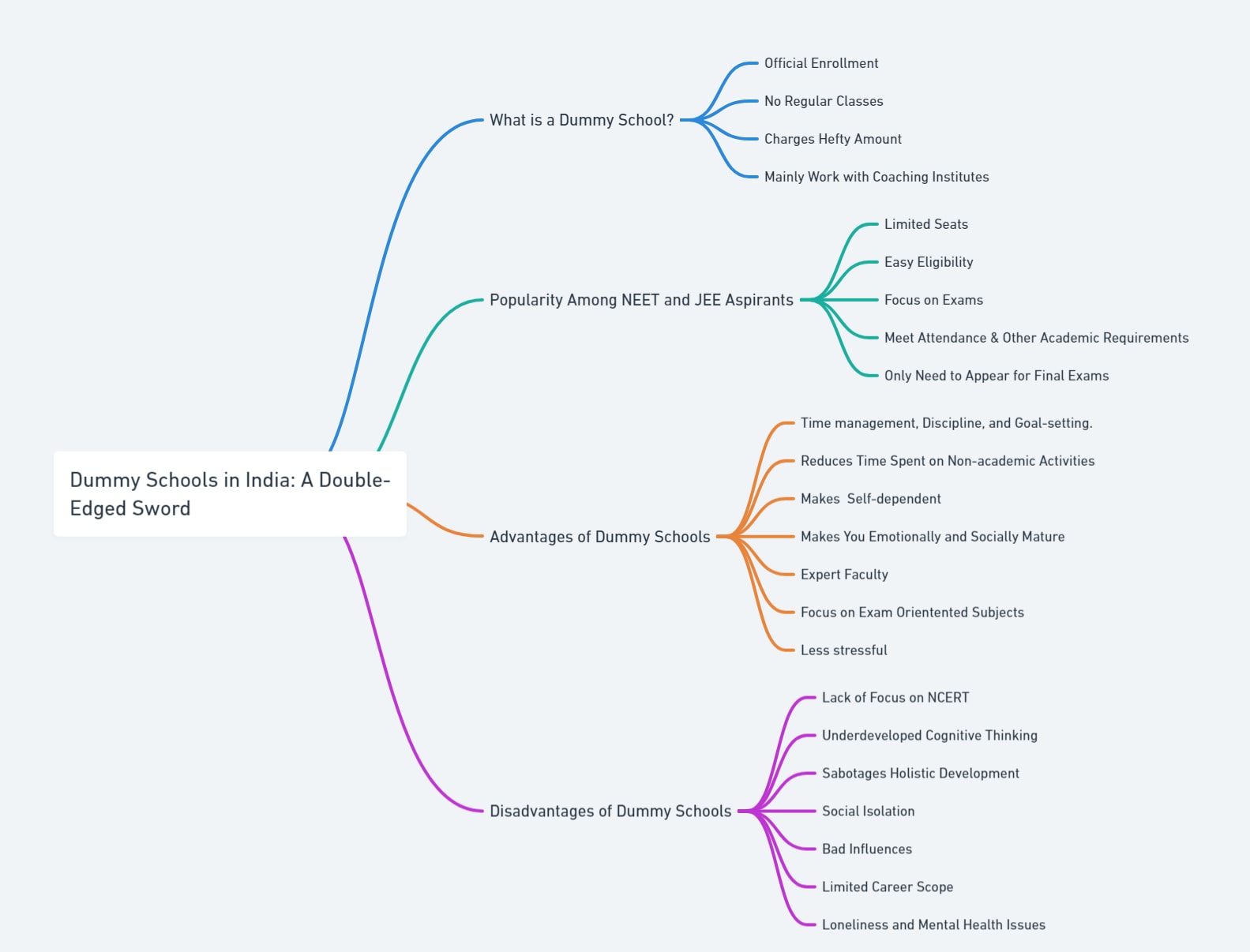
What is a Dummy School?
Dummy schools are board-affiliated schools that officially enrol students preparing for competitive entrance exams like the National Eligibility cum Entrance Test (NEET), Joint Entrance Examination (JEE), and other competitive exams in senior secondary classes. They function in contrast to traditional schools, which require the regular attendance of students in class.
Dummy schools, although not legal in India, complete all the official formalities set by boards on behalf of students to make them eligible to appear in the board exams. For this, they charge a hefty amount of money. Often, these schools work in collusion with the NEET and JEE coaching institutes, but parents can also reach out to them directly to enrol their students in such schools.
Why are Dummy Schools so Popular Among NEET and JEE Aspirants?
Dummy schools are no new schools of sensation for JEE and NEET aspirants; they have been operating in India for more than a decade now.
As the seats are limited in top medical and engineering colleges, there is cutthroat competition among the aspirants, and this has fueled the demand for dummy schools in India. As the aspirants want to focus wholeheartedly on these exams, they look for ways to avoid going to regular school to save time. In such a scenario, these schools are their only options. They serve as rescuers and time savers by lowering academic pressure and letting the students focus laser-sharp on competitive exams.
These dummy schools facilitate the 75% attendance requirement that is mandatory for a student to sit in the board exam.
Once enrolled in the dummy schools, students just have to appear for the final exams; the rest of the formalities, like attendance, project marks, practicals, etc., are taken care of by these schools. Thus giving the students ample time to focus on the entrance exams.
Students who enrol themselves in dummy schools are mostly those who move to other cities like Kota, etc., to join full-time residential coaching classes. Due to the lack of good and proper coaching facilities in their hometown, students are compelled to leave their city and temporarily migrate to a place that offers quality controlled and ‘distraction-free’ preparation for engineering and medical entrance examinations. The only way to fill the gap between their coaching classes and regular schooling is by enrolling in Dummy Schools.
Advantages of Dummy Schools
Preparing for the JEE and NEET exams is a gruelling process. It requires a lot of hard work, perseverance, and dedication. Buying sufficient time to prepare for such exams has led to the mushrooming of dummy schools in India because of the various benefits that they offer. Students are enrolled in the dummy school to prepare for competitive exams.
- Learn time management, discipline, and goal-setting.
- Saves time by reducing distractions from non-academic activities.
- Get more time for self-study and coaching classes.
- The pressure to balance the classes and the coaching is released.
- They only have to focus on the subject that matters from the exam point of view.
- There is no distraction related to school projects, practicals, or other activities.
- There is no time wastage by studying one thing twice in both school and coaching. Rather, it will help you focus on revising the subject.
As aspirants stay away from home for coaching (as most students who get enrolled in dummy schools temporarily migrate to join the coaching for NEET and JEE exams ), living in a hostel makes them self-dependent. It prepares them for the coming years of life.
- Living away from home makes them emotionally and socially mature before they come of age.
- Hostel life teaches them to learn to face the adversities of life.
- They also learn to adjust and become socially more adaptable.
- Good coaching institutes hire experts in subjects to teach the students, so the quality of teachers is far better at coaching institutes than at schools.
- As the pressure is lower, the students are less stressed compared to those who opt for regular schooling and coaching.
Disadvantages of Dummy Schools
Dummy schools, although they offer a lot of benefits for JEE and NEET aspirants, come with costs, which are as follows:
- Students lose important knowledge and perspectives that non-science subjects provide.
- No extracurricular development; lack of overall personality and social growth
- Homesickness. This leads to social isolation and mental health issues.
- Students, when in an uncontrolled environment, resort to bad habits like smoking, drinking, or entertainment (social media, cyber cafe surfing, etc.).
- Some dummy schools might not be officially recognised, which can lead to problems with certification and higher education.
Regular vs. Dummy School: Which Is Better?
As the competition is increasing drastically each year with only a limited no. of seats in the top engineering and medical colleges, the pressure to perform better by giving your best is mounting on students.
On the one hand, the psychological impact of competition culture is proven to be fatal as it comes with costs like degraded mental and physical health, stress, anxiety, underdevelopment of social skills and emotional intelligence, parental pressure, a bleak future (in case of failure), double fee payment, etc., and that too without the surety of success.
On the other hand, a study conducted by the Indian Institute of Technology (IIT) Delhi shows that students who took coaching classes performed better than those who did not. The study also revealed that coaching helped the aspirants improve their speed and accuracy, which are important for these exams.
As it is difficult to evade the competition, a more balanced approach, in this case, would be to attend regular schooling, take online coaching classes side by side, and drop a year if required after the 12th. It will steam off the pressure of delivering the best result in one attempt and give you the time needed for overall development.
When in class 11, give your maximum focus to NEET or JEE; when in class 12, take selective off to prepare for these exams. If possible, talk to your principal about your goals and coaching so that you can have better cooperation. Opt for weekend batches so that the pressure of handling both regular and online classes can be managed effectively.
Holistic development is essential for a child to become a better person and citizen of a country, so the importance of regular schooling shouldn't be underestimated.
Here is an overview for you to cross-analyse the various factors before you make a decision.