|
Why must women have to disappear because some men have taken a vow of celibacy?
BAPS goes to Paris
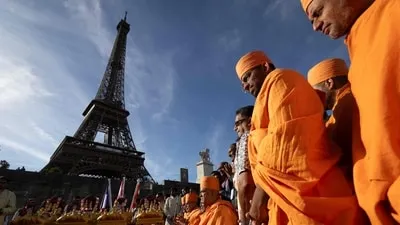
Days after the consecration of the BAPS—or, to use its full name, the Bochasanwasi Akshar Purushottam Swaminarayan Sanstha—temple in a Parisian suburb, a delegation of some 100 people associated with the organisation decided to visit the Eiffel Tower.
What happened next is under some dispute. The operating company that runs the iconic landmark said the delegation had asked for the visit to be organised so as to “limit interactions with women”. BAPS’s social media account states that “to the best of our knowledge, at no point was anyone prevented access to the Eiffel Tower”.
What is undisputed is that management had asked women staff to stay out of sight while the monks, who’ve undertaken strict vows of celibacy, came visiting on Saturday morning. On Monday, the Eiffel Tower remained shut as staff went on strike. Staff union representative Diane Davoine said the women felt humiliated as they were “asked to leave their places of work”. Suddenly, the incident and the exclusion of women was all over the news.
Some of the outrage had a touch of parochial nationalism. Much was said about the French way and how in France women are not asked to step aside. “In France, no culture, no belief, no worship, nothing nor anyone can come to dictate to women their place,” said former prime minister Gabriel Attal, a centrist. “In France, we will never accept that the presence of women will be limited,” noted far-right leader Marine Le Pen.
At home in India, the incident was treated as yet another instance of public embarrassment and shame—at par with enthusiastic tourists doing the garba on airport tarmacs or loudly sharing home-cooked meals on aircraft. “Over the last decade or so, as Gujarati wealth and influence have grown, something strange has happened to my people,” wrote columnist Vir Sanghvi who happens to be Gujarati. “We are now so conscious of our wealth that we flaunt it in the most ostentatious manner possible at oversized functions and big weddings. We act like everything is for sale.”
There is undoubtedly a new vulgarity, but the exclusion of women is an old, old problem. That it continues to happen in a modern nation whose Constitution promises equality and dignity is India’s shame. That we air our prejudices before the world shows how little we even recognise the problem.
Male celibacy is not women’s problem
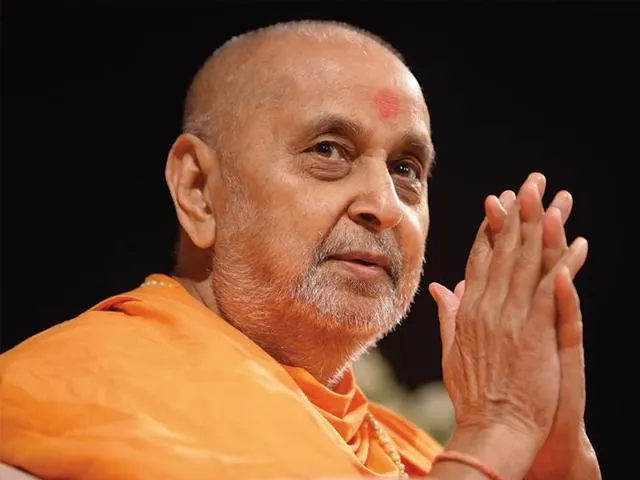
(The late Pramukh Swami Maharaj)
BAPS monks take a vow of celibacy that is so strict that the inadvertent touch of a woman, even a little girl, requires ritual purification. Its official website describes how in 1986, the Pramukh Swami blessed two children, one of whom he subsequently learned was a girl. This accidental physical contact led him to rush to the nearest river for a ritual bath and, later that night, a repentant fast. Earlier, in 1980, before undergoing a cataract operation in Boston, he insisted that no women nurses should be present even while he was unconscious.
At public events, women are asked to be seated at the rear so they remain out of sight. The BAPS website talks of how the Swamiji turned down an invitation to be the chief guest of a felicitation event to honour blood donors. His logic, not unreasonable, was that by if women were asked to sit at the rear, they could end up resenting the organisation. Yet, at a 2024 event in Kolkata, reports The Print, women who were already seated at the front rows of a gathering of chartered accountants were asked to move away before a speech by a BAPS-affiliated religious leader.
There is a larger concern about putting the onus of male celibacy on women. This is not women’s responsibility. Surely, if you’ve taken a vow to live a certain way, you must come up with the willpower to adhere to that way. And if the mere sight of a woman seated at the front row, or behind a ticket booth at a world-famous tourist attraction is enough to make you break your vow, then what does it say about your willpower?
The issue isn’t so much about BAP’s views on women or celibacy. Everyone has the freedom to choose to be celibate, or eat a certain diet, or hold medieval views about women in their private life. The issue becomes a problem when you impose these views in the public sphere and expect those around you to fall in line.
This is larger than a series of cringe moments when Indians, non-Gujaratis included, flush with their new wealth go abroad and behave badly—snapping their fingers at the service staff, not bothering with such niceties as please and thank you, for instance.
The issue is women’s equality and visibility in public life. The BAPS website has the usual platitudes about respect and dignity for women. But seeing them as temptresses who could cause noble souls to deviate from their godly path plainly exposes a misogynist mindset.
The BAPS Parisian episode comes at a time when the Sabarimala dispute is back in the courts. Here too the central question is whether discrimination against women can be allowed in a country where the Constitution guarantees equality and dignity to all citizens.
In 2018, a five-judge bench headed by then chief justice Dipak Misra held that the practice of excluding women was unconstitutional and violated the fundamental right to equality of female worshippers.
Over 50 petitions were filed seeking a review of the 2018 judgment. Arguments have been heard on both sides and judgment has been reserved. One can only hope that it will be in favour of women’s full and robust participation in all aspects of life. Keeping men on the straight and narrow is not a woman’s job.
|