
The observatory in Delhi includes three large instruments set up by Sawai Jai Singh for reading the time
and observing celestial coordinates, and a multifaceted structure that performs various functions,
believed to have been added by his son. Ahead of a planned restoration, a look at all the
instruments.
— Kabir Firaque
Delhi’s Jantar Mantar, currently
undergoing the first steps of a planned restoration, has four instruments that are a mix of science and
mystery. Three of them were set up by the Rajput ruler Sawai Jai Singh who built five observatories in
northern India 300 years ago. The fourth, which has become this Jantar Mantar’s signature, is the Misra
Yantra with its semicircular arcs. Believed to have been added later by one of Jai Singh’s sons, it had
multiple purposes, some of which are not yet fully understood.
The other three instruments not only
tell us about Jai Singh’s keen interest in astronomy but also serve as a lesson for any student starting
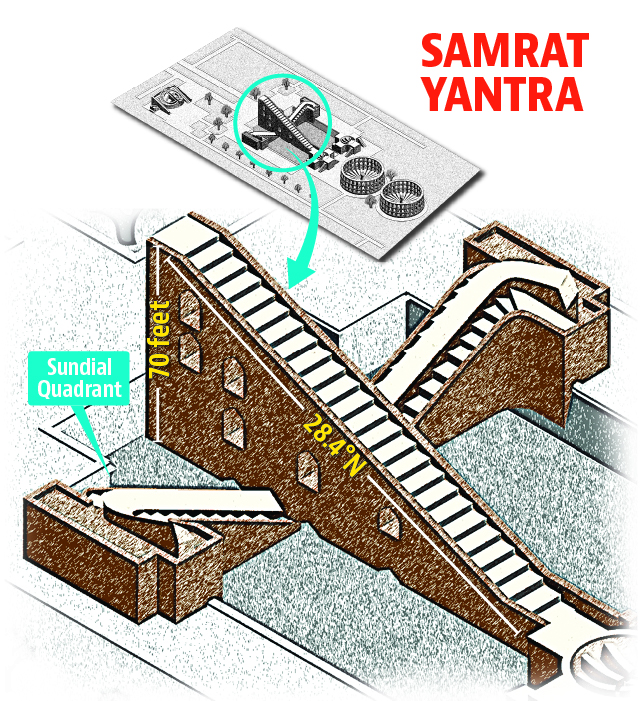
out in the subject. These are common to the observatories in Delhi and Jaipur: a sundial called the Samrat
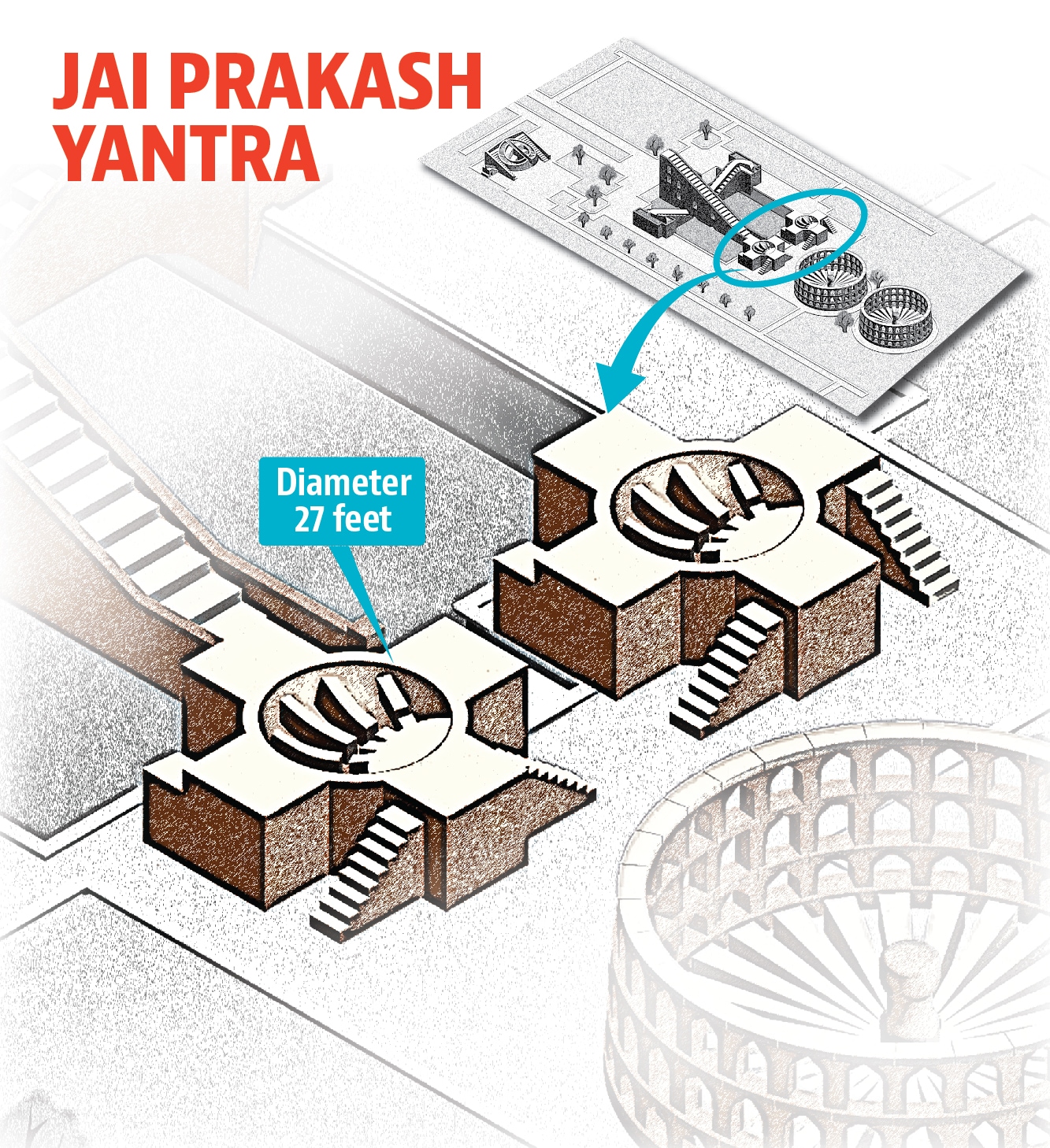
Yantra, a pair of hemispherical bowls called the Jai Prakash Yantra, and a pair of cylindrical structures
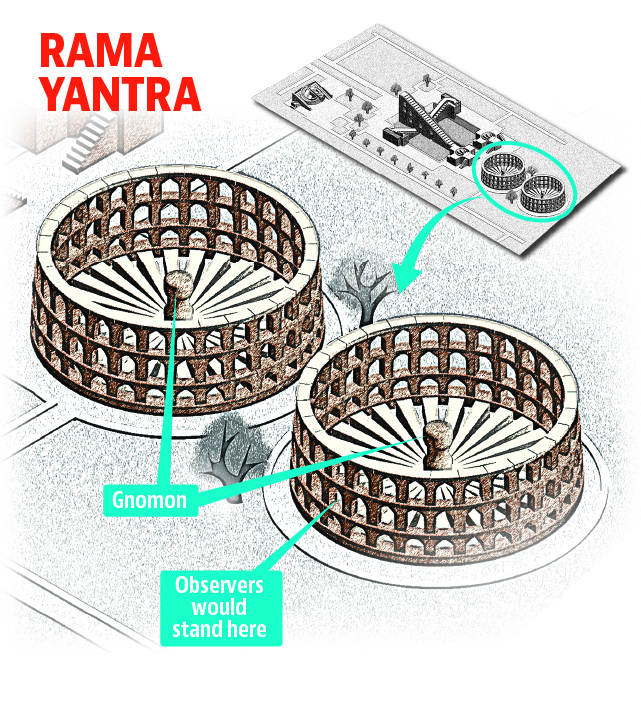
called the Ram Yantra.
We know that a sundial tells the time with its shadow, cast by the sun as it
moves across the sky. To ensure that the shadow moves equal distances at equal intervals, the sundial
needs to be aligned (or calibrated) perfectly. Because of the earth’s tilt, a vertical sundial at any
location (other than the poles) will not accurately reflect the movement of the sun
To make it
effective, the sundial needs to be tilted so that its shadow-casting part, called the gnomon, is aligned
with the earth’s north-south axis. This tilt needs to be at an angle equal to the location’s latitude:
elementary geometry shows that this will ensure the gnomon points towards one of the celestial
poles.
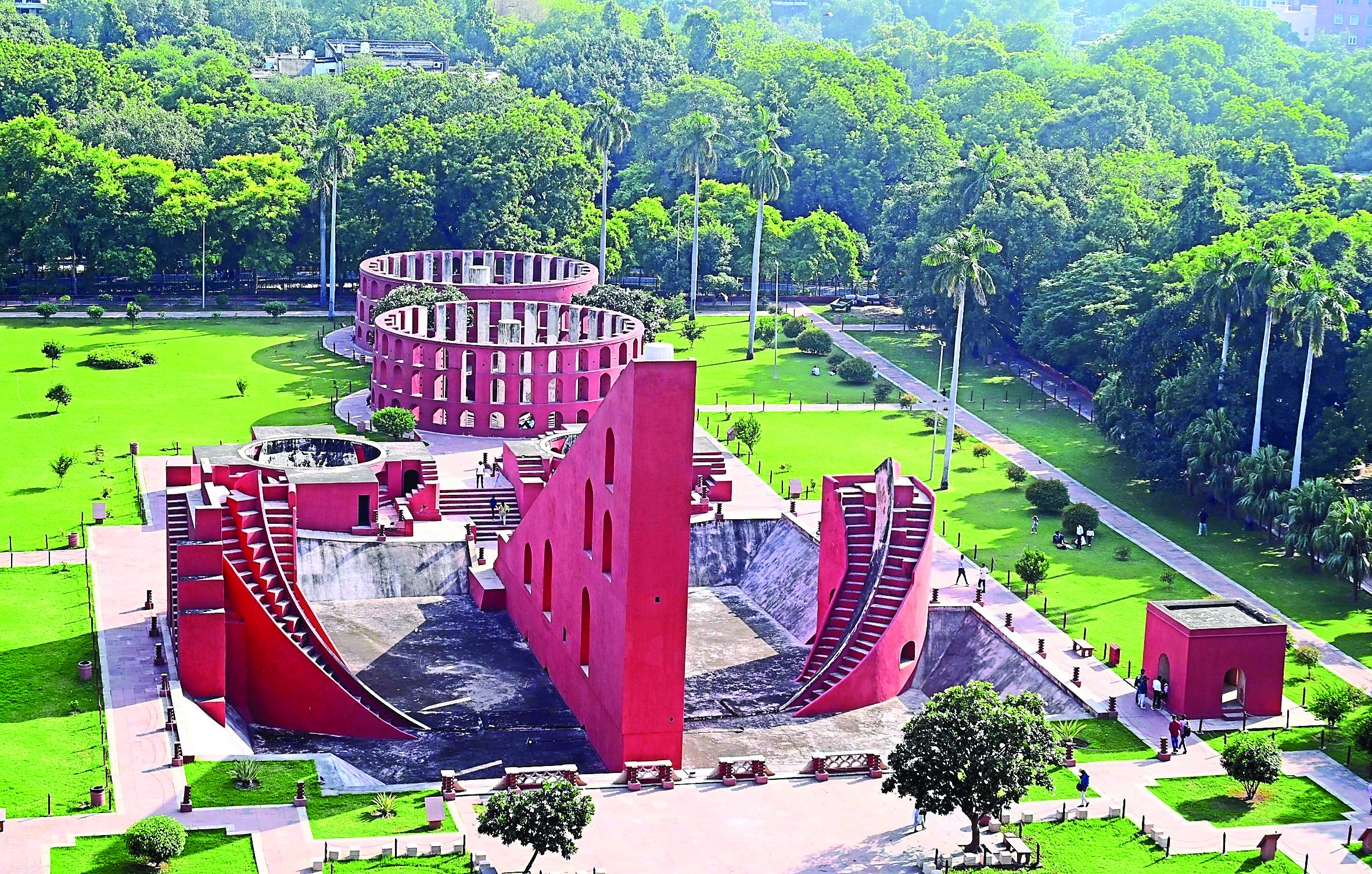
And indeed, the gnomon of the Samrat Yantra points towards the pole star.
Samrat Yantra
Samrat Yantra
The gnomon is a right-angled triangle. The slanting side is at an angle of 28.4° to the
ground, meant to match what was thought to be Delhi’s latitude in those days (it is taken as 28.7°
today). One either side of the triangle lies a bow-shaped quadrant, each of which is inclined at 28.4°
to the vertical in the equatorial plane.
The sundial works by casting the shadow of the gnomon (a
reflection of the celestial north-south meridian) on the two quadrants (a reflection of the equatorial
plane) hour by hour, minute by minute. As the sun moves from east to west, the shadow of the gnomon
moves eastward, entering the western quadrant at sunrise and leaving the eastern quadrant at
sunset.
Today, no graduations are readable on what remains of the original marble slabs on the
quadrants. A restoration with lime plaster was attempted in 1910, but only faint markings are visible in
some parts, according to a status report by Dr Aalok Pandya, who heads the physics department at the
Indira Gandhi National Tribal University in Amarkantak, Madhya Pradesh, and is working with the
Archaeological Survey of India (ASI) on the restoration.
The original graduations marked the
quadrants up to the fine scale of three segments within every minute, according to ‘The Astronomical
Observatories of Sawai Jai Singh’, a graphic novel written and illustrated by Mumbai-based architect
Rachana Sankhalker, then a masters student at IIT Bombay, and published by ASI in 2023. The markings
thus told the time to an accuracy up to 20 seconds.
Two pairs of twins
Two pairs of twins
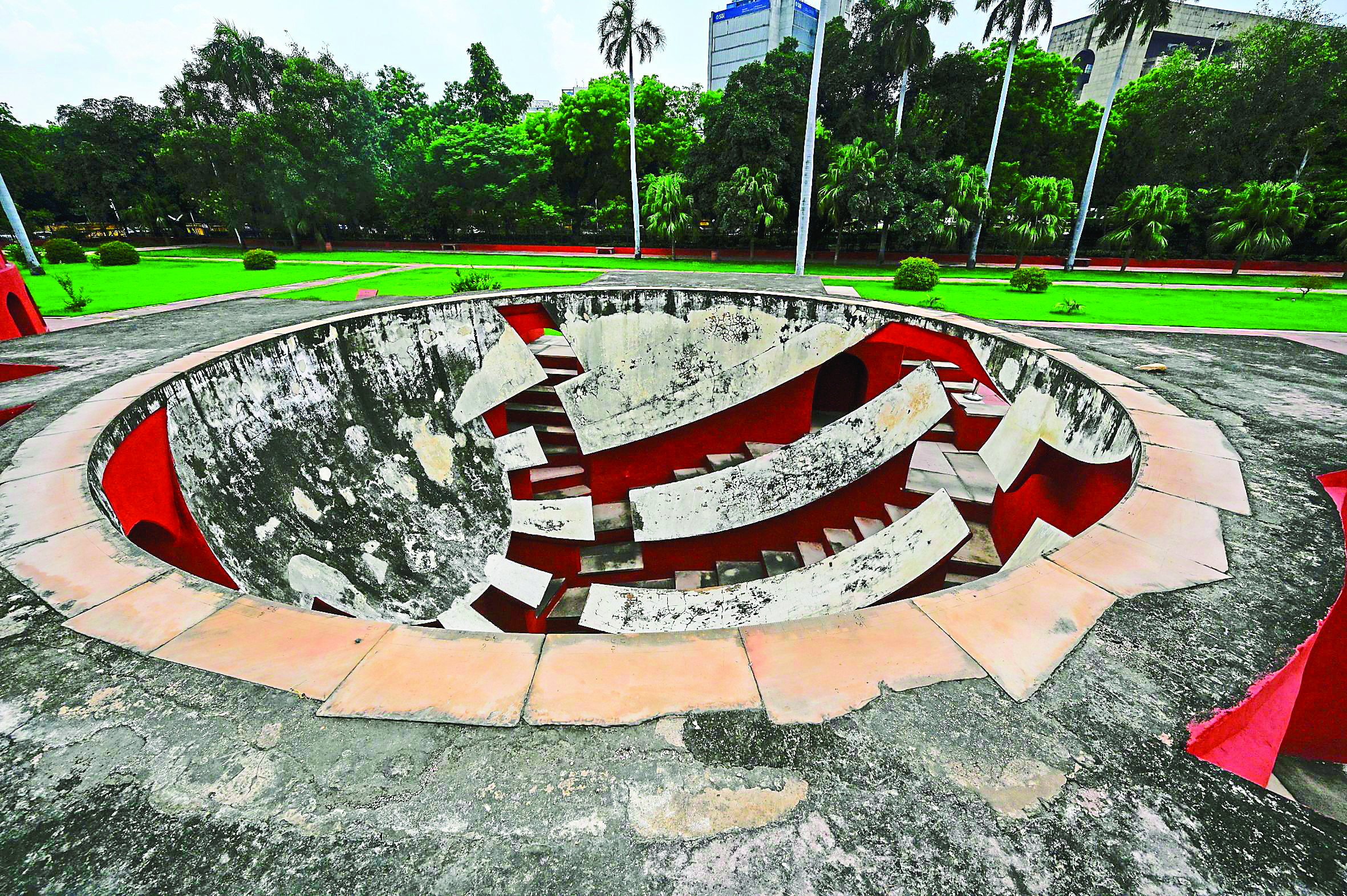
The Jai Prakash Yantra and the Ram Yantra consist of two halves each, the former of two
hemispherical bowls partly set into the ground and partly above, and the latter of two cylindrical
structures. The two components in each pair are equally sized but are not identical, with their markings
complementing rather than matching each other.
In both bowls and both cylinders, readings for
celestial coordinates are set on a series of inscribed surfaces interspersed with gaps, enabling the
observer to move around. The bowls have their markings on evenly spaced slabs on the floor, while the
cylinders are marked on radially placed floor slabs as well as on the walls, again interspersed with
evenly spaced gaps. In both instruments, each gap is equal in size to a graduated section, but what is
present in one half is absent in the other.
Consider the bowl-shaped pair first. Any marked surface
in one bowl is a gap in the other bowl, and vice versa. Again, any radial slab in one cylinder is absent
in its twin, where it is replaced with a gap. This is true also of the graduated sections and gaps in
the walls. These complementary structures can be compared with hands: when the fingers on each are
spread out and the hands then interlocked , the fingers of one hand go into the gaps in the other hand.
In each structure, the two twins can be imagined to represent one whole.
The gaps allow the observer
to move around or stand while the shadow of the object being studied falls on a marked surface. When the
shadow falls on a gap in one structure, it falls on a marking in its twin. The shadow can now be read
either by the same observer moving across to the twin instrument, or by another observer already
stationed there.
Sneh Kesari, a Ghaziabad-based amateur astronomer and entrepreneur who deals in
astronomical equipment and conducts educational programmes, was introduced to the twin instruments in
2004 when, as a student, he took part in a project supervised by N Rathnasree, a long-serving director
of the Nehru Planetarium and one of the leading experts on Jantar Mantar until her death in
2021.
Kesari explained how observers took readings on the two instruments. In the Ram Yantra, each
cylinder has a gnomon stretching out of the centre of the floor up to a height equal to that of the
cylinder. While an observer in the daytime notes the shadow cast by the sun, nighttime observations are
made of celestial objects directly. The observer aligns their eye with the scales until the object
appears directly on top of the gnomon, and then takes the reading at that point.
“You also move up
and down the walls and make an adjustment. You take note of where exactly the object appears on top of
the gnomon, and there we get the readings,” he said.
The hemispherical bowls in the Jai Prakash were
constructed as a reflection of the night sky. Inside the dome, there is a slot to attach a pole
extending to the top of the instrument. The observer would adjust their eye until the celestial object
appeared right on the tip of the pole, and take note of the reading marked on the scale adjacent to the
eye.
Celestial coordinates can be measured in different systems. The equatorial coordinate system
gives a celestial object’s right ascension and declination (the celestial equivalents of latitude and
longitude) which are constant across the earth, changing only with time as the object charts its
celestial path. The horizon coordinate system gives azimuth and altitude, which use the observer’s
horizon for reference and therefore varies according to location.
The readings in the Ram Yantra are
for azimuth and altitude, while those in the Jai Prakash Yantra were possibly for right ascension and
declination. The original markings in the Jai Prakash were replaced during the 1910 restoration, and
even those are barely legible now. In the Ram Yantra, in contrast, the markings higher up on the walls
are almost intact.
Misra Yantra
Misra Yantra
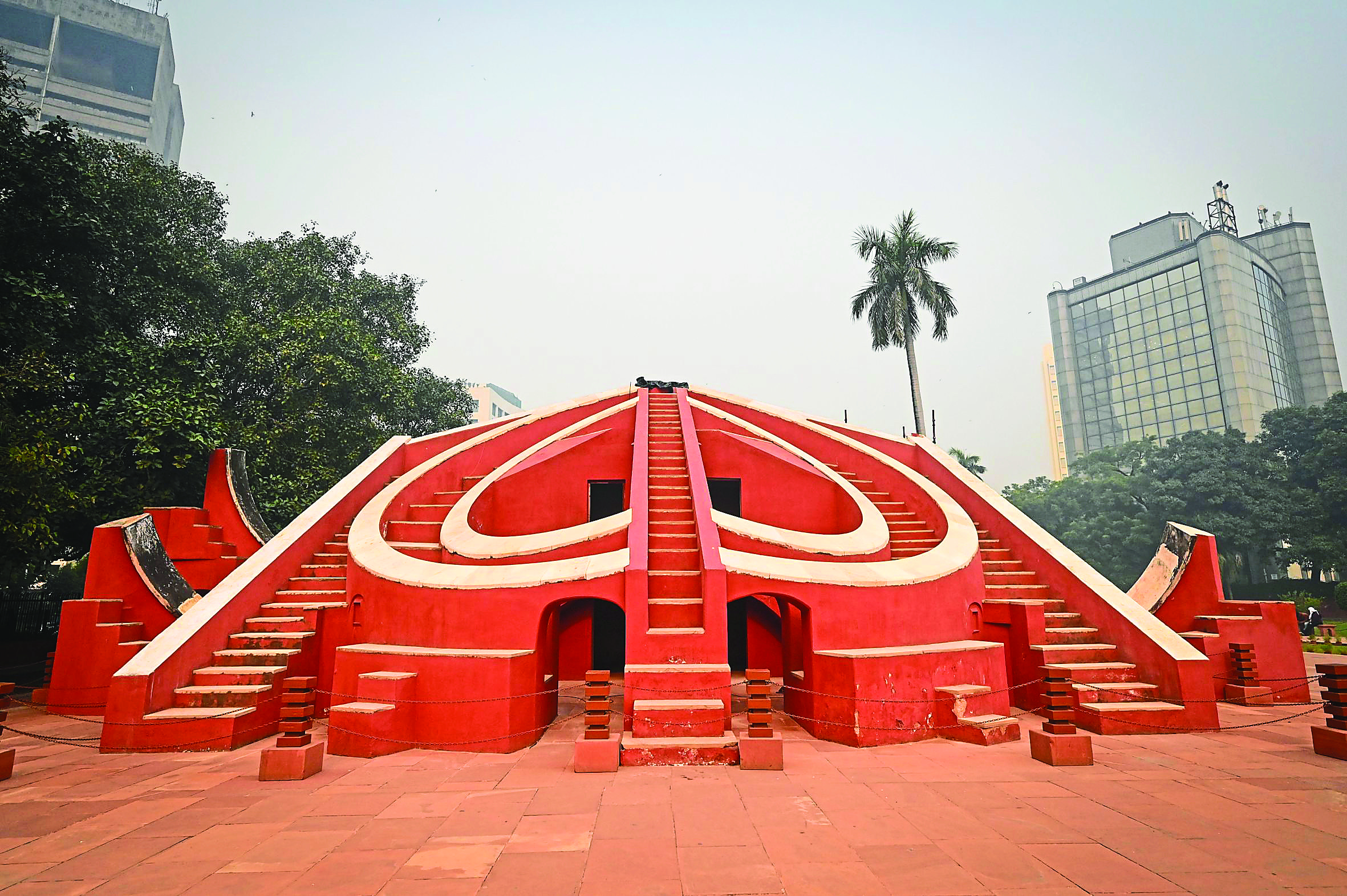
It was the face of the 1982 Asian Games. It is the face of Delhi’s Jantar Mantar itself,
but the only one of five such observatories to have such a structure. The Misra Yantra, with its four
semicircular in front and several other features, has so many aspects that is perhaps better described
as a collection of instruments than as a single instrument.
The questions surrounding it begin with
its construction. Physicist Virendra Nath Sharma, a leading expert on Jantar Mantar and now Professor
Emeritus with the University of Wisconsin, believes it was built not by Sawai Jai Singh but by one of
his sons, Madho Singh, sometime between 1750 and 1754.
Sharma mentions this view while describing the
Misra Yantra in the Indian Journal of History of Science in 1994. Three decades later, his paper remains
a key reference document on the structure and its instruments, whose functions range from the obvious to
the uncertain.
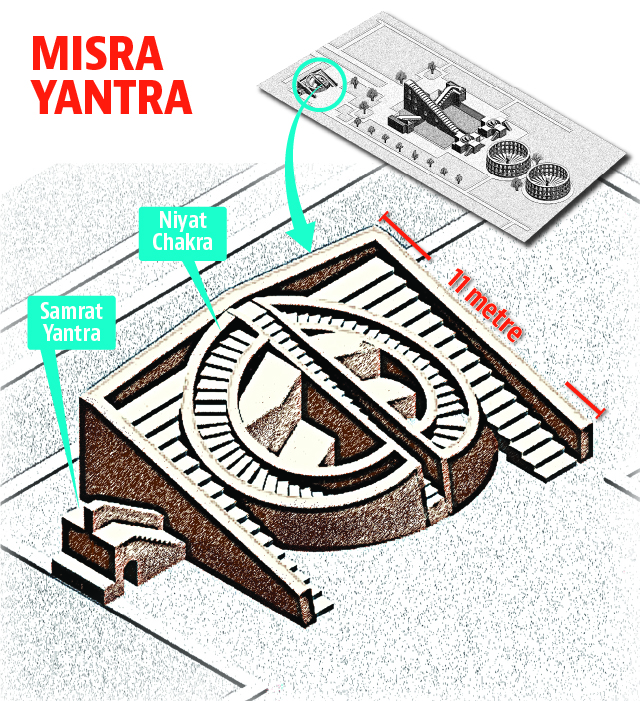
The Misra Yantra includes the semicircular arcs around a gnomon in the front; a
sundial with two gnomons of its own and two quadrants; an additional quadrant whose function is not
clear; a small instrument called the Dakshinottara Bhitti Yantra that was likely less significant than
the others; and a mysterious wall on the back, the Karka Rasi Valaya. This is where the ongoing
restoration project has started.
The Dakshinottara Bhitti Yantra and the sundial are most easily
described. The former, resting on the east wall, consists of a pair of arcs that do not meet properly at
the top, Sharma observes, and could have been used to measure the altitude of the midday sun by
measuring the shadow of a rod placed on the instrument. The instrument, however, is too close to the
ground for any serious work on measuring the altitude of a planet or star, Sharma writes.
The Misra
Yantra’s sundial has been constructed in two halves, with a gnomon and a quadrant each on the west and
the east, telling the time on either side of noon. The markings are mostly lost.
The additional
quadrant, whose function Sharma describes as unknown, is on the western side. Its markings eroded, the
structure is titled 5° towards the south. This angle is significant to the Karka Rasi Valaya. Sharma
writes that it is possible that its purpose was similar to that of the wall. More on the wall later;
first, a look at the semicircular rings at the front.
The four semicircles
The four semicircles
Called the Niyat Chakra, the instrument consists of four scales that are set on the
semicircles surrounding the central gnomon. Its function has been the subject of some speculation, with
some scholars suggesting that it was also meant to give time readings from locations from four different
countries. Sharma’s paper dispels that view.
The Niyat Chakra was meant to observe the declination of
a celestial object traversing the sky. The observer would fix a rod into a hole on the gnomon and
observe its shadow on the scales, with the reading giving the declination of the sun at specific times.
For night readings on celestial objects, the observer needed to place their eye on the edge of the scale
in such a way that the central pin and the object appeared in one line. This point on the scale would
indicate the declination of the object.
There used to be a popular belief that the four semicircles
represented the meridian arcs of Zurich, Greenwich, Notkey in Japan, and Serychevo on the Pacific island
of Kuril. Sharma’s paper dismisses this: Notkey and Serychevo have no observatories, and the one in
Zurich was actually built after the Misra Yantra.
Wall of mystery
Wall of mystery
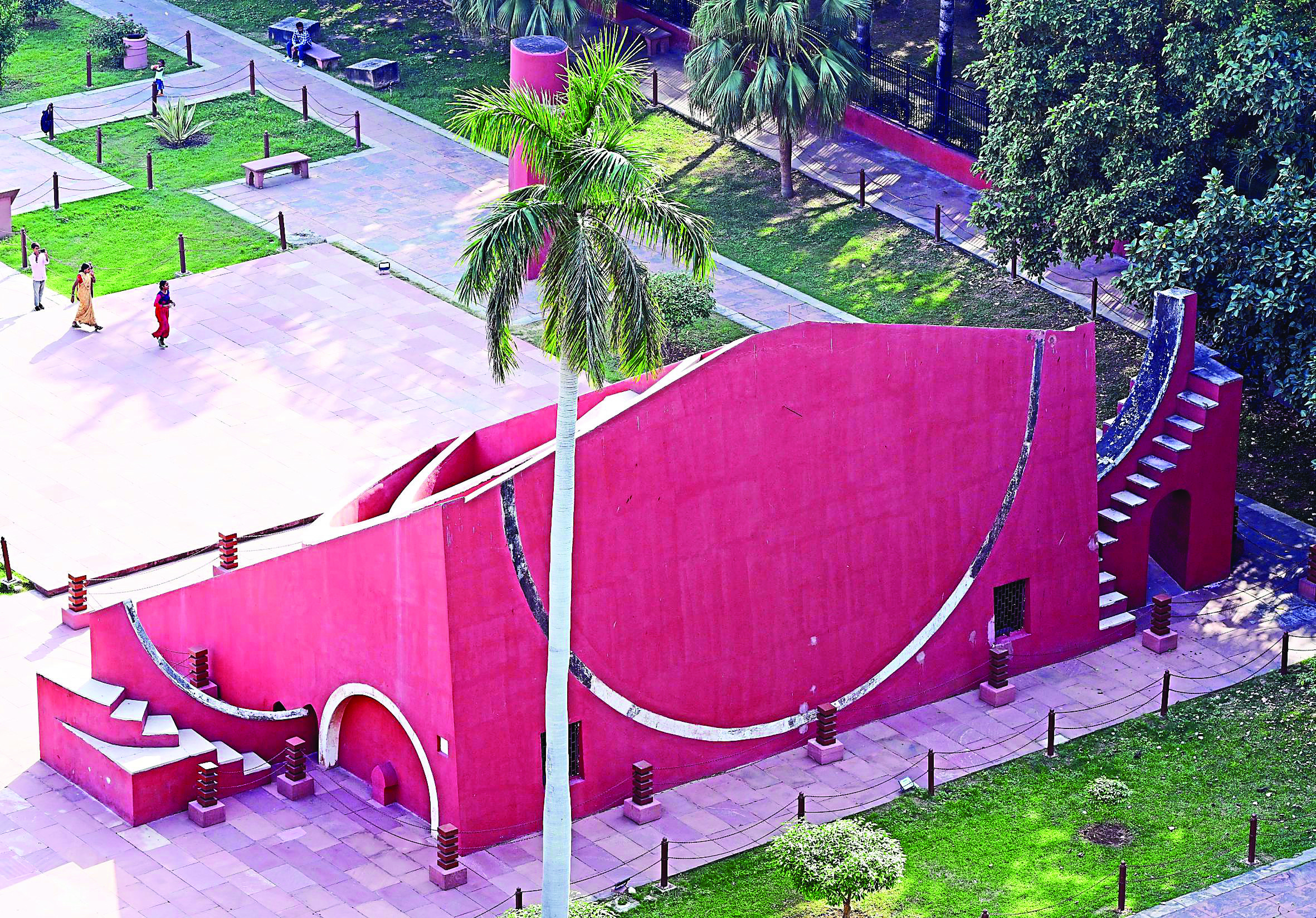
The back wall stretches in the east-west direction but
does not stand vertically. It is inclined by about 5 degrees to the vertical, towards the south. This is
roughly equal to the difference between Delhi’s latitude (taken as 28.4°) and the Tropic of Cancer
(23.5°). In effect, this makes the Karka Rasi Valaya parallel to an imaginary vertical wall on the
Tropic of Cancer.
The wall is in the shadow of the sun for most of the year, but on summer solstice
the sun shines exactly over it for much of the day. The wall may have been meant to indicate the entry
of the sun into the Tropic of Cancer, the late director of Nehru Museum, N Rathnasree, wrote in a paper
in the Indian Journal of History of Science in 2008.
A small rod acting as a gnomon sticks out at 90°
to the surface, just below the top of the wall and in the centre of its horizontal span. Sharma and
Rathnasree’s papers dwell on which what information could have been gained from the shadow of the rod
cast by a celestial object.
In theory, Sharma writes, the wall may have been used once every 24 hours
to measure the longitude of a celestial object such as the moon once every 24 hours. That moment would
be when the first point on the Tropic of Cancer (the summer solstitial point) coincides with the
meridian (an imaginary north-south circle passing the celestial poles and the observer’s zenith and
nadir).
While the meridian is fixed for a given observer, the sky turns with respect to the
observer’s location and makes a full circle in a little under 24 hours. “So once every day, each point
of the sky, including the summer solstice point, will cross the meridian,” said astrophysicist Aniket
Sule, associate professor with the Homi Bhabha Centre for Science Education, Tata Institute of
Fundamental Research.
“Now, the base dial of the Karka Rasi Valaya is parallel to 23.5° declination
(Tropic of Cancer). So when the summer solstice point is at the meridian, the dial will match the
ecliptic longitude circle,” he said. When that happens, the observer sits near the dial and aligns their
eyesight with the object and the rod. “Mark the angle at which the object is exactly behind the axial
rod. That would give the ecliptic longitude,” he said.
In a status report ahead of the restoration,
Aalok Pandya, head of the physics department at the Indira Gandhi National Tribal University in
Amarkantak, said the wall could be used for five months, two-and-a-half months on either side of June
21. The shadows would become more prominent as the solstice day approached, and then get fainter before
disappearing two-and-half-months after the solstice.
Sule of TIFR explained how the wall could be
useful in those months: “In principle you could use the shadows to measure the ecliptic longitude of the
sun, if you knew the time when the summer solstice point would come on the meridian (each day exactly 4
minutes earlier than on the previous day).”
Rathnasree’s paper speculates whether the wall had other
purposes besides measuring celestial longitudes. “One wonders whether the instrument was also meant to
be used as a (non-standard) clock on the day of the solstice, using the shadow movements on the wall,”
it says. For a considerable period before and after noon, the shadow of the gnomon seems to move equal
distances in equal time intervals, which Rathnasree describes as very attractive to view.