
Journalist Vittorio Pozzo is the only coach to have won successive World Cups
He started his career as a journalist and returned to take up media duties, but what Vittorio Pozzo achieved in between makes him the most influential tactician in football during the pre-World War II era.
World football was stumbling through early pangs and arguments over the place of professionals in the game when the second World Cup was played in Italy in 1934. The venue for the edition was not popular to begin with, as Italy was under the fascist rule of Benito Mussolini.
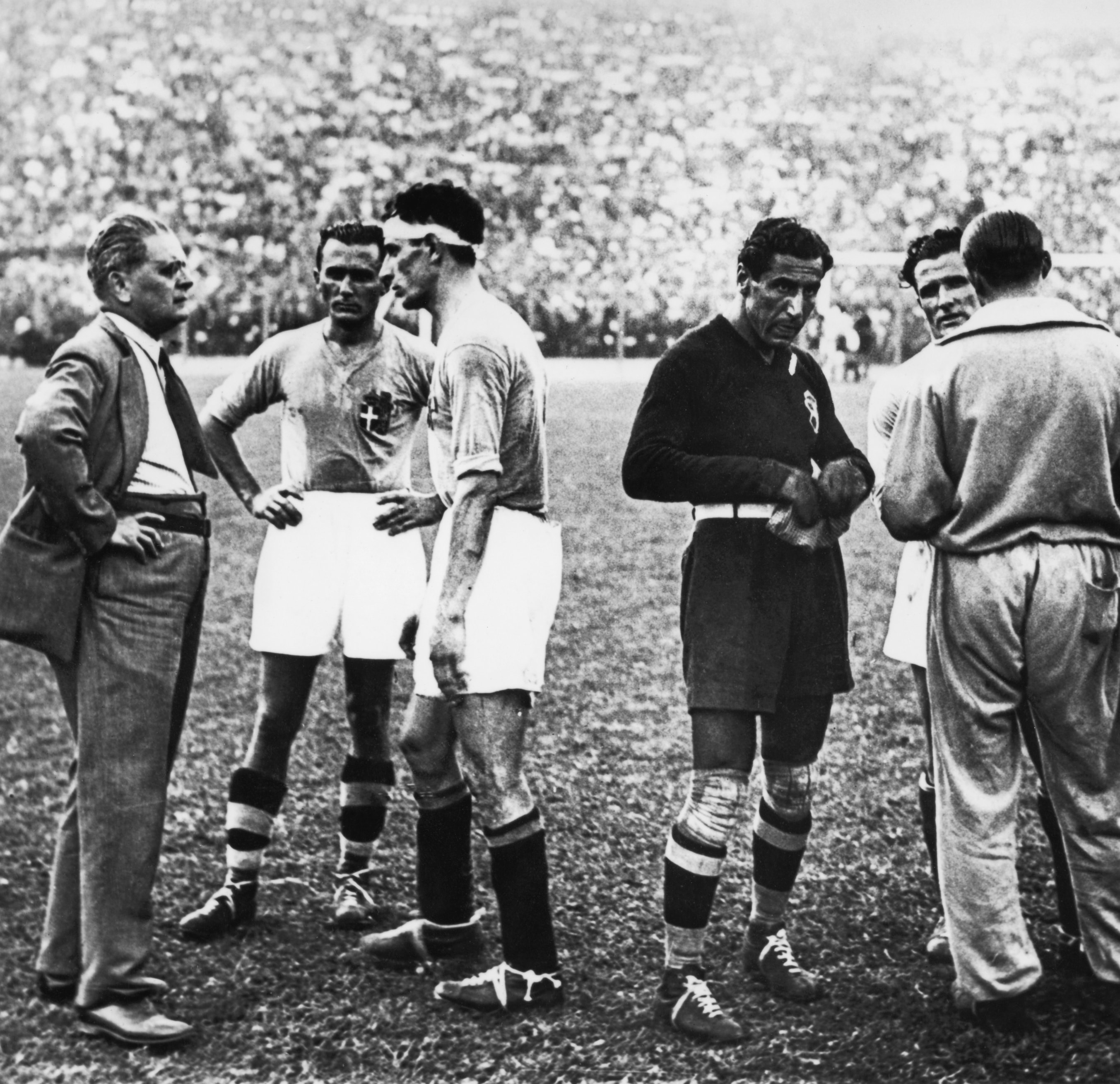
Pozzo engages in a team talk during the 1934 final against Czechoslovakia. Getty
Pozzo, handed the reins of the Italy team, set off a revolution by introducing his Metodo tactical formation, and going on to win the 1934 and 1938 World Cups.
Until Pozzo’s innovation, the British Isles led the way in the department with the WM, called Sistema in Italian, formation that came into prominence and was widely adopted by other national teams as well as clubs. In England, the Sistema formation was popularised by Arsenal manager Herbert Chapman. It was 3-2-5, 3-4-3, or precisely 3-2-2-3 (reflecting the letters WM). It became popular when the 1925 off-side rule change reduced defensive players needed between the leading attacker and the goalline to two from three. The gap in the centre of the formation between the two wing halves and two inside forwards allowed teams to counter-attack.
The pyramid of Cambridge (2-3-5) was the other popular formation--it had five forwards, three midfielders and two full-backs.
Pozzo and his friend Hugo Meisl, who was the Austria manager for 25 years, are credited with developing the Metodo system. The key to the formation was playing two defenders as full-backs with a player in a central position in front of them, between the two half-backs, He functioned as a central or defensive midfielder, “centromediano metodista” in Italian. This centre half-back also turned into the “regista” (deep-lying playmaker). This formation was particularly useful to technical teams that focused on a slow build-up, unlike the English Sistema style that advocated a robust, fast-playing approach.
Pozzo was also the pioneer in holding training camps before tournaments. The all-time great manager’s consecutive titles have been matched only by Brazil’s victory in 1958 and 1962. He remained the only manager to win back-to-back World Cups until US women’s team coach Jill Ellis emulated him with victory in 2019.
Born in 1886, Pozzo played football in France, Switzerland and Italy and studied in Manchester, where he also learnt the finer points of the game. His coaching career was incident-filled -- he managed Italy from 1929 to 1948, besides coaching the side on three previous occasions. At the 1938 World Cup in France, the Italy players on the field made the Roman salute--the symbol of the fascist government--before the first game against Norway in Marseille. Italians who had fled the fascist regime and opposed Italy’s participation in the tournament, were at the stadium. As they booed the gesture, Pozzo, who was also lined up with the players, asked them to perform the salute again. It was hugely controversial, and stamped Pozzo as a fascist, although in later years he was considered only a reluctant fascist. Pozzo defended his action as lifting the morale of the players who were being booed by their own compatriots.
He won a bigger psychological battle in the semi-final victory over Brazil. Ahead of the match at Marseilles, Pozzo found that Brazil, certain of beating Italy, had booked the only plane available the day after the match for the final in Paris. He went to the Brazilians on the French Riviera and asked them to hand over the bookings if his team won. The Brazilians didn’t just dismiss the request, they even offered Pozzo a ride to Paris to watch their team play in the final. The manager went back and told his players, who were extra motivated, and won 2-1. Brazil still didn’t give up the tickets, but Italy took the train to Paris where they beat Hungary 4-2 in the final.
Pozzo, who also was a founder of Torino FC, later became a journalist again with La Stampa. He died in 1968.
