
Maradona’s journey through four editions was an equal parts saga of sublimity and sin
As a boy wonder, Diego Maradona said on a television programme that he had “two dreams”. The first was to play in the World Cup. The other: win the eighth division league title and “whatever follows” with Argentinos Juniors. Maradona played in four editions of the World Cup, and left an everlasting imprint on all of them, changing them and football forever.
Maradona’s story began in Lanus, a shanty town south of Buenos Aires, but his sage wasn’t just Argentina’s to own. The world held its breath till he dribbled death in 2004. And mourned as one when he couldn’t, in 2020. So what if, by then, he was a hero who, in the words of Uruguayan writer Eduardo Galeano, became a “dirty God and sinner.”
A cruel initiation
Maradona was omitted from the squad which won the 1978 World Cup because coach Cesar Menotti felt the 17-year-old wouldn’t be able to handle the pressure of the tournament at home. Four years on in Spain, Maradona, already an icon in Argentina, got a chance to showcase himself in front of Europe. Just before the 1982 World Cup he was bought by Barcelona for a then record fee of $8m.
His indifferent World Cup debut in a loss to Belgium at his new home — Barcelona’s Camp Nou — was a premonition of what would be two torrid years in Spain. Argentina beat Hungary and El Salvador to advance to the second group league but exited after defeats to Italy and Brazil. “Stop Maradona and you stop Argentina”, a tactic shown by Belgium and perfected by Italy through Claudio Gentile — he committed 23 fouls on Maradona, 11 in the first half — became the leitmotif.
Maradona was hacked down every time he was about to get the ball. Years later, in a television interview, Gentile said: “It was to make sure he was so well marked that he couldn’t get the ball, because once he has possession that’s when he becomes a problem.”
FIFA then did not have rules in place to protect playmakers. It wasn’t till 1998 – the first World Cup without Maradona since 1982 – that tackles from behind became an offence in the laws of the game. In Argentina’s 3-1 loss to Brazil in 1982, Maradona was shown the red card for retaliation, a kick to Joao Batista’s midriff.
On top of the world
In 1984, after winning a Spanish Cup and a Spanish Super Cup, Maradona moved from Barcelona to Napoli for another record transfer fee of $13.2m. With him in the mix, the team that finished 11th among 16 in the Serie A, rose to 8th in 1984-85, and third the following season.
Maradona made his ambition of winning the league with Napoli clear, and their rise in ranks made Naples believe. He instilled hope in the poor alleys of the southern Italian city. Looked down by the elite northern clubs led by Juventus, Neapolitans sought something more than victory -- they sought salvation through him. The benevolent Maradona bestowed that bounty in 1987 when Napoli became the Serie A champions for the first time. It turned into a landmark year in Napoli’s history when they became the third Italian club ever to win the League and Cup double. In his six years at the club, Napoli won two Serie A titles, made two second-place finishes in the league and won an Italian Cup and the UEFA Cup.
Maradona was a superstar when he arrived in Mexico with Carlos Bilardo’s Argentina. It was also the first time India saw live coverage of the entire World Cup. No one, not even Pele, has had such an impact on one edition as Maradona did in 1986 on way to winning Argentina the title.
The two goals against England, the ridiculous and the sublime, sum up Maradona. In the time of VAR (Video Assistant Referee), it is inconceivable that the first would have stood. Four minutes later, Maradona scored what would later be called the goal of the century as genius was summed up in 11 touches that foxed five English players and floored goalkeeper Peter Shilton.
Of the first one Maradona later said: “It was scored a little bit with the head of Diego and a little with the hand of God.”
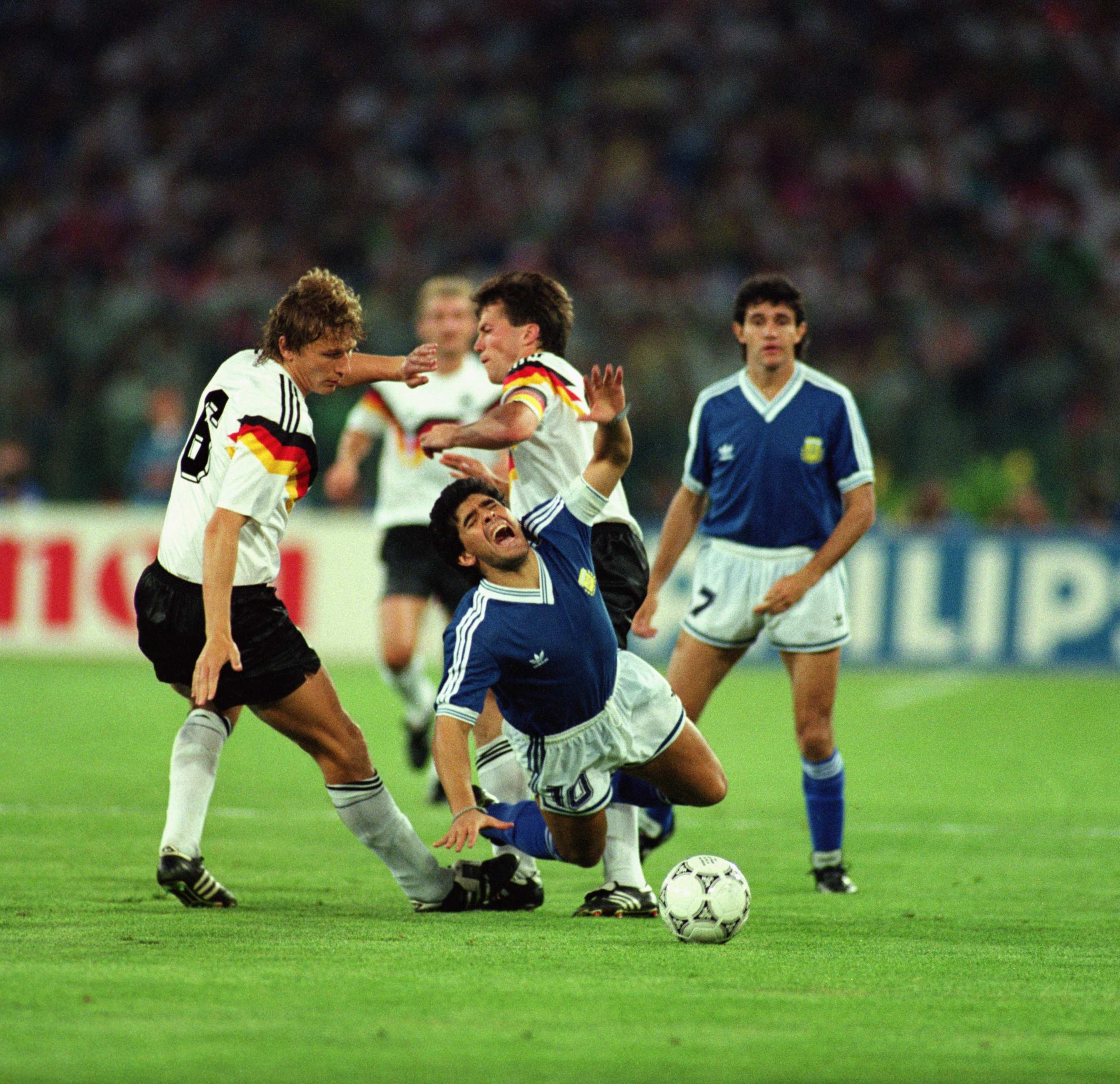
Argentina lost to West Germany in the 1990 final. Getty
And of the second, Uruguayan commentator Victor Hugo Morales said real-time on air (in Spanish): “…The cosmic kite, which planet did you come from?... Thank you God, for football, for Maradona, for these tears.”
Almost there, again
Before Italia ’90, Maradona said: “I don’t like the fact that now everybody is asking Neapolitans to be Italian and to support their national team. Naples has always been marginalised by the rest of Italy. It is a city that suffers the most unfair racism.” This triggered hostility towards the Argentina team. It was only at the Stadio San Paolo in Naples in their semi-final victory against Italy that the Argentine national anthem was not booed.
Argentina lost 1-0 to West Germany in the final, a complete turnaround for a team that began with a loss to Cameroon and progressed as the third team from the group. They beat Brazil through Maradona’s inch perfect assist to Claudio Caniggia. Goalkeeper Sergio Goycochea became the tiebreak hero over the next two knockout matches against Yugoslavia and Italy, where Maradona missed his penalty against the former and scored with a similar shot against the country of his club.
The fall
Things began to slide south soon after the 1990 World Cup. Maradona tested positive for cocaine in an Italian federation’s drug test and was banned for 15 months. He served the ban and signed for Sevilla in La Liga, where Maradona was reunited with his World Cup-winning manager, Bilardo. But at the end of the 1992-93 season, he returned home and signed for Newell’s Old Boys.
Between 1990 and 1994 football had seen a sea change. The Premier League started in England in 1992 with 22 teams and broadcasting rights sold for £304m. England though did not qualify for USA ‘94. Argentina did through play-off against Australia; Maradona being brought into the squad on public demand. His World Cup campaign though lasted just two games before he was banned again for failing a dope test, this time for ephedrine. “They cut off my legs and wouldn’t let me defend myself,” he said. “I didn’t use drugs, I don’t know what happened, I swear that I wasn’t doped but I see that they don’t care,” Maradona said ending his fight as a footballer.
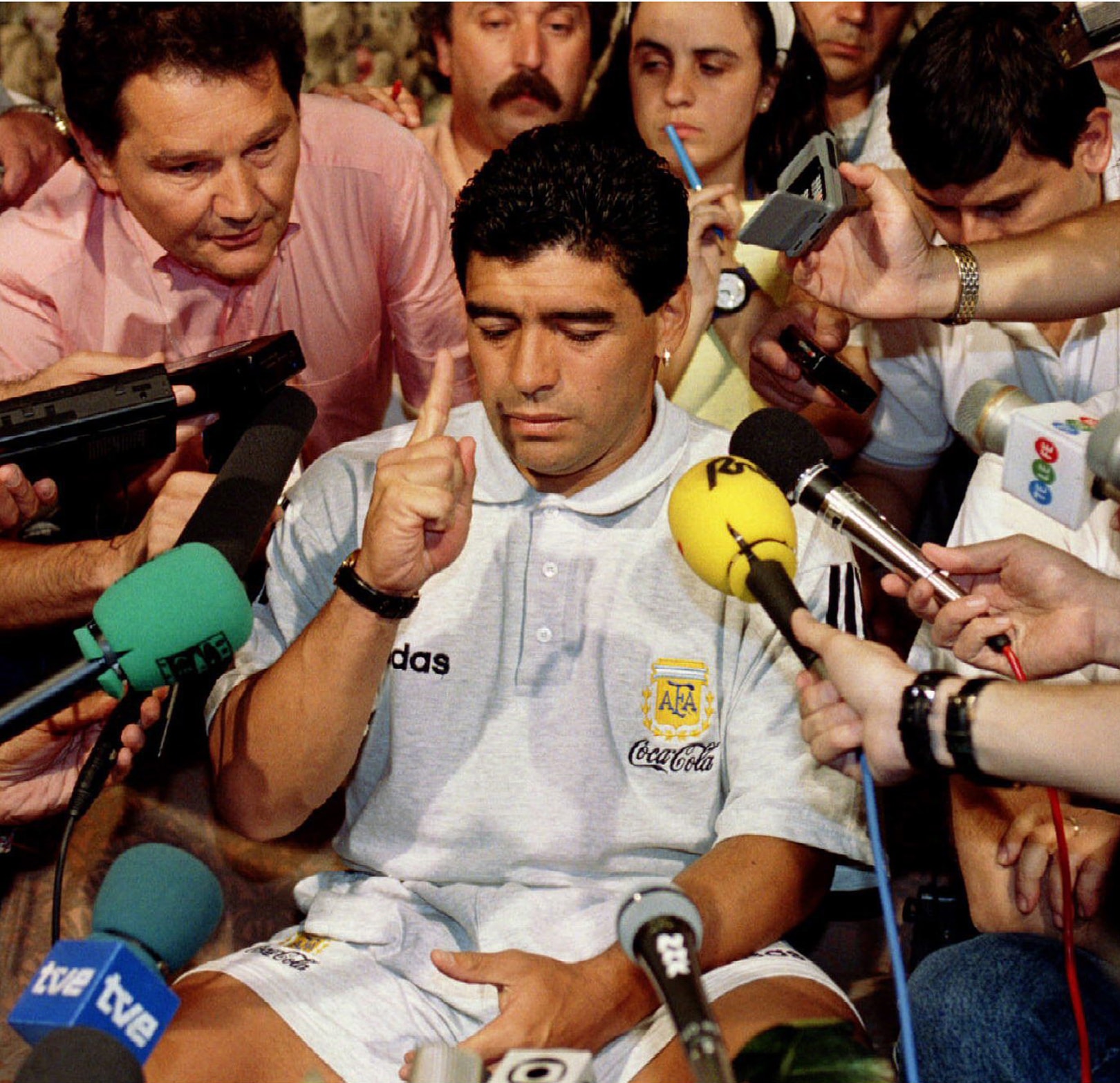
Maradona failed a dope test at the 1994 World Cup. Reuters
The legacy
It was a fight between life and death from there on, multiple health issues plaguing him. After cheating death in 2004, he came back to coach Argentina in the 2010 World Cup. But that one too ended in tears as Argentina bowed out losing 0-4 to Germany in the quarter-finals. But the legacy of the magnificent left foot lived on. Mourning Maradona’s death at the age of 60 in 2020, Lionel Messi said: “I can say without a doubt that if someone inspired me to become a footballer, it was him.”
The likes of Messi and Cristiano Ronaldo have someone like Maradona to thank as FIFA made tackles from behind an offence and instructed referees to protect footballers against dangerous play since the 1998 World Cup, four years after Maradona played his last. “I have him (Maradona) engrained in my head because of what he did at the 1986 World Cup. I was 14 years old,” said France playmaker Zinedine Zidane, who won the World Cup in 1998.
“The best of the lot, no question,” said Brazilian legend Zico, who played against Maradona in the 1982 World Cup. “In my generation, my era, he was simply the best. I saw Maradona do things that God himself would doubt were possible. He always had someone marking him, he always had someone hanging on to him, and yet he could still always conjure up wonderful pieces of magic. A genius.”
