
The FIFA World Cup’s long and illustrious history entails many fascinating moments. A look at some of the famous anecdotes from the fourth era…
A game of life and death
After an own goal in a 2-1 defeat to hosts USA in 1994 that had a huge bearing on Colombia exiting the World Cup, Andres Escobar penned a heartfelt column for Bogota’s El Tiempo newspaper. “Life doesn’t end here. We have to go on. Life cannot end here,” the 27-year-old wrote as his team was sent packing from the group stage. For Escobar it was but only a game. Not quite so for some others in a country seeped in violence and drug cartels. Out with his friends in Medellin days after returning from USA, a few men confronted Escobar in the parking lot of a nightclub. As the argument intensified, a man pulled out a 0.38 calibre pistol and shot the footballer six times, reportedly shouting “Gol” (“Goal”) after each shot. Rushed to the hospital, Escobar was declared dead soon after. The incident sent shockwaves through Colombia, with more than 1,20,000 people attending Escobar’s funeral. The culprit was later identified as a bodyguard of one of the cartel’s bosses. Humberto Castro Munoz was sentenced to 43 years in prison, but was released after 11 years on account of good behaviour.
Disgrace of Gijon
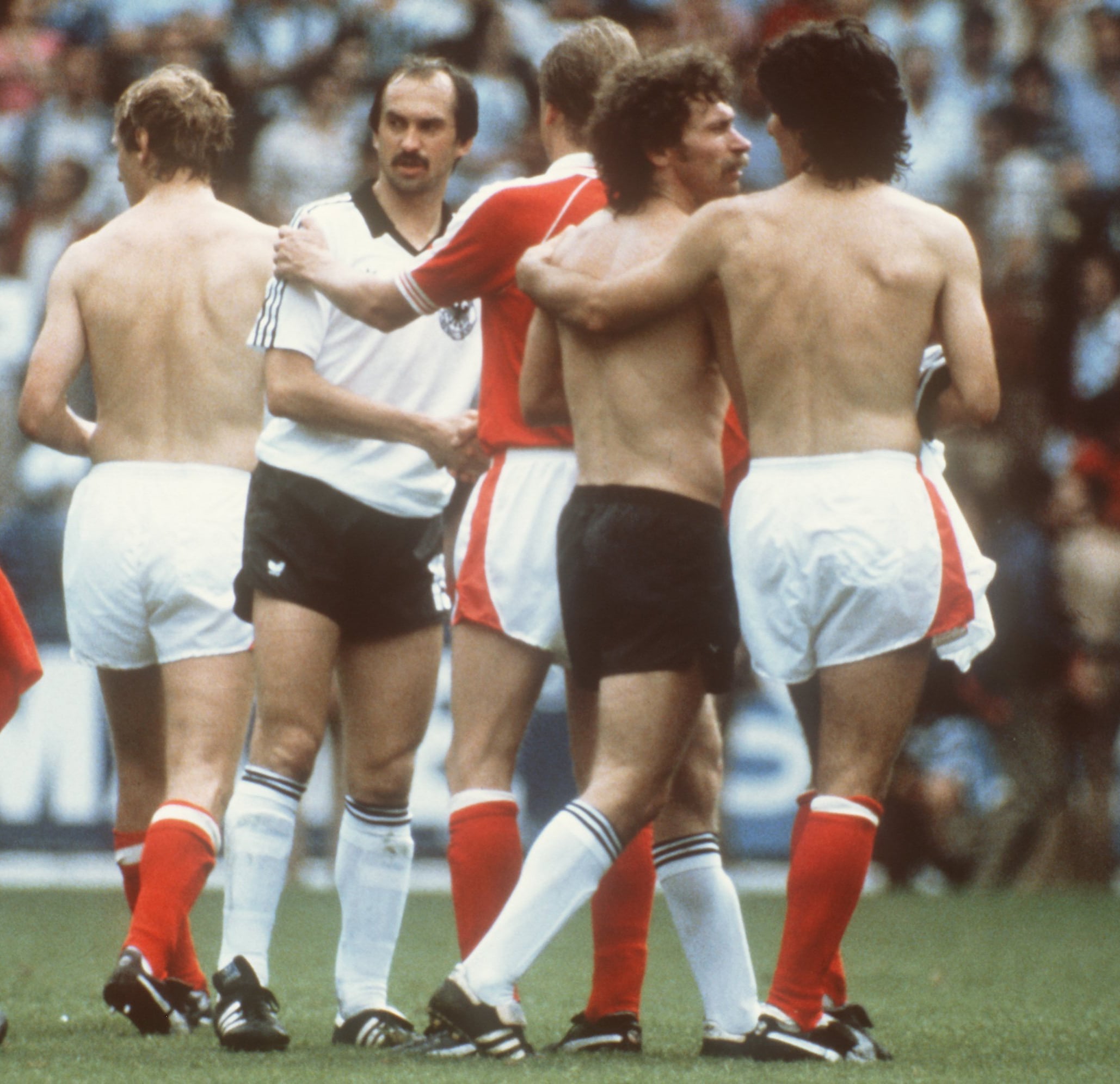
A still from the Germany vs Austria game in 1982. Getty
In one of the most shameful events in World Cup history, which later came to be referred to as the Nichtangriffspakt von Gijon (the non-aggression pact of Gijon), West Germany beat Austria 1-0 -- a result that ensured both teams advanced to the second-round group league at the expense of Algeria.
West Germany got in an early goal and neither team showed any sign of attacking further. Consequently, Algeria, who had beaten West Germany 2-1 in their opening match of the 1982 World Cup, were eliminated. Algeria had beaten Chile in the final group game one day before West Germany met Austria. That meant if West Germany beat Austria 1-0, both would progress. Algeria cried foul, but in vain. However, from the 1986 World Cup onwards and for all subsequent FIFA tournaments, the final round of group league matches are played simultaneously so as to prevent “fixing” as much as possible.
Goals at a premium
Italia ’90 was one of the most boring World Cups in the history of the competition. With an average of just 2.21 goals per game, the tournament till date remains the one which saw the fewest goals scored. Things hit a low in the 1992 European Championships and in a bid to get rid of the negative football, FIFA banned the back pass to the goalkeeper. So the mind-numbing sight of keepers rolling the ball out to defenders, receiving it back, picking it up and holding it in their hands to kill times was gone. It did not immediately improve the scoring rate from the next World Cup, but it forced a change in time-wasting tactics by teams.
The Scorpion who ventured out
Colombia’s 1990 World Cup team had stars — Carlos Valderrama, Faustino Asprilla, Andrés Escobar, Freddy Rincón and Leonel Álvarez — but none had captured the imagination of fans as much as their goalkeeper Rene Higuita. His unique look with mane-like hair and a deep moustache notwithstanding, he was known as a keeper who could score goals, help in attack and play as a sweeper. As Colombia coach Francisco Maturana put it, “We have something extra, very special, which makes the difference and raises the level of our team. It is called Rene Higuita... with Rene acting as a sweeper, we effectively have 11 outfield players.” During extra-time of their pre-quarterfinal match against Cameroon, Higuita made the blunder of his life. While dribbling the ball way outside the area, Cameroon’s 38-year-old star striker Roger Milla dispossessed Higuita and slotted home the winner. It made Cameroon the first African nation to enter a World Cup quarter-final. But strangely, Higuita was not seen as the villain. “It was a mistake as big as a house,” he confessed later but coach Maturana said anger was not an option: “Rene was expressing the Colombian soul.” Higuita was later immortalized by his “Scorpion” kick he displayed during a friendly against England at the Wembley Stadium in 1995.
Emeka: From Kolkata to World Cup
Since the start of the Indian Super League (ISL), it has seen many top players have come to India.
ISL brought in stars such as Alessandro del Piero, Diego Forlan, Helder Postiga, Roberto Carlos, and Marco Materazzi. But there was one whose journey as a player was in the opposite direction: Nigerian Emeka Ezeugo.
He made his club debut at East Bengal and then went on to represent his national team at the Olympics and the World Cup. The midfielder who later played for Mohammedan Sporting and Mohun Bagan, was with East Bengal in 1986-87. He represented Nigeria at the Seoul Olympics in 1988. He was part of the Nigeria squad at the 1994 World Cup in the USA and came on as a 77th minute substitute for Finidi George against Bulgaria.
Baggio’s costliest miss
Italy’s superstar forward Roberto Baggio missed the penalty kick in the 1994 World Cup final which led to a 3-2 victory for Brazil and their fourth title. Italy’s Franco Baresi and Daniele Massaro had missed their penalties in the shootout and if Baggio had scored, Brazil who had a shot left could still have won the World Cup. But Baggio turned an overnight villain. “I don’t want to brag but I’ve only ever missed a couple of penalties in my career. And they were because the goalkeeper saved them not because I shot wide,” Baggio wrote in his autobiography “A Door in the Sky”. “When I went up to the spot I was pretty lucid, as much as one can be in that kind of situation. I knew Taffarel (Brazil goalkeeper) always dived so I decided to shoot for the middle, about halfway up, so he couldn’t get it with his feet. It was an intelligent decision because Taffarel did go to his left, and he would never have got to the shot I planned. Unfortunately, and I don’t know how, the ball went up three metres and flew over the crossbar…”
