
From the ignominy of a fixing ban to becoming Italy’s saviour, three games that shook the World Cup
Six goals.
Six goals in his final three matches of a World Cup.
Six goals that made Italy champions in 1982 after 44 years, ousting arguably the best ever Brazilian team along the way.
Paolo Rossi scored those six goals: a hat-trick against Brazil in the last quarter-final league game, two against Poland in the semi-final, and the opening goal in Italy’s 3-1 victory over West Germany in the final.
Those six goals won Rossi the Golden Boot (highest scorer at a World Cup), the Golden Ball (the best player at a World Cup) and later the Ballon d’Or. Only five players in 21 World Cups till date have won both the Golden Ball and the Golden Boot in a single edition: Leonidas da Silva (Brazil) in 1938, Garrincha (Brazil) in 1962, Mario Kempes (Argentina) in 1978, and Salvatore Schillaci (Italy) in 1990 are the others.
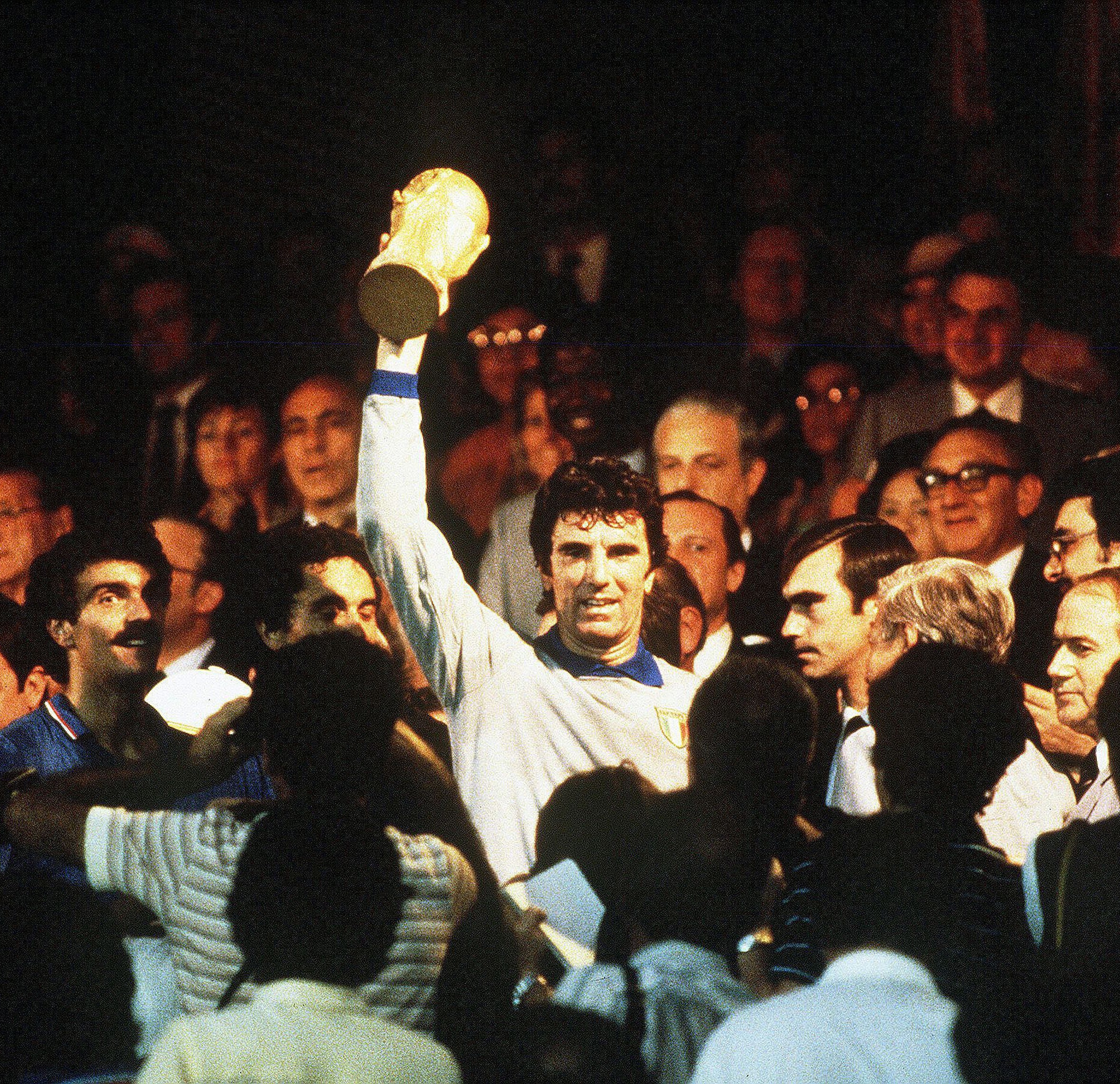
Italy’s Dino Zoff lifts the World Cup in 1982. Getty
Rossi wasn’t even supposed to play in Spain.
In 1980, he was sucked into one of football’s biggest match-fixing scandals, the Totonero. He was initially banned for three years but it was reduced to two following an appeal. Rossi’s ban ended barely two months before the World Cup and Italy coach Enzo Bearzot picked him in the squad right away ignoring criticism in the media that Rossi was out of match practice, unfit, frail and lacked muscles.
For the first four matches in Spain, Rossi was a ghost of the player who had scored 21 and 24 goals in successive seasons for Vicenza, and earned his place in the 1978 World Cup squad where he showed sublime poaching skills to score three goals as a 21-year-old as Italy finished fourth.
Mighty Brazil fall
Italy started the tournament shakily, scraping through the first group league phase without a win. In the second-round group league, they started with a win in which they out muscled defending champions Argentina. Brazil were next in a “playoff” for a semi-final. Critics called this Brazil team — featuring Zico, Socrates, Cerezo and Falcao — even better than Pele’s legendary 1970 squad. In one of the most entertaining and thrilling matches in World Cup history, Italy beat Brazil 3-2. Rossi, who barely touched the ball in the first four matches, scored all three.
“Everything suddenly changed,” Rossi told FIFA’s website. “Nothing was going my way and then suddenly everything was going my way. It was suddenly all so easy. Such is the beauty of sport. A goal can change everything. In my case it changed my entire life.”
The semi-final was a breeze past Poland featuring Grzegorz Lato, the Golden Boot winner of 1974. Rossi scored both goals in the 2-0 win. The final was against West Germany. Their goalkeeper Harald Schumacher had almost killed France’s Patrick Battiston with a knock in his face in the semi-final and did not even concede a free-kick for it. But when Rossi nodded in the first goal sneaking in behind the German defence, Schumacher barely moved. Marco Tardelli’s long-ranger sparked celebrations like never seen before and Alessandro Altobelli completed the tally following a solo run by Bruno Conti down the right. Paul Breitner’s goal was too little too late.
Vindication
Bearzot redeemed himself in the eyes of the Italian media as his faith in Rossi paid off, as did Italy’s adventurous brand of football far removed from their stolid defensive approach. Captain Dino Zoff, at 40 became the oldest player to win a World Cup. After being partially blamed for Italy’s loss to Holland in 1978, his redemption came through his sublime performances against Brazil and West Germany.
Serie A too redeemed itself as it quickly became the biggest league in Europe. Brazil’s Falcao was already part of Roma. Michel Platini joined Juventus in 1982. Zbigniew Boniek and Zico joined Udinese in 1983. Socrates was part of the Fiorentina squad for two seasons from 1984 and Diego Maradona joined Napoli in 1984. Finally, Ruud Gullit, Marco Van Basten and Frank Rijkaard joined AC Milan in 1987.
Those six goals changed everything.
