
He came as a talented teen and left the World Cup shining like a diamond
Pele’s legacy goes beyond what he achieved on the pitch for Brazil. For a country that was growing, he was a binding force, one who gave them hope and confidence. So wobbly did they feel without him that in 1961 the Brazilian government declared him the “official national treasure” to prevent him from being signed by top European clubs. In Pele, a biopic on Netflix, former president Fernando Henrique Cardoso describes him as one who “rose to fame at the moment of Brazil’s birth as a modern country”.
That the boy from Três Corações became the emblem of Brazil’s newfound confidence was possible because of his spectacular entrance in the 1958 World Cup as a 17-year-old. Pele didn’t feature in first two games with reports suggesting coach Vicente Feola thought he wasn’t disciplined enough but under player pressure, he was introduced in the third game against USSR. He fitted immediately into Brazil’s 4-2-4 system.
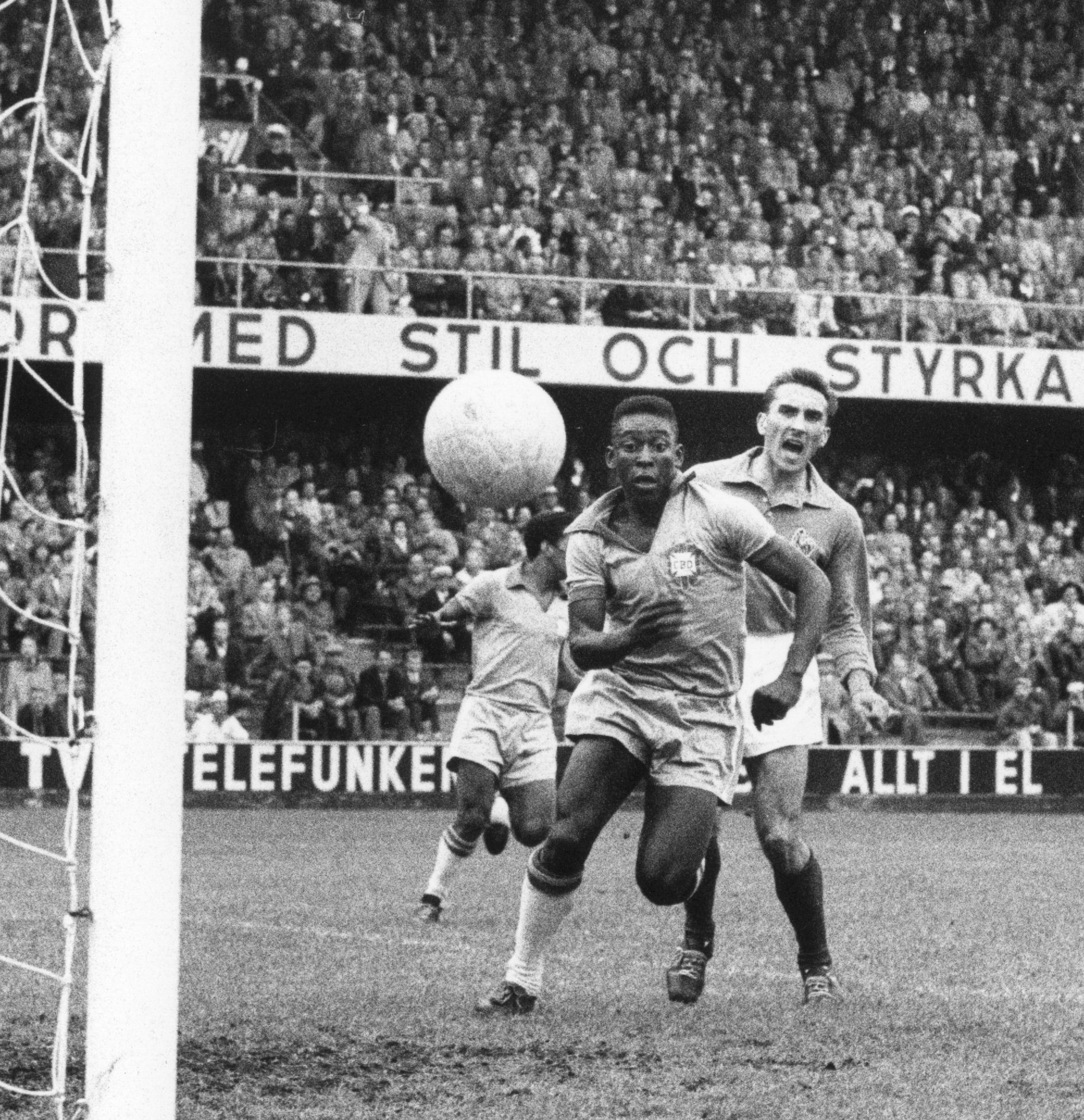
Pele in action against France during the 1958 World Cup. Getty Images
Soon, fans went crazy over his speed, nutmegs, footwork and the emphatic finishes. He became the youngest scorer in the World Cup when he netted the winner against Wales in the quarter-final. In the semi-final against France, who had tournament’s top-scorer Just Fontaine in their ranks, he netted a stunning hattrick to guide Brazil to a 5-2 win.
Then, Pele was the name on everybody’s lips and his crowning glory came when he scored twice in the 5-2 win over hosts Sweden in the final helping Brazil overcome the disappointments of 1950 and 1954.
Pele continued to rule the hearts of the fans the world over—whether it was the 1962 edition in Chile or in England four years later—but on the personal front,
both ended in disappointments. Brazil won the 1962 edition but Pele could feature in just one match before injury ruled him out of the tournament.
'Shameful failure'
The 1966 edition was the worst. Brazil were knocked out in the group stage and Pele left battered and bruised.
So frustrated he was by the tactics employed against him that he vowed to never play World Cup again. He also wasn't happy with team’s preparation in lead-up.
“It was a total, shameful failure. Everyone thought we'd win with ease. But our preparations were not planned with the same humility as in 1958 or 1962. We were already starting to lose the title before we even set foot in England,” he later described it in his autobiography. Time healed his hurt, literally and otherwise. As the 1970 edition inched closer, Pele decided to return to play for Brazil. In 1970, first steps were taken to clampdown on foul play with the introduction of cards.
It was the first time the world got the glimpse of Pele as the tournament was televised live. The stage was set for him and he didn’t disappoint. While he was a raw talent in Sweden, in Mexico he shone like a polished diamond.
Brazil won all their group matches beating Czechoslovakia, defending champions England and Romania. In quarter-final, they saw-off Peru before avenging the defeat of the final game in 1950 by toppling Uruguary 3-1 in the semi-final and then storming past Italy 4-1 in the final. With the help of youngsters like Jairzinho, Rivellino and Tostao, who needed two eye surgeries in USA to repair a detached retina after being hit by a ball, around him and with coach Mario Zagallo, a former teammate, Pele helped Brazil clinched their third World Cup in four editions and sealed his status as the Greatest Of All Time.
