
West Germany and Argentina emerged champions in the era football and commerce raised a toast to each other
“Your rival is running very strongly, he’s everywhere, there doesn’t seem to be much aggression or lobbying on your side,” the reporter Morley Myers told Stanley Rous. “How do you feel about this?” Myers then asked the FIFA president. “I let my record speak for itself,” Rous replied. This exchange took place on June 10, 1974, one day before 122 member associations elected the president of football’s apex body.
We know what happened next. Rous, then 79, lost 68-52 to Joao Havelange, 20 years younger, after two rounds of voting. A former referee was pensioned off by a polyglot and a businessman. And football changed. Or rather, the world of sport changed. “Nineteen Seventy Four was the watershed year,” Andrew Jennings wrote in Foul!The Secret World Of FIFA: Bribes, Vote Rigging And Ticket Scandals.
Enter Havelange
Havelange won with support from Africa, which sought more than the solitary World Cup slot they got under Rous, and that happened with help from Horst Dassler, whose family owned Adidas. The Dasslers had a long connection with sport — Horst’s father Adolf had prepared special boots for Germany captain Fritz Walter in 1954 — but this was at a different level altogether.
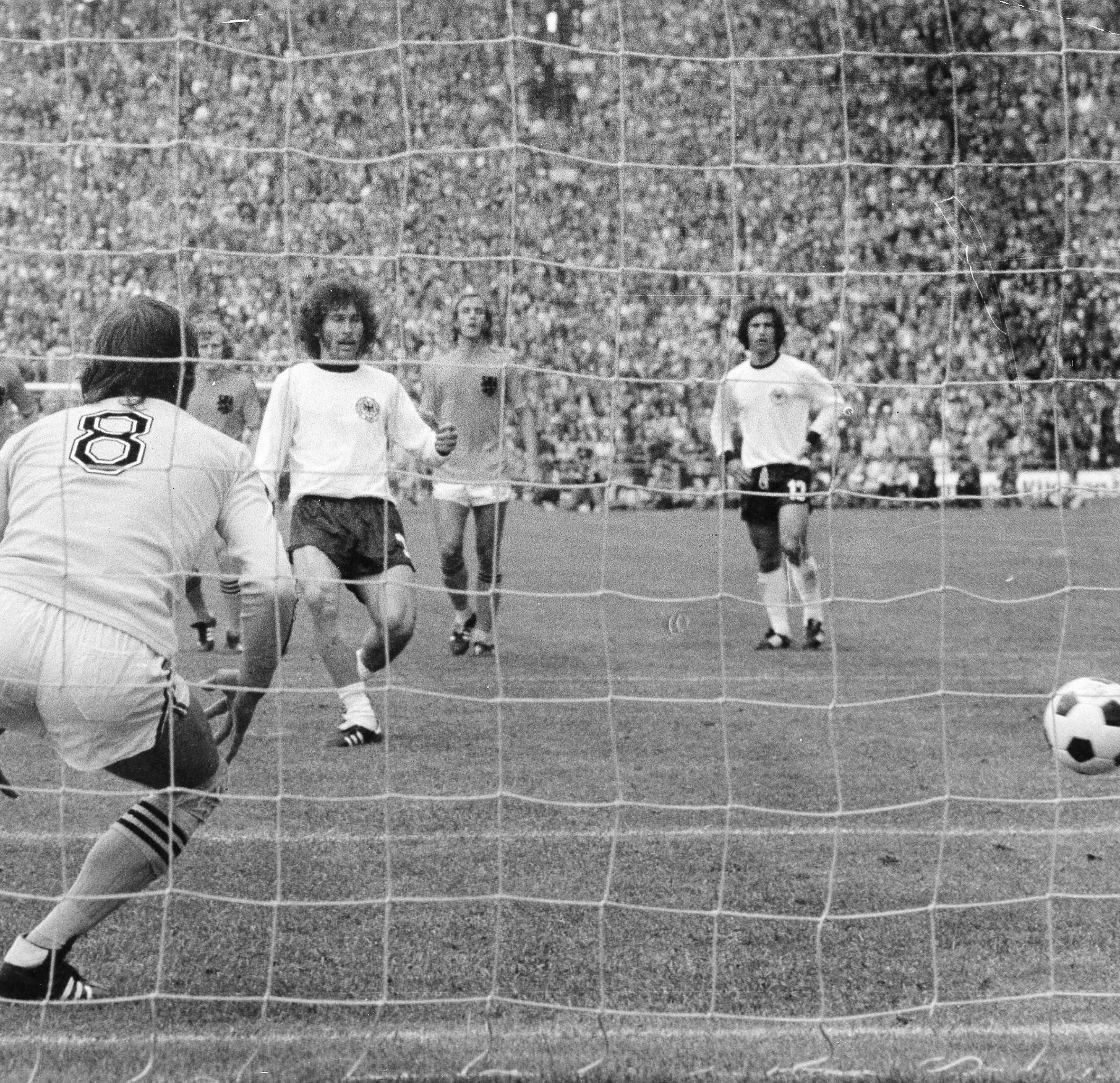
Germany's Paul Breitner scores in the 1974 final. Getty
Jennings’s book, where the conversation between Myers and Rous was chronicled, talks about marketers growing sport with Dassler being the “puppet master”. Commercial deals with Coca-Cola and Adidas (they remain FIFA’s World Cup partners till date), and McDonald’s were signed as global giants vied to be associated with the World Cup, a property Havlange and Horst Dassler thought had been terribly undersold.
This wasn’t how Rous saw things. He was unhappy about “commercialising the game,” Myers says in Foul!. A man of somewhat saturnine manner, Rous was okay with South Africa’s segregation laws thinking, according to Jennings’s book, that it was not for FIFA to interfere in matters of a country’s governance. And he was alright with nine berths for Europe, four for South America, and three for the rest of the world.
Two days after the elections, the 1974 World Cup began in West Germany. It was the first in five editions without football’s first global superstar, Pele. It was also the first without quarter-finals and semi-finals. Sixteen teams were divided into four groups, and the top two from each were then split into two pools of four with the winners of each playing the final. Holland and West Germany made it to the summit showdown.
While Holland had struggled to qualify, their players agitating for more money, West Germany didn’t have the best of starts labouring past Chile through a goal from Paul Breitner, who is one of the four players to have scored in two World Cup finals (Vava, Pele and Zinedine Zidane are the others). They beat Australia 3-0, but fluffing a host of chances lost 1-0 to East Germany through Juergen Sparwasser’s late goal in a match that was played under heavy security. Like Holland, the Germans had demanded more money from the federation for playing the World Cup and, like Holland again, the players were told to pipe down or else a reserves team would be fielded.
If after all this that they lost to East Germany, the situation was bound to leave the public bitter. Reports began to emerge that manager Helmut Schoen had little or no control, and that it was captain Franz Beckenbauer who was running the show. As it turned out, however, the defeat to East Germany meant the hosts were in the easier group -- one that didn’t have Brazil and Argentina, or Holland who had left their problems behind and were playing spectacular football.
Beckenbauer finds form
It was in the second phase that West Germany hit form, beating Yugoslavia 2-0 with Beckenbauer magnificent in his forays upfield from a defensive position. Beckenbauer was inspired by Italian full back Giacinto Facchetti springing into attack, and got Bayern Munich and then the national team to let him do it. With Poland having had a good tournament — Gregorz Lato won the Golden Boot with seven goals and, was helped by attacking players Kazimierz Deyna and Robert Gadocha — their match against West Germany was the contest that decided which team would make the final from the group. With a typically opportunistic finish, Gerd Mueller ensured it would be the hosts.
No World Cup final has had this dramatic a start than the one in 1974, with Holland converting an early penalty. But while they dominated, Holland didn’t threaten West Germany after that, and the equaliser came from another penalty, converted by Breitner. Berti Vogts managed to keep Johan Cruyff quiet — some task that— and through Uli Hoennes, Wolfgang Overath, Bernd Holzenbein, Juergen Grabowski and Rainer Bonhof, West Germany began asserting themselves. After Beckenbauer had a cheeky lob palmed over, Mueller scored his last goal for Germany, ending his international career in style with a staggering 68 goals in 62 games.
That is how the scoreline stayed though it could have been different had Jonny Rep managed to beat Sepp Maier in goal after Cruyff had drawn Beckenbauer towards him and released his team mate. It remains the costliest miss in Holland’s World Cup history.

Argentina manager Cesar Luis Menotti before the 1978 final. Getty
Holland would play another final four years later, and again lose to the home team (Argentina) -- this time without Cruyff. If 1974 was the year football took the first steps to becoming the billion-dollar behemoth it is now, the 1978 edition was possibly the first since Benito Mussolini’s time that the World Cup was used for what was later termed as “sportwashing”.
In power since 1976, the junta led by General Jorge Videla of Argentina had ruthlessly suppressed dissent with thousands killed or disappeared. There were reports of torture chambers, some clandestine, some not so. For the military dictatorship, therefore, the World Cup was about making a good case for themselves to the world and to their people. Since no one protested strongly, the junta had its way. All games though had goal frames with black bands near the bottom -- the ground staff’s way of conveying a political message to the world.
What Menotti said
Things were so bad that Argentina manager Cesar Luis Menotti had to tell his players that they were trying to win the World Cup not for the rulers but for the common people who filled the seats. Win they did, riding on the brilliance of Mario Kempes whose left foot complemented the skills of fellow forward Leopold Luque, whose preferred weapon was the right foot. But it was not without controversies.
There were refereeing decisions that favoured Argentina — a penalty awarded to them and one denied to France in the same game. And there was more -- Argentina refusing to heed Brazil’s request that the last set of games be played together; and the hosts taking the field five minutes after scheduled kickoff in the final.
Then Juventus manager Giovanni Trapattoni said Argentina wouldn’t have won had the competition been held elsewhere. The Dutch, for their part, were angered further when Argentina complained about the bandage of Rene van der Kerkhof’s arm in the final. Though he had worn that in other games too, Italian referee Sergio Gonella agreed with Argentina. Holland lost their poise, committing a string of fouls, and in a match that had a spurt of late goals, Argentina won their first World Cup title — one whose legitimacy would be cemented eight years later by Diego Armando Maradona in neighbouring Mexico.
