
He was the heart of the Holland team that did everything but win the 1974 World Cup
Johan Cruyff controls the ball with his left foot, drags it with his right and turns towards his goal. Freeze the next frame and you would think he is teeing a pass with his right foot. Jan Olsson thinks so too and tilts left. But Cruyff uses the instep of his right foot to push the ball back, turns and scooters to audible gasps from a Dortmund stadium that couldn’t believe what it had seen in the 23rd minute of the Holland-Sweden game.
It ended 0-0 but that moment encapsulated everything enchanting about Holland and their driving force in the 1974 finals. “I do not understand how he did it,” Olsson told The Guardian the day Cruyff died in 2016. The full back’s career lasted 18 years, but it was for his part in one of football’s most iconic moments that Olsson is most remembered.
“Now when I see the video, every time I think I have got the ball. When he is about to kick the ball, I am sure I am going to take it, but every time he surprises me. I loved everything about this moment,” Olsson said in that interview.
Relaxed and confident
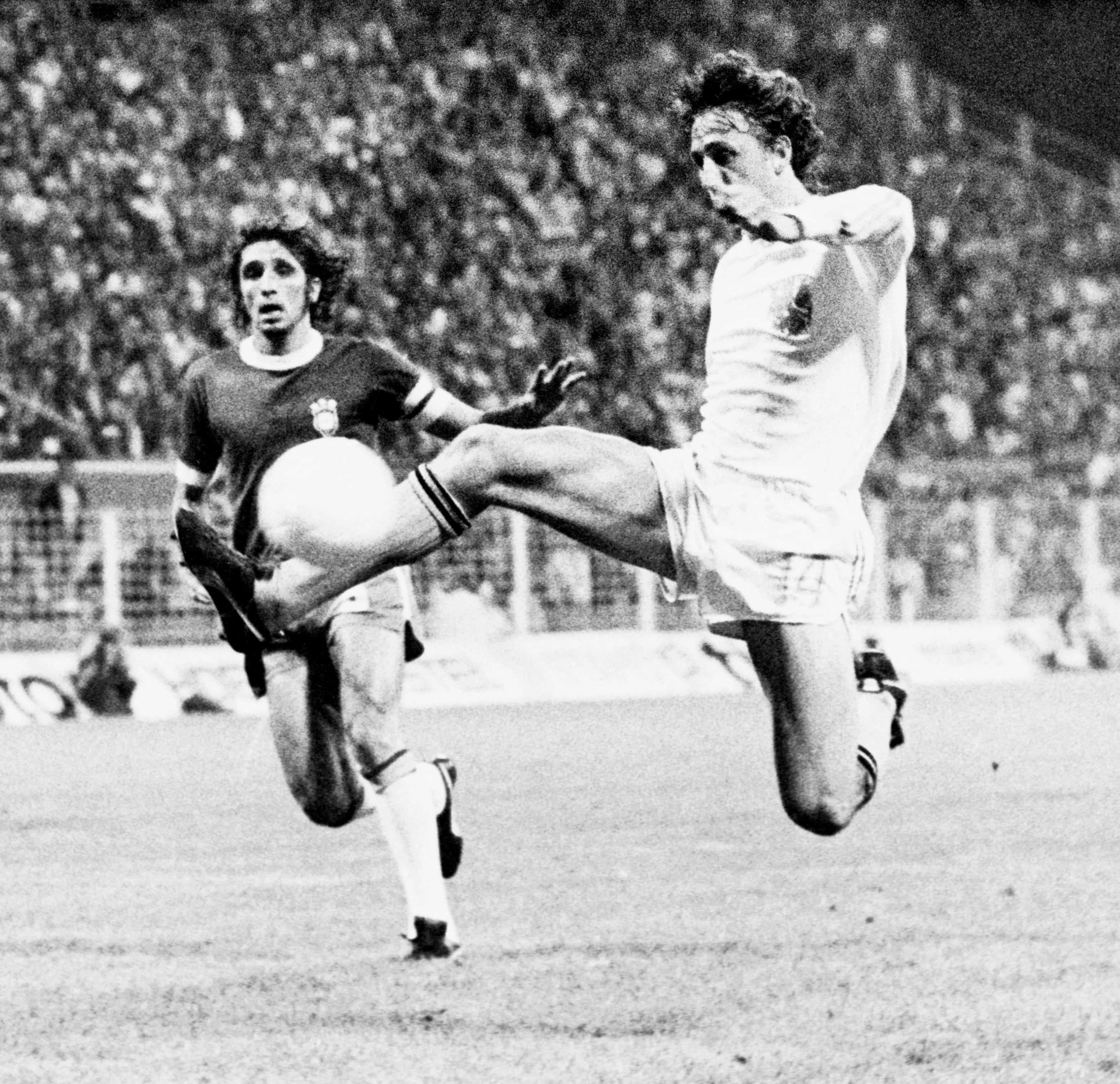
Cruyff volleys home his team's second goal against Brazil in '74 World Cup. Getty
With wives and girlfriends allowed at the training centre, Holland’s long-haired footballers looked like a group that was relaxed and confident in equal measure. “Go out there and enjoy,” Cruyff would say— a quote engraved in his statue at FC Barcelona. Holland looked determined to do just that.
They saw off Uruguay easily and after the draw against Sweden, Cruyff turned on the magic in the 4-1 win against Bulgaria. He won an early penalty and provided the final pass for the second goal.
Grouped with Argentina and Brazil, Holland swatted aside both in the second phase on way to the final. Cruyff rounded Argentina goalie Daniel Carnevali to open the scoring. After the interval, Cruyff shifted left and produced a delivery for Johnny Rep to head home. Then, Cruyff scored with an on-the-run volley. Carnevali raising arms in frustration showed how helpless he and the team were that night.
Defending champions Brazil had come not just without Pele but also Tostao, Gerson and Clodoaldo who had played their part in the dream run of 1970. So they swapped the beautiful game for the brutal. Cruyff was the centre of their attention but still managed to provide the assist for Johan Neeskens to fetch up at the right time and stab home. The insurance goal came from a Cruyff volley.
Holland were in the final and again it was Cruyff who set up the first goal, before most West Germans had touched the ball. His acceleration— the important thing, Cruyff would say, was to decide when to run and when to do nothing — caught Berti Vogts by surprise and forced Uli Hoeness to bring him down. Penalty. Neeskens put Holland ahead. Five minutes into the final, Holland may have felt they had a hand on the trophy. It was not to be and the man for whom football was essentially a creative, cerebral exercise joined Ferenc Puskas and Zico and Socrates as the best to have never won a World Cup.
Balletic grace
Lean, lithe and lethal, Cruyff had strong legs that helped him overcome crunching tackles. He was fast and he could dribble. Knowing he could find one role restrictive Holland manager Rinus Michels gave Cruyff the freedom to do his thing. Cruyff glided over the pitch, moving into areas that would catch rivals by surprise and do it with such balletic grace that football writers of the time would compare him with Rudolph Nureyev.
“Playing football is very simple but playing simple football is the hardest thing there is,” is a Cruyff aphorism. Yet, along with Neeskens, Ruud Krol, Jonny Rep, Arie Haan, Rob Rensenbrink, Cruyff would do just that in an ‘Oranje’ team where players seamlessly switched positions. It was the development of an idea birthed at Ajax, with whom Cruyff and Michels had a deep connection, where cadets were made to play in a number of positions to help them understand the game better.
Three Ballon d’Or trophies, three successive European Cups with Ajax, league and cup wins in Holland and Spain and a glittering coaching career where he gave Barcelona an identity they still cherish meant there was so much more than the solitary pursuit of a World Cup which eluded him. “There may be no one who influenced football like he did,” his son Jordi has said in an interview to The Guardian in August 2019.
