
Even in a time of titles such as Mardon Wali Baat, the exceptions were outstanding. Chief among these: Jaane Bhi Do Yaaro (1983), a madcap satire of cake-throwing, disrobing and a corpse on roller skates that was also, somehow, a classic.
“Jaane Bhi Do Yaaro just happened somehow,” the late Kundan Shah said to me once. He looked distracted, as if he still couldn’t understand why this small, madcap satire that he put together with a group of friends – almost in the spirit of a student film – became a canonised cult classic. “We didn’t make it with the idea that anyone would ever watch it.”
We did watch it, though, over and over until the 1983 film became one of the most-quoted Hindi films of its time (think of “Thoda khao thoda phenko”; “Gutter ka paani alag, peene ka paani alag” and “Maine vastra-haran ka idea drop kar diya”).
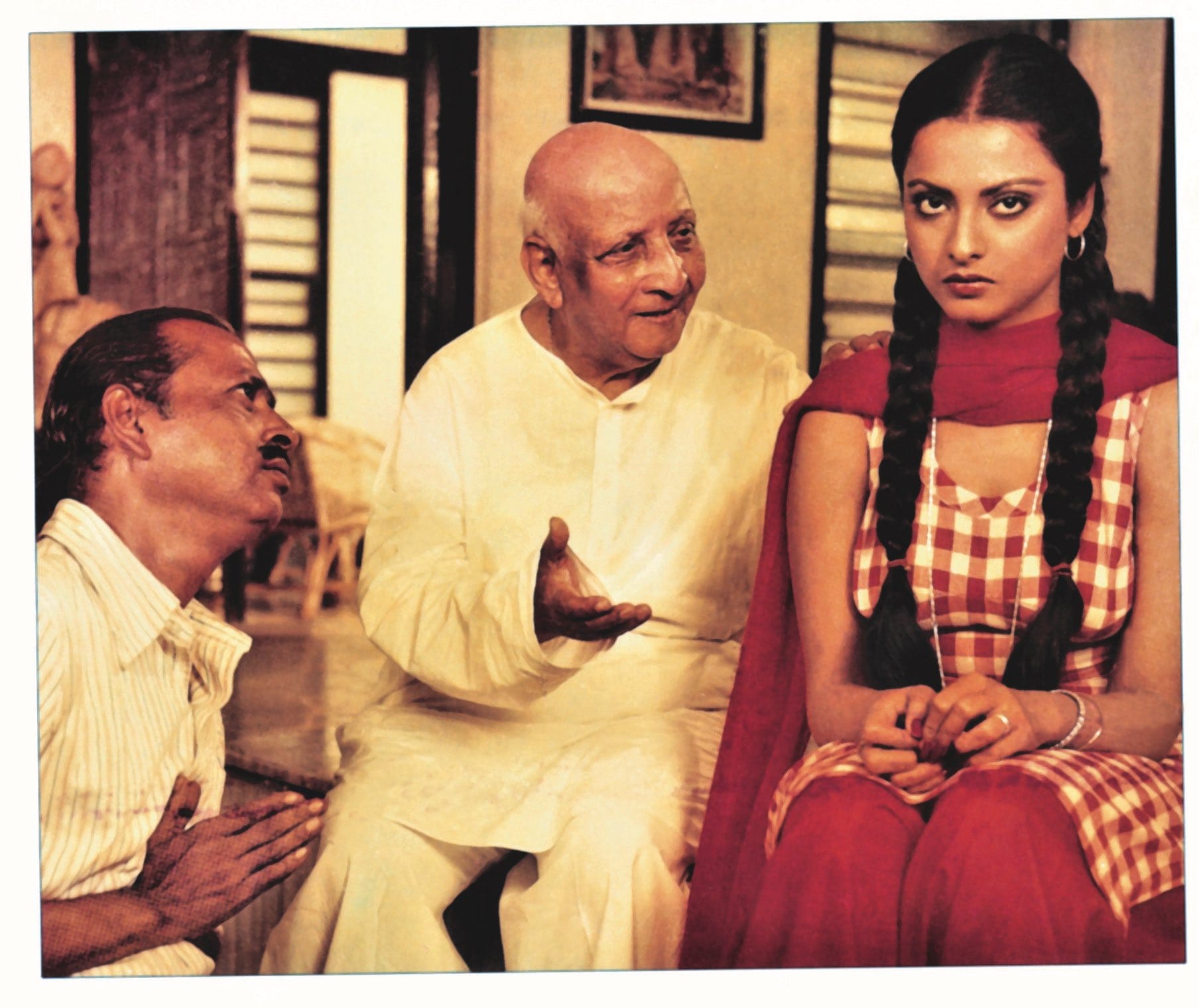
In Hrishikesh Mukherjee’s comedy-drama Khubsoorat (1980), Rekha plays a disruptive visitor who upends a strictly run household.
For those of us who first saw it as children on TV, the most astonishing thing about JBDY was that it was full of “serious” actors (Naseeruddin Shah, Om Puri, Pankaj Kapoor) and yet it was wacky and frenetic and more outrageous than anything in the mainstream: a corpse on roller skates, slices of cake being tossed about, the Pandavas trying to disrobe Draupadi. It wasn’t until years later that one grasped the acerbic social commentary beneath the zany surface.
In some ways, the hard-to-categorise nature of JBDY makes it representative of the most enduring Hindi cinema of that period. When we think back on the late-1970s and the ’80s, we speak in binaries: “mainstream vs parallel”, “commercial vs art”. There is something to this categorising, with the escapism of a Manmohan Desai movie at one end of the spectrum and the grittiness of a Govind Nihalani film at the other, but many notable films occupy an unclassifiable middle ground between those modes.
“Unclassifiable” because the official Middle Cinema was still around, as were its directors who had begun their careers a decade or two earlier. This period saw Hrishikesh Mukherjee’s Gol Maal, Khubsoorat, and one of my favourites, the underappreciated failing-marriage comedy Rang Birangi; Basu Chatterjee’s Khatta Meetha and Chameli ki Shaadi; Gulzar’s Angoor and Ijaazat. Add to this the work of Sai Paranjpye – evergreen, feel-good films like Chashme Baddoor, about a diligent young man and his roguish pals; and Katha, which transposes the hare-vs-tortoise fable to a Bombay chawl.
But equally notable were some films that are hard to label. Saeed Mirza, one of Kundan Shah’s close friends, made Mohan Joshi Hazir Ho, which again combined slapstick comedy with social commentary, through the story of an elderly man who tries to fight injustice.
There was the work of Pankuj Parashar, which included some droll films that are still under-watched – the Farooque Shaikh-starrers Ab Aayega Mazaa and Peecha Karo, and better-known works such as Jalwa (a Beverly Hills Cop remake with Naseeruddin Shah as a muscular action hero!) and Chaalbaaz, which used mainstream stars (Sridevi, Rajinikanth, Sunny Deol) and a familiar Seeta aur Geeta-inspired story but was full of off-kilter moments where it seemed to be winking at the audience and saying, let’s not take all this too seriously.
In some obvious ways, the ’80s weren’t quality years for commercial cinema. Even as a boy who loved the dishoom-dishoom and the testosterone-fuelled posters with three glowering heroes, and waited breathlessly for the Friday release of titles such as Jaan Hatheli Pe and Mardon Wali Baat, on some level I knew this wasn’t “good cinema”. In earlier eras, the 1950s for instance, Indian films had been in conversation with movements around the world, being influenced in form and content by Hollywood while also trying to emulate the socialist cinemas.
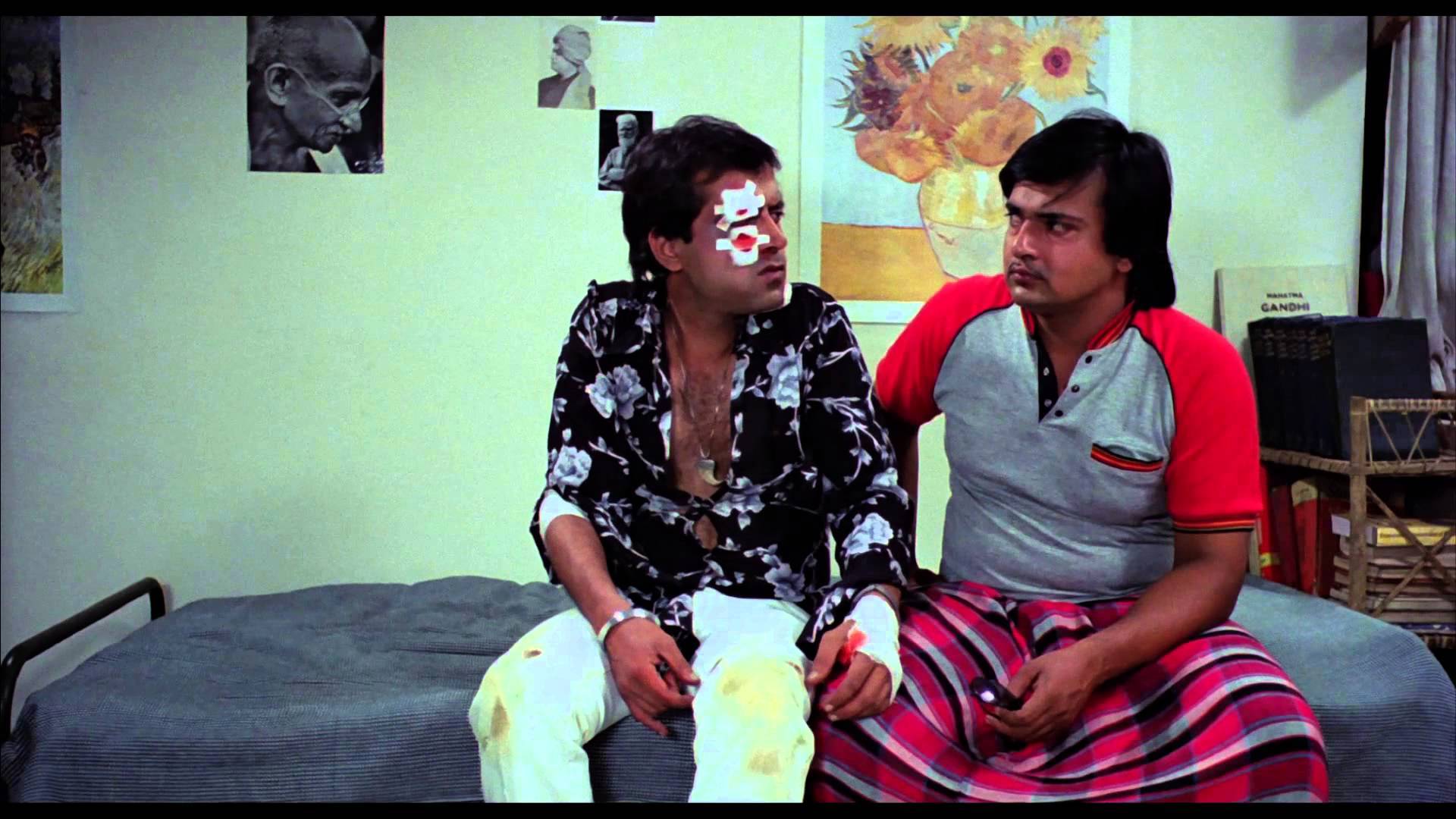
Sai Paranjpye had a range of evergreen, feel-good films in this period, including the buddy-romcom Chashme Baddoor (1981), about a diligent young man in love, and his roguish pals.
But in the ’80s, most mainstream Hindi films were cut off from the outside world, in a vacuum, regurgitating old formulas and archetypes. In the years leading up to liberalisation, culturally and otherwise, there was a sense that the film industry didn’t know what it was trying to be.
But the exceptions to this rule were outstanding, even in the mainstream. The films of JP Dutta (Ghulami, Hathyar) and Rahul Rawail (Arjun, Dacait) were stylish and visually inventive. There were the breezier Amitabh Bachchan-starrers that defied the Angry Young Man formulas. Light comedies such as Do Aur Do Paanch (in which Bachchan and Shashi Kapoor try to out-prank each other) and the rambunctious Satte Pe Satta (inspired by Seven Brides for Seven Brothers) hold up better today, for me, than his more conventional action films.
There was the young Govinda’s disruptive presence. And there were the films with the gloriously inventive villains’ dens, from blockbusters like Shaan (1980) to less successful works like Teesri Aankh (1982) which, amidst its overall mediocrity, has a magnificent climactic musical-fight sequence where a singing Dharmendra infiltrates a lair and finds himself in a multi-level video game
In fact, one can imagine the hapless photographers in Jaane Bhi Do Yaaro, Vinod and Sudhir, caught in one of those plush lairs with spiky walls and shark tanks – after all, one of the crazy characters who never made it to the final version of JBDY was a short-sighted hitman called the Disco Killer, played by a young Anupam Kher!
Another of my favourite JBDY nuggets is that the film almost had a scene featuring a philosophical talking gorilla, the costume for which would have been the werewolf get-up used in Raj Kumar Kohli’s big-budget multi-starrer Jaani Dushman (1979). What a wide array of films brushed against each other in this zaniest of eras.
(Jai Arjun Singh is the author of The World of Hrishikesh Mukherjee and Jaane Bhi Do Yaaro: Seriously Funny Since 1983)
