
He had his big break with the patriotic film Saat Hindustani, but continued to play supporting roles. He played second lead to Rajesh Khanna, played an anti-hero. Then he put on a cop’s uniform and everything changed.
The youth of India was restless in the 1960s. The country had gained independence but unemployment was high. Amitabh Bachchan was struggling to find a job in Calcutta, now Kolkata, when his younger brother, Ajitabh, following up on his dada’s larger dream, sent a picture of the young man to a film magazine in Bombay.
Around the same time, a friend named Tinnu Anand (son of screenwriter Inder Raj Anand, and later an actor-director himself) recommended Bachchan to filmmaker Khwaja Ahmad Abbas, who was scouting for new faces for Saat Hindustani. Bachchan arrived in Bombay to meet the director, but when Abbas learnt that he was the son of the poet Harivansh Rai Bachchan, he refused to sign him until he had spoken to his parents. Harivansh Rai Bachchan assured Abbas that he supported his son’s dream.
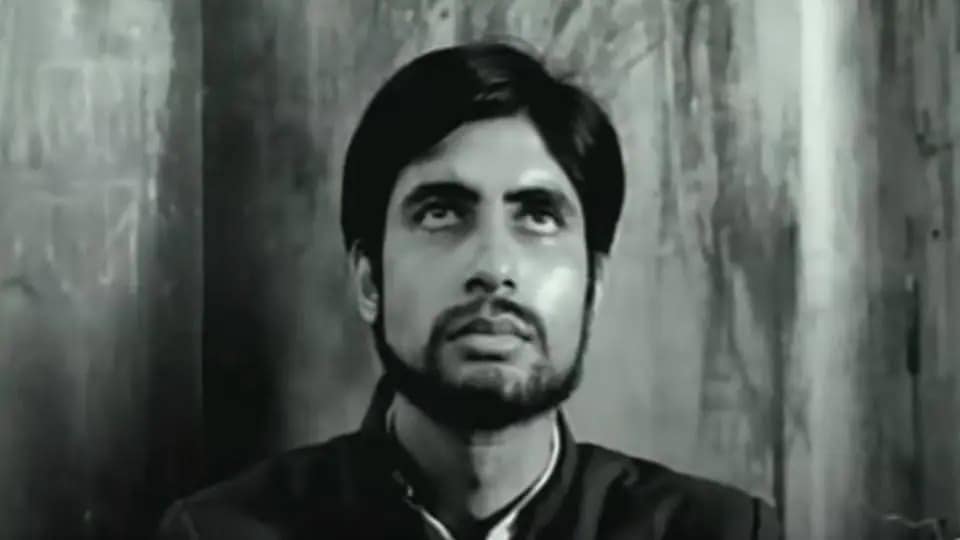
Bachchan’s debut film, Saat Hindustani (1969), was about seven Indians who revolted against Portuguese rule in Goa. Bachchan played a poet named Anwar Ali from Bihar.
Saat Hindustani (1969) told the tale of seven heroic Indians who revolted against Portuguese colonial rule in Goa (a state that remained a colony until 1961). Bachchan played a poet named Anwar Ali from Bihar. The story followed him and the six others — five from different parts of India and one from Goa — as they hoisted Indian flags on Portuguese forts and buildings.
Saat Hindustani got Bachchan his first National Award, for Most Promising Newcomer, but his struggles were far from over. He played supporting actor to Rajesh Khanna in Hrishikesh Mukherjee’s Anand (1971), the story of a terminally ill patient. Bachchan played an earnest doctor troubled by his patients’ suffering, and angry with the increasingly commercial-minded medical fraternity.
In Parwana (1971), Bachchan played an anti-hero, a talented sculptor obsessed with a young woman. (In my opinion, his career’s best thriller). In the same year, he played a man trapped by a secret that threatens his marriage, in Sanjog.
Around this time, he had started shooting for Mehmood’s Bombay to Goa, which released in the summer of 1972, and, call it destiny, writers Salim-Javed were driving past the newly built Chandan Theatre in Juhu, and decided to watch it. While they found most of it unengaging, the writers were struck by a fight sequence between Shatrughan Sinha and Amitabh Bachchan in a bar. When Sinha enters the frame and challenges Bachchan, he does not rise instantly. Javed Akhtar said it was his confidence, the way he continued to chew his gum during the entire fight sequence, that drew them to the actor.
Salim-Javed had recently submitted a script about an angry police officer to filmmaker Prakash Mehra. All the top heroes, from Dilip Kumar to Dev Anand, Rajesh Khanna, Dharmendra and Raaj Kumar, had turned it down. Dev Anand wanted changes. Khanna felt it went against his image. Dharmendra liked the film but had no dates, and Raaj Kumar wanted to shoot in a different location. Salim-Javed pitched the new actor, Amitabh Bachchan, and the rest is history.
Zanjeer was released in 1973 and presented a new expression on the Indian screen. For the first time, the law preserver was viewed as human. The Hindi cinema of the ’60s had depicted the police force as buffoons, always arriving at the crime spot after the drama was over. Zanjeer created a hero who was both righteous and furious. He grabbed the culprit by the collar, and knocked on a dormant conscience.
Think of the famous scene where criminal Sher Khan (Pran) walks into the police station with his trademark swagger, and is about to take a seat. Vijay kicks the chair and says the immortal line: “Jab tak baithne ko na kaha jaaye sharafat se khade raho. Yeh police station hai tumhare baap ka ghar nahi.” The Indian moviegoer had not seen this kind of simmering rage before and after a stunned silence, audiences rose to applaud.
Something changed with this film, not just for the actor and the movie world but for the public. It was as if the hero on the screen had unleashed a repressed angst. Here was a man ready to take on the system. It was the beginning of anti-establishment films where the hero was the anti-hero.
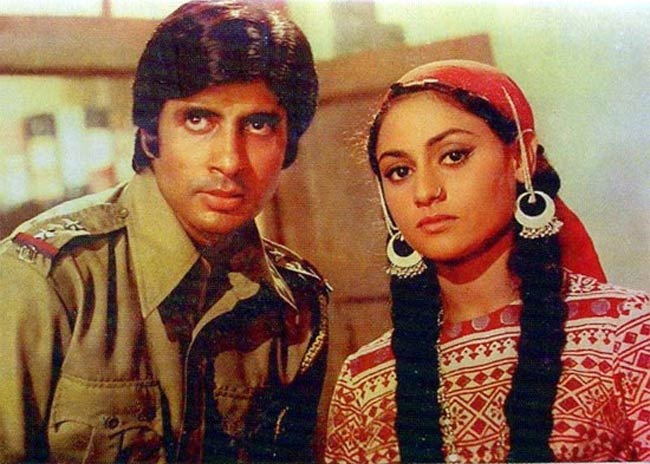
Zanjeer (1973) presented a new expression on the Indian screen. The Hindi cinema of the ’60s had depicted the police force as buffoons. Here, the cop was a hero, both righteous and furious.
Two more Bachchan hits followed in 1973, both directed by Hrishikesh Mukherjee. Abhiman was the story of two singers, Subir and Uma, and how pride destroys their marriage. Namak Haram was the tale of an unequal friendship between a mill worker and a mill owner.
Bachchan has a knack for making every character he plays believable, Mukherjee once told me. The aloof neighbour of Mili (1975) is burning with rage but has a vulnerable side too. The professor of Chupke Chupke (1975) is comic but endearing in his awkwardness.
Where stars before him had embraced personas — the lovable rogue, the slick city boy, the rural heartthrob — Bachchan was a chameleon. He altered his persona with every role, absorbing not just the complexities of the character but also becoming the alter ego of his writers and filmmakers. The audience sensed his involvement and identified with him.
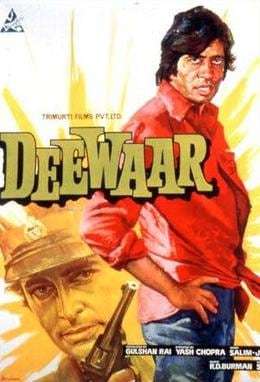
Deewar (1975) brought the mafia into the mainstream. Bachchan played Vijay, a shoeshine boy who rises to become the biggest don of Bombay.
Writer Salim Khan said the reason Bachchan was effective was because he mixed anger with tears. He was sometimes the victim, sometimes the oppressor, often anti-establishment and frequently on the wrong side of law, but there was an earnestness about him, combined with the tall frame and baritone voice that overpowered the screen and made him a hero to men, women and children alike.
Then came another big twist. The year 1975 changed the trajectory of Indian cinema, with Yash Chopra’s Deewaar and Ramesh Sippy’s Sholay. Deewar, inspired by the story of gangster Haji Mastan, brought the mafia into the mainstream. Bachchan played Vijay, a shoeshine boy who rises to become the biggest don of Bombay. Deewar was reminiscent of Mother India but while Radha (Nargis) revelled in sacrifice, Vijay aspired to change fortunes.
Sholay, of course, changed definitions of success and stardom. Salim-Javed’s popular lines entered the everyday lexicon (“Tumhara naam kya hai, Basanti?”); its depiction of friendship between Jai and Veeru inspired many more films; and Bachchan became the face of the flawed hero, ready to take on any number of Gabbar Singhs.
Just two years after his first success, Zanjeer, Bachchan had become a phenomenon. He was raining superhits and was the first star to be called a One-Man Industry by trade pundits, because in terms of revenue, the Number 2 star was actually Number 10.
Bachchan had the unflinching adoration of his audience. They didn’t care if he was spying on his wife (Rekha; in Do Anjaane), picking pockets (in Hera Pheri), or killing (in Adalat). There was always a justification and poetic justice by the end. They sang with him in Kabhi Kabhie (1976), laughed with him in Amar Akbar Anthony (1977), and cried with him in Alaap (1977), a poignant tale of a barrister’s son who goes against his father’s wishes and chooses music over law. That was another Hrishikesh Mukherjee film, dedicated to the late maestros KL Saigal and Mukesh.
In an interview in 1978, Mukherjee told me that he originally set out to make a classical musical, but the gloom of the Emergency was so overwhelming that the depression filtered into his narrative, and his protagonist, Amitabh Bachchan. “There is a possibility that had I made the film a year later, the outcome would not have been so depressing.”
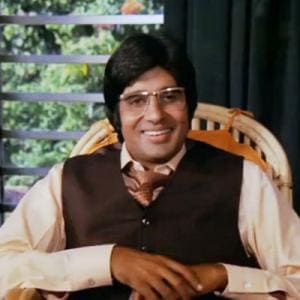
Bachchan is a director’s delight, a chameleon who alters his persona with each role. Here, he is the comic professor of Chupke Chupke (1975), endearing in his awkwardness.
Looking back, Hrishikesh Mukherjee’s gloom seems over-emphasised because, in the same year, director Manmohan Desai delivered the big entertainer Amar Akbar Anthony. Looking back, I feel the media unfairly labelled him the angry hero, when he was, in fact, so much more. He did comedy (Do Aur Do Paanch), tragedy (Muqaddar Ka Sikander), a musical (Mr Natwarlal), and drama (Trishul) early in his career. He was mischievous in Namak Halaal, seductive in Silsila, and vulnerable in Sharabi (all films of the ’80s). While his predecessors had all retired or moved on to character roles by their fifties, Amitabh Bachchan was still a draw at the box office and was repackaged by director Mukul Anand’s films Agnepath, Hum and Khuda Gawah in the 1990s.
He was at centre-stage in Baghban, he was complex in Cheeni Kum, intolerant in Piku, intriguing in Pink and lovable in Paa, all released after 2010.
In a career spanning 53 years and over 200 films, the actor has experimented with television, stage shows, music, poetry, commercials, and more. He has worked with generations of technicians, spanning technological eras that saw film go from black-and-white to colour to cinemascope, Dolby and sync sound. And in all these years, he took a break from the arc lights only thrice.
In 1982, when he suffered the near fatal accident on the sets of Coolie. In 1984, when he briefly quit movies and joined politics. And in 1995, when he took a sabbatical after Khuda Gawah to review his trajectory.
His track record of box-office hits and his body of work remain unmatched, in the 100-plus years of Indian cinema.
