
In the tales of the ’60s and ’70s, depictions of women became more urbane. Women were gaining and claiming more agency off-screen too. And female actors opened new doors to what women could be seen to do
In the summer of 1966, when photographer Dhiraj Chawda was told he would be shooting Sharmila Tagore for the cover of Filmfare magazine, he didn’t know the image would become part of Bollywood history. Among the clothes and accessories that Tagore had brought with her for the shoot was a black-and-white bikini. “I remember when I showed the two-piece bikini to the photographer, he asked me, ‘Are you sure about this?’ In some of the shots, he even asked me to cover my body,” she later told the magazine.
What Chawda didn’t know was that the actor wanted to wear a bikini in the song Aasman Se Aaya Farishta, in Shakti Samanta’s An Evening in Paris (1967), which was being shot at the time. In the song, Tagore’s character is water-skiing and being wooed by Shammi Kapoor, who is hanging off a helicopter. The dozens of extras, also water skiing, wore bikinis but Samanta was worried about the censor board.
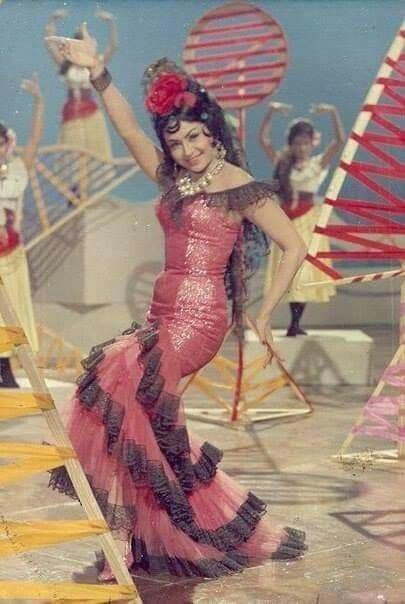
Helen in Teesri Manzil (1966). Some of this decade’s new stories spawned new stereotypes: the gold-digger, the eye-candy, the vamp. But even they opened new doors. Helen, usually clad in outlandish headgear and cabaret-style outfits, owned this space.
At the time there was intense debate in the industry and in the media about the excessive censoring of elements such as kissing scenes. Actor-comedian I.S. Johar wrote multiple columns in film magazines calling out “the prudes”. For this song, Samanta thought a one-piece swimsuit would be a safer option. Later that year she made her statement, waterskiing in a blue two-piece in the song Mere Bechain Dil Ko Chain in the whodunit Aamne Saamne.
If the cinema of the 1950s was about social responsibility, the Swinging Sixties were colourful, flamboyant and optimistic. There was an infusion of young blood which gave the audience frothy romcoms, travel films, and noir thrillers.
There was a more realistic depiction on screen of how the general audience saw women in real life (which is either as the Madonna or the whore, there was no in-between). When they weren’t just eye candy, female characters were typically relegated to playing suffering mothers, dutiful wives or coy girlfriends. They bore oppression in silence and looked to the men in their lives to protect and provide for them
Some of these spawned new stereotypes: the gold-digger; the damsel in distress; the seductive coquette; the eye-candy; the vamp. But in a few cases, these were freeing. Some of these women had that rare thing in Bollywood, agency, as they stepped out of white saris and into gold lame. Sure, they invariably met with a tragic end, but they opened new doors to what women could be seen to do. And no one owned this space like Helen.
Dressed in a boa, outlandish headgear and cabaret-style outfits, she would usually make an appearance in one song in a film. Choreographed classics such as O Haseena Zulfon Wale (Teesri Manzil, 1966), Aa Jaane Jaan (Intaquam, 1969) and Piya Tu Ab to Aaja (Caravan, 1971) truly captured the hedonism of the ’60s.
Asha Parekh’s performance as the melancholic widow who isn’t really a widow, in Samanta’s Kati Patang (1971), is easily one of the strongest characters written for a female actor to date.
She takes the place of another woman, raises a child as a single mother, dares to falls in love.
And there was Rosie in Guide (1965), who walked out of an unhappy marriage, began a romantic relationship with a man she’d just met, and embarked on a successful career as a dancer.
These exceptional actors didn’t conform off-screen either. Take Waheeda Rehman. In a post-Partition Indian in which many Muslim actors adopted Hindu screen names (Yusuf Khan became Dilip Kumar; Nargis was born Fatima Rashid; Meena Kumari was Mahjabeen Bano; Madhubala was born Mumtaz Jahan), she refused.
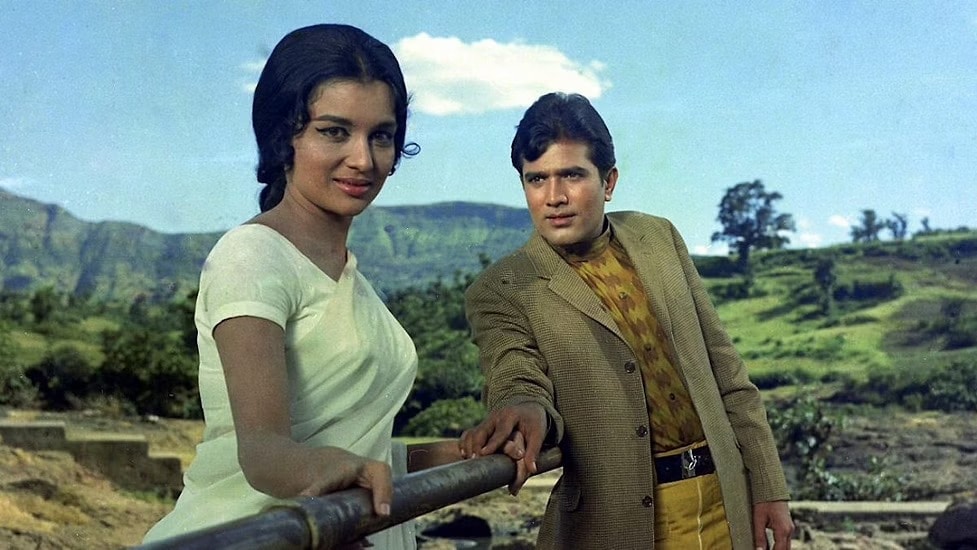
Asha Parekh and Rajesh Khanna in Shakti Samanta’s Kati Patang (1971), the story of a woman who raises a child as a single mother, and finds love.
She was just 17 when Raj Khosla, who directed her first Hindi film CID (1956), suggested it. “My parents have given me this name and I like it. I won’t change it,” she replied.
And, then there was Sharmila Tagore, who pushed the envelope in many, many ways. After they met in 1965, Tagore and the late Mansoor Ali Khan Pataudi became desi pop culture’s first “It” couple. When they married three years later, she was at the peak of her career. The audience wouldn’t accept a married heroine, she was told. She stood her ground, and her career thrived.
Even more unusual for the time, she continued to act after her first child, Saif Ali Khan, was born.
As the ’70s rolled around, a newer crop of actresses emerged. Hema “Dream Girl” Malini got her start playing a widow in Andaaz (1971) and Raaj Kumar’s scorned and vengeful mistress in Lal Patthar (1971), and then had a double role in Seeta Aur Geeta (1972) that established her box-office supremacy.
For the first decade of her career in Hindi films, Rekha’s calling card was an infamous kiss with Biswajeet in Anjaana Safar (1969), which was eventually released a decade later as Do Shikaari (1979); she was 15. It led to being on the cover of the Asian edition of Life Magazine, under the headline “India’s Kissing Crisis”. Almost a decade of B-grade films later, she began to come into her own towards the end of the ’70s, with a compelling performance as a rape survivor dealing with the trauma and its effects on her marriage in Manik Chatterjee’s Ghar (1978).
Meanwhile, Zeenat Aman and Parveen Babi, with their roots in modelling, their Western outfits and their overt sexuality, changed Bollywood’s idea of what a leading lady could be.
Also challenging the status quo with her onscreen presence was Shabana Azmi, who was just 19 in her debut film Ankur (1974). On the surface, it’s yet another landlord-mistress tale.
Lakshmi, the Dalit character who is ordered by her landlord to abort his child, acknowledged a revolution when she quietly asked: “Must I alone feel the shame?”
