
These were phenomenal, action-packed years in the history of Hindi cinema, crowded with films cutting across styles, themes and genres. New trends arrived, settled or faded away, and films moved ahead in fresh, exciting directions.
Colour came to the industry in the 1960s and the effect was immediate. Directors and movie stars packed their bags and headed outdoors, away from studios and cities. Filmmakers began flocking to places such as Kashmir to shoot jaunty romances and scintillating songs. The Shakti Samanta-directed Kashmir Ki Kali (1964), starring Shammi “Yahoo” Kapoor and a young Sharmila Tagore, is probably the best example of this trend, where the scenic locales of Kashmir were as much part of the film as the love story.
It was only natural that this urge to explore India in colour would extend to other parts of the world too. Raj Kapoor’s Sangam (1964) took audiences on a whirlwind tour of glamorous Paris and picturesque Switzerland. Foreign travel was difficult if not impossible for the average Indian then, so films became their window to the world. Later movies even had the destinations in their titles: Love In Tokyo (1966), An Evening In Paris (1967), Night In London (1967), Around The World (1967).
By the end of the 1960s, romantic films of the time had found a new hero, the crinkly eyed Rajesh Khanna. The heyday of the earlier stars was frankly over. The trio of Raj Kapoor, Dev Anand and Dilip Kumar was aging; later entrants such as Shammi Kapoor had lost much of their earlier sheen. Along came Shakti Samanta’s Aradhana (1969), with its pulsating music and charismatic leading man. Rajesh Khanna dominated movies for the next few years with his irresistible brand of romantic charm
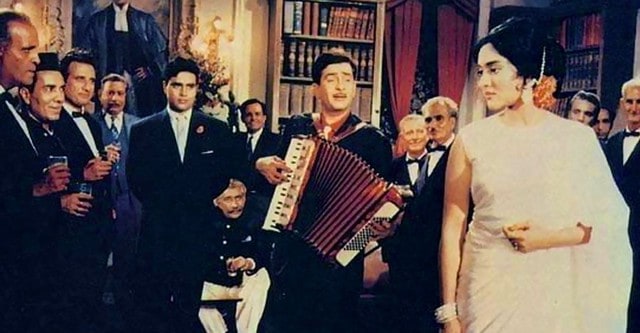
Raj Kapoor’s Sangam (1964) took audiences on a whirlwind tour of Paris and picturesque Switzerland.
But two of his best films, directed by Hrishikesh Mukherjee – Anand (1971) and Namak Haraam (1973) – were portents of things to come. Both films co-starred a lanky young actor with eyes full of suppressed fire. This was Amitabh Bachchan, who would blaze across our screens, leaving audiences shaken and in complete thrall of the fiery character he brought to life: the Angry Young Man.
Hindi cinema had never lost its empathy for the poor, and remained steadfast in its opposition to injustice. These sentiments found a new champion, the vigilante hero, who fought the system, who raised his voice against poverty, corruption and exploitation. Vijay, as Bachchan’s character was often called, first combusted our screens in Prakash Mehra’s Zanjeer (1973), where he played an intense cop out for vengeance.
This familiar but new way of fighting for justice mostly took place in the city, and film crews returned to streets and alleys, godowns, and docks. The hot-tempered hero, in keeping with the changed times, didn’t hesitate to resort to violence to make his point. There was discontent in the nation with soaring inflation, shortages, industrial strikes and student unrest and people longed for a saviour to make things right, even if he was make-believe.
The hero acquired shades of grey and was often on the wrong side of the law. But he always had a generous, good heart. Whether it was the ultimate blockbuster Sholay (1975) or the tightly scripted Deewar (1975), Bachchan played such characters with conviction and power.
There was a new kind of heroine also quietly making her presence felt, best exemplified by unconventional Westernised actresses Zeenat Aman and Parveen Babi. They were free-spirited, not bound by societal restrictions. Who can forget that scene in Deewar where Anita (Babi) is lying in bed with Vijay (Bachchan), sharing a post-coital cigarette?
The 1970s were also the start of what is known as the parallel cinema movement; the realistic, semi-arthouse cinema spearheaded by filmmakers such as Shyam Benegal, Govind Nihalani, Saeed Mirza, and others. The film that is generally regarded as the start of this movement was Mrinal Sen’s Bhuvan Shome (1969), about the transformation of a middle-aged, stiff bureaucrat because of a young woman he meets while on a trip to Gujarat. But the film that truly kicked off the parallel cinema wave was Benegal’s Ankur (1974), in which a feudal landlord’s son sleeps with a Dalit woman, gets her pregnant, refuses to take responsibility and instead mistreats her and her deaf-mute husband.
At the other extreme end of the cinema spectrum were the outright arthouse filmmakers such as Mani Kaul and Kumar Shahani, who often based their experimental films on works of Hindi literature.
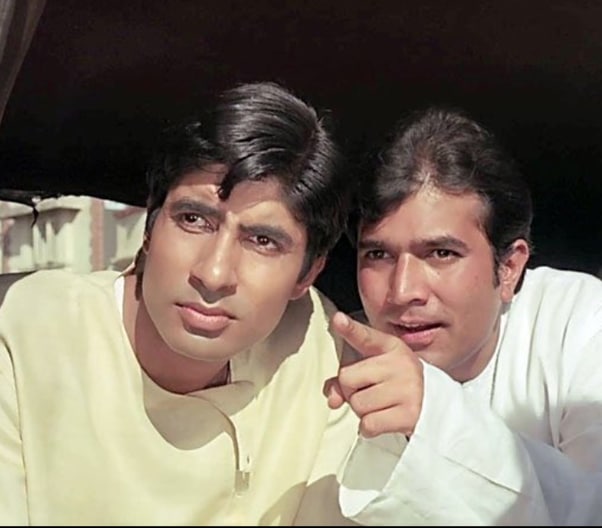
Rajesh Khanna and Amitabh Bachchan in Anand (1971). Bachchan was still a lanky newcomer at this point, but his blazing eyes and simmering rage would soon sweep all else off the screen.
For example, Kaul’s Uski Roti (1969) was based on a short story by Mohan Rakesh, and Shahani’s Maya Darpan (1974) on a story by Nirmal Verma.
So on the one hand were the big Bachchan blockbusters by Yash Chopra, Ramesh Sippy, Prakash Mehra and Manmohan Desai. By the late ’70s, the actor had morphed from being an angry young man to an all-in-one entertainment package encompassing everything from action to comedy. The pinnacle was Desai’s classic masala fun film, Amar Akbar Anthony (1977).
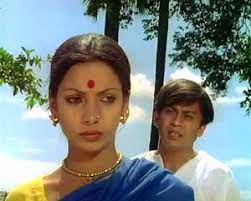
Shabana Azmi in Ankur (1974), the Shyam Benegal film that truly kicked off the new wave. A landlord’s son sleeps with a Dalit woman, gets her pregnant, refuses to take responsibility and then begins to harass her and her husband.
On the other hand there was the parallel cinema. And right in the centre was the middle-of-the-road cinema, spearheaded by filmmakers such as Hrishikesh Mukherjee and Basu Chatterjee. Delightful, light-hearted films like Rajnigandha (1974), Chhoti Si Baat (1975) and Chupke Chupke (1974) were released in these years. This meant that the debate around “art” versus “commercial” films became acute and fraught at this time.
But this was undoubtedly a time of great ferment and creativity in filmmaking; the Film and Television Institute of India (FTII) itself contributed to exciting new acting talent (Shabana Azmi, Naseeruddin Shah, Om Puri etc) and bold new directorial talent (Mani Kaul and Kumar Shahani).
Meanwhile, government attempts to bolster the film industry continued apace. In 1975, the Film Finance Corporation transformed into the National Film Development Corporation (NFDC), which went on to finance some of the best-known films of the parallel cinema movement. Interestingly, NFDC functioned under the information & broadcasting ministry, but that was not an impediment to the green-lighting of several anti-establishment films.
As in previous years, this era saw some stupendous stand-alone films that either shone in their brilliance or had a far-reaching influence on Hindi cinema. The beauty and grace of Kamal Amrohi’s Pakeezah (1971) has never been replicated. Raj Kapoor gave Hindi cinema its first teenage love story, Bobby (1973), which set the pattern for umpteen films about young love in the decades to come. Vijay Anand’s Guide (1965) was the path-breaking tale of a married woman who left her husband to pursue her passion, dance, and be with her lover.
Two of Anand’s other films – Teesri Manzil (1966) and Jewel Thief (1967) – remain racy, absorbing thrillers with splendid music. Basu Bhattacharya made a lyrical film on Hindi writer Phanishwar Nath’s evocative short story Maare Gaye Gulfam, again with memorable music
Padosan (1968) and Chupke Chupke (1974) were beloved comedies that are still audience favourites. There are simply too many gems to recount. It’s an indicator of how rich and fruitful these years were.
