
When Mr India was released in 1987, Sridevi was the superstar people lined up to watch. But by 1988, a new star was rising. Madhuri Dixit combined girl-next-door charm with undeniable sex appeal. Theirs was a rivalry that would play out over decades.
The year 1988 was one of flux in the Hindi film industry. The audience was shifting towards more youthful stories, showing an eagerness to embrace new actors. Nasir Hussain launched his nephew Aamir Khan in Qayamat Se Qayamat Tak, and it was a blockbuster. A star was expected to be born that year, and one was. But he wasn’t the only one.
Six months later, N Chandra’s Tezaab rocked the box office, raking in ₹8 crore, making it the biggest hit of the year. And driving its success was a young woman who hadn’t really had a hit yet: Madhuri Dixit. She became known as the Ek-Do-Teen Girl. She followed this success with short but noticeable roles in films such as Ram Lakhan, Tridev and Parinda over the next couple of years. Then Indra Kumar’s Dil (1990) turned her into a megastar. Cast opposite Aamir Khan, Dixit displayed acting talent that matched her dance moves, and inexplicably combined a girl-next-door charm with undeniable sex appeal. With her innocence and mild suggestiveness, she was the Indian male fantasy come to life.
Blockbusters such as Beta (1992) and Khal Nayak (1993) followed, and the young actress was now stamping her presence on every project. Songs like Dhak Dhak and Choli Ke Peeche had audiences and the industry sitting up to take notice.
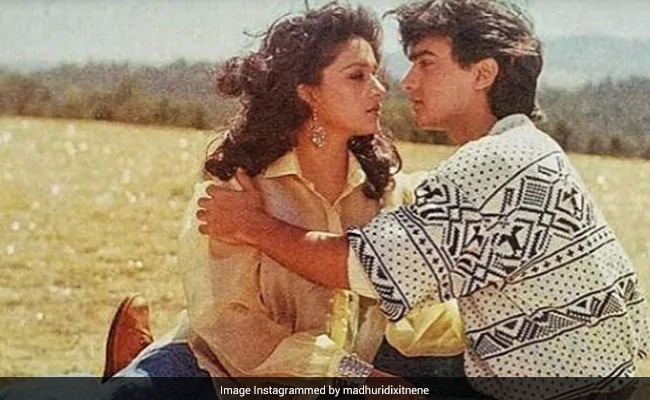
Indra Kumar’s Dil (1990; co-starring Aamir Khan) turned Dixit into a megastar. With her innocence and mild suggestiveness, she was the Indian male fantasy come to life.
Five years after the release of Tezaab, a battle began to play out. The magazine Filmfare featured Dixit and Sridevi on a November 1993 cover with the headline “Clash!”
A decade earlier, Star & Style had featured Sridevi on a November 1983 cover, with the headline: “All The Reasons Why Sridevi Is Going to Be The Next Superstarini.” The young actor was already a sensation in Tamil and Telugu cinema then, with multiple hits opposite superstars like Rajinikanth and Kamal Haasan. She won over the Hindi-film audience with Himmatwala and Sadma.In 1986, she was part in every major blockbuster, including the classics Karma, Nagina and Aakhree Raasta.
When Mr India was released in 1987, Sridevi was the superstar people lined up to watch. Hawa Hawaai played everywhere from paan shops to birthday parties, and the actor had dates blocked all the way to the ’90s. Her performances in Chandni (1989) and Chaalbaaz (1989) were early examples of female-driven box-office success. She is still widely regarded as India’s first female superstar. She was in advertisements for everything from soaps to light bulbs, and rode a new wave of popularity in an age when TV was gaining a foothold in homes.
But the ’90s weren’t kind to Sridevi. While her Khuda Gawah (1992) was a hit, Madhuri Dixit’s Beta did twice as much business at the box office and went on to become the highest grosser of the year. For the third consecutive year, Dixit was in the year’s biggest film (it was Dil in 1990 and Saajan in 1991).
Then Boney Kapoor’s magnum opus, Roop Ki Rani Choron Ka Raja (1993), bombed at the box office. As one of the film’s leads, Sridevi’s reputation took a beating. Judaai (1997) would be her last film as a quintessential Bollywood heroine.
She was 34. Dixit would go on to rule the ’90s with films such as Hum Aapke Hain Koun..! (1994), Raja (1995), Dil To Pagal Hai (1997). At 35, after Devdas (2002), Dixit stepped away, moved abroad, started a family.
Then, 15 years after her last film, Sridevi returned. She was a hit all over again, in English Vinglish (2012), considered her most nuanced performance. Then in the Tamil film Puli (2015); the Hindi film Mom (2017). Dixit had made a return too, unsuccessful at first, with Aaja Nachle (2007). She found her groove with Dedh Ishqiya (2014) and backed it up with a powerful performance in Gulaab Gang (2014). Now 55, she recently made her streaming debut, in the Netflix series Fame Game.

Fifteen years after her last film as a quintessential Bollywood heroine, Sridevi returned. She was a hit all over again, in English Vinglish (2012), considered her most nuanced performance.
Meawhile, Sridevi’s return was tragically short-lived. She died in an accidental drowning in a hotel room in Dubai in 2018, aged 54. She is survived by her husband Boney Kapoor, and their two daughters. In a twist that she may or may not have appreciated, what was to be her next role — that of brothel madam Bahaar Begum in the multi-starrer Kalank (2019) — was passed on to Madhuri Dixit.
