
Gold leaf, stained glass, mirrors everywhere — the spectacle fit right into a new generation of Hindi films that signalled an India on the ascendant. And, as the NRI film got bigger, so did sets, costumes, budgets.
There are 127 pillars in the pink-and-blue haveli that Paro (Aishwarya Rai Bachchan) dashes through, first in joy, then in sorrow and despair, in Sanjay Leela Bhansali’s retelling of Devdas. It took 122,000 pieces of stained glass to finish her bedroom.
In the scene where the courtesan Chandramukhi (Madhuri Dixit-Nene) dances to the song Kaahe Chhed, her red-and-gold Abu Jani-Sandeep Khosla ghaghra weighed so much (30 kg), that its momentum kept it swirling long after she’d stopped. The 2002 film was a dazzling blur of colour and dance, glitter and glass. It cemented his visual aesthetic as a love of the opulent.
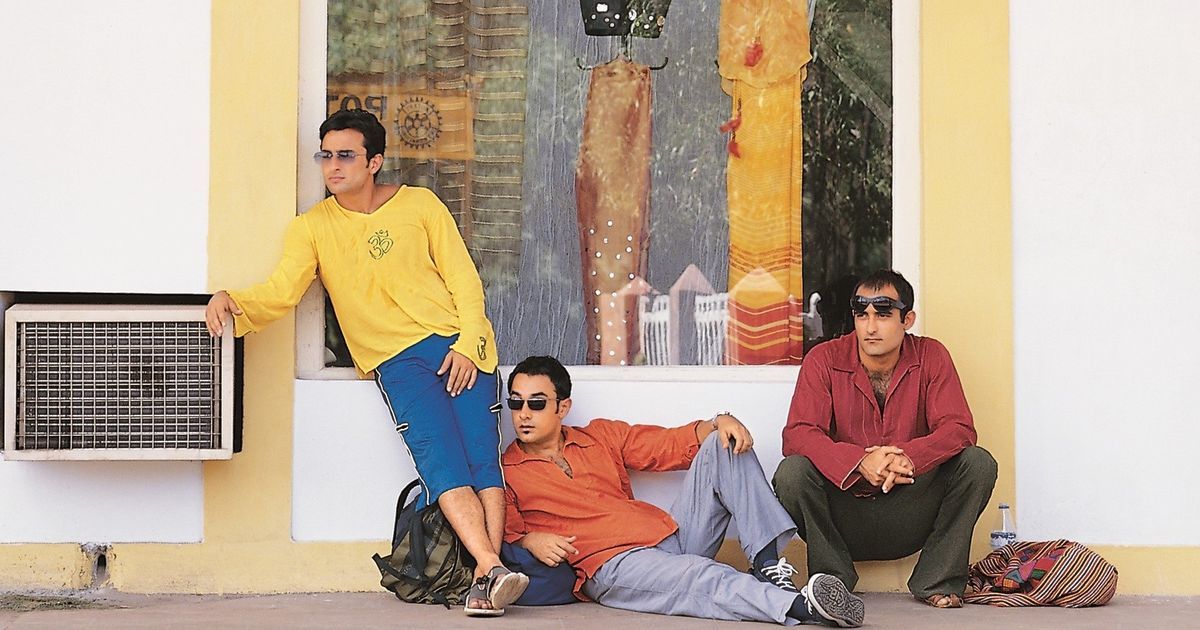
The three stars of Farhan Akhtar’s Dil Chahta Hai, Aamir Khan, Saif Ali Khan and Akshaye Khanna, have, through the film, the casual indifference to money that only comes with considerable wealth.
The most expensive Hindi film made until then (with an estimated budget of ₹50 crore) was an unadulterated spectacle, and it fit right into a new generation of Hindi films that coincided with India’s economic liberation. Thus was reborn the spectacle.
As budgets grew, films became “aspirational”. Even the lead characters’ names changed. Raju became Raj or Rahul; Pooja became Poo. Even the pets’ names went from Moti, Basanti and Brownie to Dobby, Tuffy and Bruno. And they all, pets and people, dressed almost exclusively in designer wear.
Characters were also increasingly taking vacations, eating out at restaurants and even at five-star hotels. The singing and dancing moved from the outdoors to the nightclub and discotheque.
When the three stars of Farhan Akhtar’s Dil Chahta Hai (2001) drove off to Goa together, they did it in a Mercedes convertible. What followed was an exuberant celebration of youthfulness, leisure and friendship, as Aamir Khan, Saif Ali Khan and Akshaye Khanna fought, made up, grew up. There was, in every frame, the casual indifference to money that only comes with considerable wealth.
What a sharp change from the 1970s, when Bachchan’s character driving a Ford Mustang in Don (1978) was all it took to show the audience that he was a criminal.
As the rich became richer, the poor became invisible. There were no mill workers and daily labourers in the films of the early Aughts. Instead, in the same year as Dil Chahta Hai, Shah Rukh Khan (in Kabhi Khushi Kabhie Gham) arrived home in a helicopter, his large waiting family gathering on the lawns before what could only be described as a colonial-era British mansion.
Amid this rash of NRI and aspirational films, the celebrations ballooned. The film weddings that had set the template for the big fat Indian wedding off-screen got even bigger. Hum Aapke Hain Koun..! (1994) introduced choreographed sangeets and multiple outfit changes. Then came Manish Malhotra’s sheer saris and embroidered kurtas, introduced via Karan Johar and his multi-star extravaganzas.
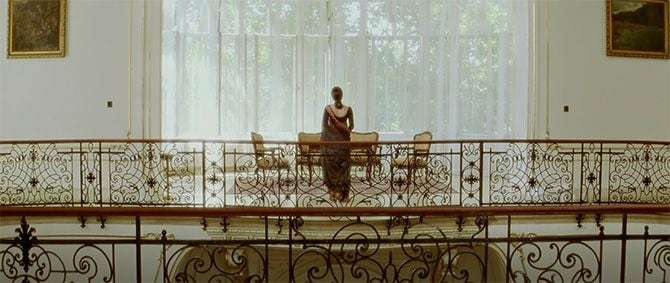
Years before Devdas (2002), Bhansali was honing his ability to visually stun. In the 1999 film Hum Dil De Chuke Sanam, every set is opulent, every frame seemingly designed to stand on its own.
As the Indian economy looked outwards, so did our films. It’s not as if filmmakers had never looked overseas in the past; extensive parts of big-budget movies had been shot abroad ever since Radha (Vyjayanthimala) and Sundar (Raj Kapoor) flew to Europe for their honeymoon in Sangam (1964). Expatriate Indians were rarely addressed or acknowledged in these films, and on the rare occasions when they were, it was to push the stereotype of people that had given up their culture in favour of the debauched west.
Preeti (Saira Banu) was shamed in Purab Aur Paschim (1970) for dressing and behaving like a Westerner, and Jasbir (Zeenat Aman) in Hare Rama Hare Krishna (1971) is shown as a pot-smoking hippie who’s given up her culture to become Janice. The mid to late 1990s saw a huge change in all this, and there were two reasons. First, overseas business was suddenly contributing bigger numbers to Hindi cinema. The second was that the NRI was a convenient and already available archetype of the uber Indian, one who lived abroad and hence already an achiever in the eyes of a desi audience who had suddenly discovered the lure of capitalism.
And so, Dilwale Dulhania Le Jayenge’s Raj (Shah Rukh Khan) doesn’t sleep with the young Indian woman he is very attracted to; Kishorilal (Amrish Puri) of Pardes finds the perfect match for his son in Kusum (Mahima Chaudhary), who sings I Love My India; and in Namastey London (2007), British-born vodka-swirling Jazz aka Jasmeet (Katrina Kaif) falls in love with Arjun (Akshay Kumar) after he schools a racist white man on all the things that make India great.
And in this manner, via luxury goods, designer wear and some well-timed meet-cutes, the gap between London and Ludhiana was bridged.
(Karishma Upadhyay is a film journalist, critic and author of Parveen Babi: A Life)
