
The triumph of freedom was laced with the tragedy of Partition, with independent India’s leaders inheriting a bleak political and economic landscape as they went about the task of building a new republic on top of a bruised civilisation. Vallabhbhai Patel gave the nation territorial coherence, but after 1950, the political leadership largely rested with Jawaharlal Nehru, Mahatma Gandhi’s protégé who combined mass charisma with broadly democratic instincts and a sense of India’s place in the world. In the first phase of Independence, India worked on foundations and consolidation.
The myths and reality of the Nehru years
As India turns 75, it is natural to survey the past and reflect on how the country has changed since 1947. Yet, because archival records for India’s history after 1947 are patchy at best, our understanding of the Jawaharlal Nehru years has only become murkier over time.
Increasingly, public perceptions of this period have come to be dominated by the debates of the present. Whether lionising him or demonising him, political parties, social scientists and ordinary people have mobilised Nehru for their own ends, weaving myths about the Nehru years in the process.
Read more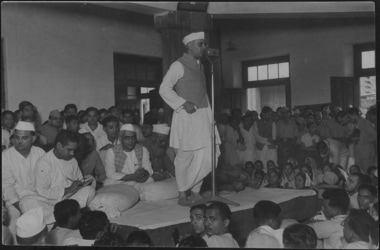
Jawaharlal Nehru attends a Congress Seva Dal volunteers’ rally in Kanpur.
In the first phase of Independence, India worked on foundations and consolidation.
On August 29 1947, the Constituent Assembly had two choices — to act as a constitution-framing and a law-making body or to separate these roles. The Assembly opted to divide these functions. It resolved that “The business of the Assembly as a Constitution-making body should be clearly distinguished from its normal business as the Dominion Legislature, and different days or separate sittings on the same day should be set apart for the two kinds of business.” As a result, the Constituent Assembly would meet in what is now the Central Hall to draft the Constitution. And on different days, it would convene in the Lok Sabha chamber as the Constituent Assembly (Legislative) to make laws and question Prime Minister Jawaharlal Nehru’s Government. Read more
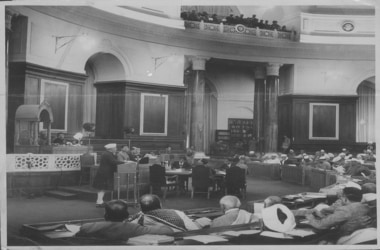
The Constituent Assembly would meet in what is now the Central Hall, to work on drafting the Constitution.
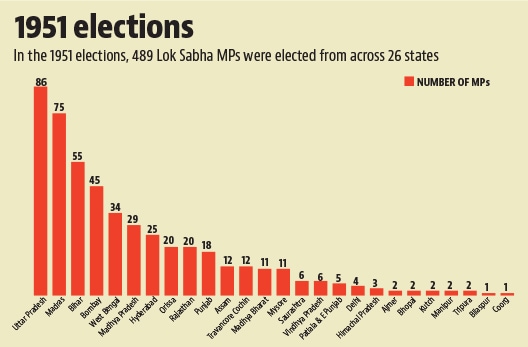
Although independent India held its first general elections in 1951, at least a section of Indians were not voting for the first time in their lives. This was because the British government gave limited democratic representation to Indians before independence. Does the presence of limited franchise and electoral competition mean that the post-1947 period was insignificant, as far as the foundations of India’s electoral democracy is concerned? In the first of five interactive graphics, we track 75 years of politics in data. Read more and view graphics
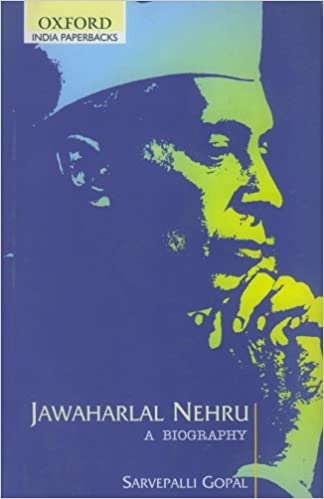
Compiled by Prashant Jha. To see why he picked these books, click here
