
The duo of PV Narasimha Rao and Manmohan Singh enhanced economic freedom in the early 90s, unleashing the spirit of Indian entrepreneurship. India’s middle class boomed. The Indian market became deeply attractive. Indian corporates grew. Aviation and telecom became lessons in the benefits of opening up the economy; information technology made India a global player and an object of aspiration for the young. The coalition era first produced instability. But from that instability emerged a political culture that rested on having a central core in the form of a national party (BJP till 2004, the Congress till 2014) with a range of regional parties providing support but extracting their share of the slice in return.
When India rose
From the gloom of the 1980s, economic reforms and a rising external profile saw India finally finding its space in the world. It helped that domestic politics swung from extreme instability to the institutionalisation of coalitions. But there were alarm bells. The 1980s left India
bruised. It faced the prospect of an economic disaster. Its internal security was in shambles, with Kashmir, Punjab and Assam facing domestic rebellions orchestrated or supported by external adversaries. Two Indian leaders – a former prime minister and a sitting Prime Minister – had been assassinated in the span of seven years. Read more
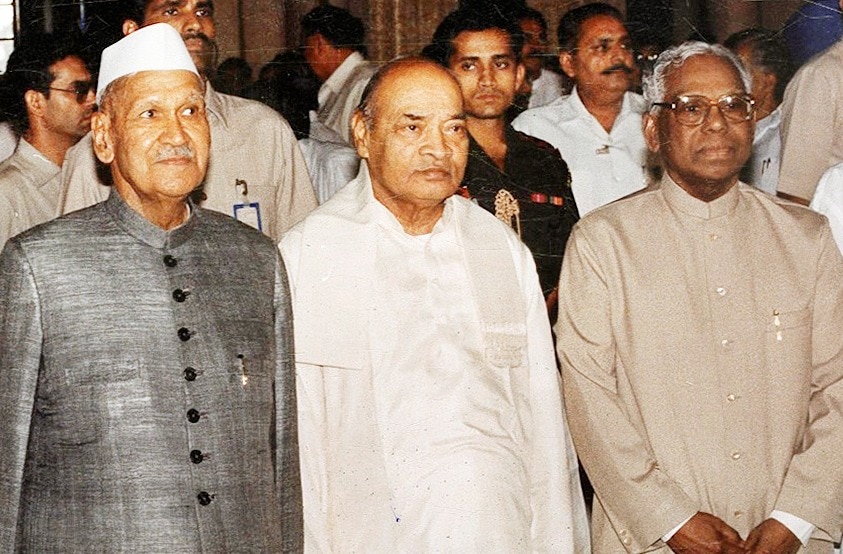
Narasimha Rao with the President and Vice-President.
India’s most powerful friend, the Soviet Union, had collapsed. But from that potentially ruinous phase arose a new India.
1991 was a tumultuous year for India in multiple ways. In hindsight, one can say that this was the period when the country was at its most vulnerable. Political instability, wherein the country had three Prime Ministers in less than two years (from December 1989 to June 1991), was compounded by a grave fiscal crisis. This domestic turbulence was playing out even as the global strategic framework was moving from the familiar US-Soviet Union bipolarity to a US-led international system with the unexpected implosion of the Soviet Union in December 1991. If 1991 was the year of tumult and turbulence, India was fortunate that it was able to find the most appropriate helmsman in PM PV Narasimha Rao. His tenure, between June 1991 and May 1996, can described as the most consequential by way of coping with a wide spectrum of challenges — political, diplomatic, security-strategic, economic and societal. Read more
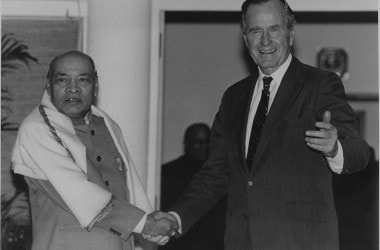
Prime Minister PV Narasimha Rao meets US President George HW Bush.
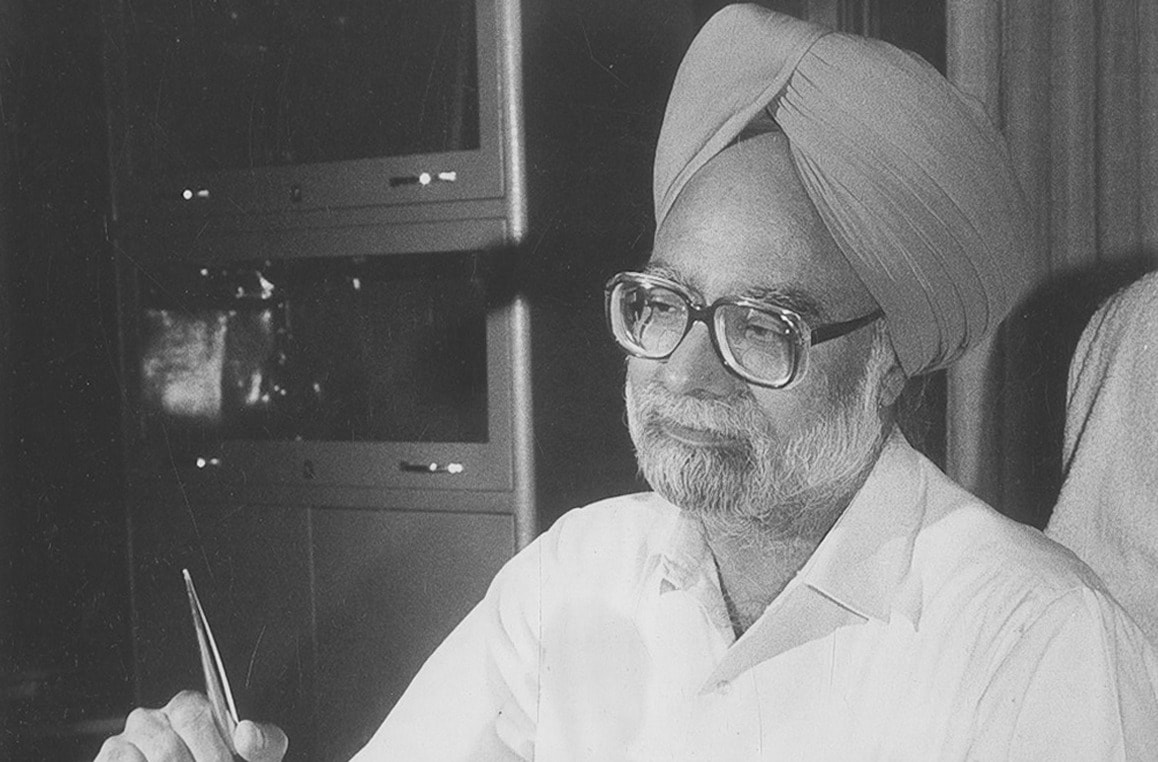
Finance minister Manmohan Singh gives the final touches to the Budget on June 23, 1991, before presenting it to Parliament.
The early 1990s are largely remembered for the beginning of India’s economic liberalisation. One easily forgets that these far-reaching economic reforms took place against a backdrop of deep political instability and fragmentation. Between 1989 and 2007, India had no less than seven governments, including three minority governments. Fragmented electoral outcomes in the mid-1990s led to the formation of short-lived coalition governments. The National Front, again, in 1996, under the leadership of HD Deve Gowda, followed by the United Front government led by IK Gujral who, like his predecessor, did not last a year.
Coalition governments stabilised once they became organised around the two national parties, BJP first, in 1998 and 1999 then Congress, in 2004 and 2009. Read more
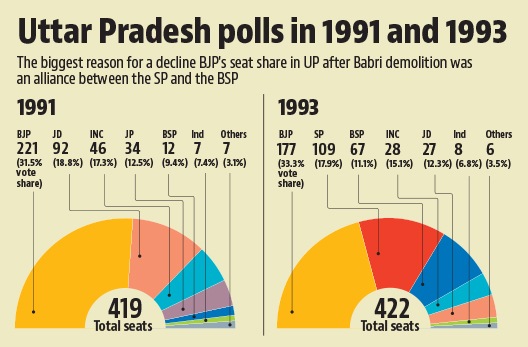
The Bharatiya Janata Party (BJP) was running state governments in four states – Himachal Pradesh, Rajasthan, Uttar Pradesh and Madhya Pradesh – when the Babri mosque was demolished on December 6, 1992. Kalyan Singh, the BJP’s chief minister in Uttar Pradesh, was dismissed by the union government on December 6 itself for reneging on his promise to protect the mosque. Even though the BJP marginally increased its vote share between the 1991 and 1993 elections in Uttar Pradesh, its seat tally fell from 221 to 177.
The biggest reason for this was an alliance of two subaltern parties, namely Mulayam Singh Yadav’s Samajwadi Party (SP) and Kanshiram’s Bahujan Samaj Party (BSP). The fact that an OBC-SC alliance managed to prevent the BJP from capturing power even as the Congress ceded ground to the BJP, gave rise to the thesis of Mandal politics being the best antidote to the politics of Kamandal (read Hindutva). In the fourth of five interactive graphics, we track 75 years of politics in data. Read more
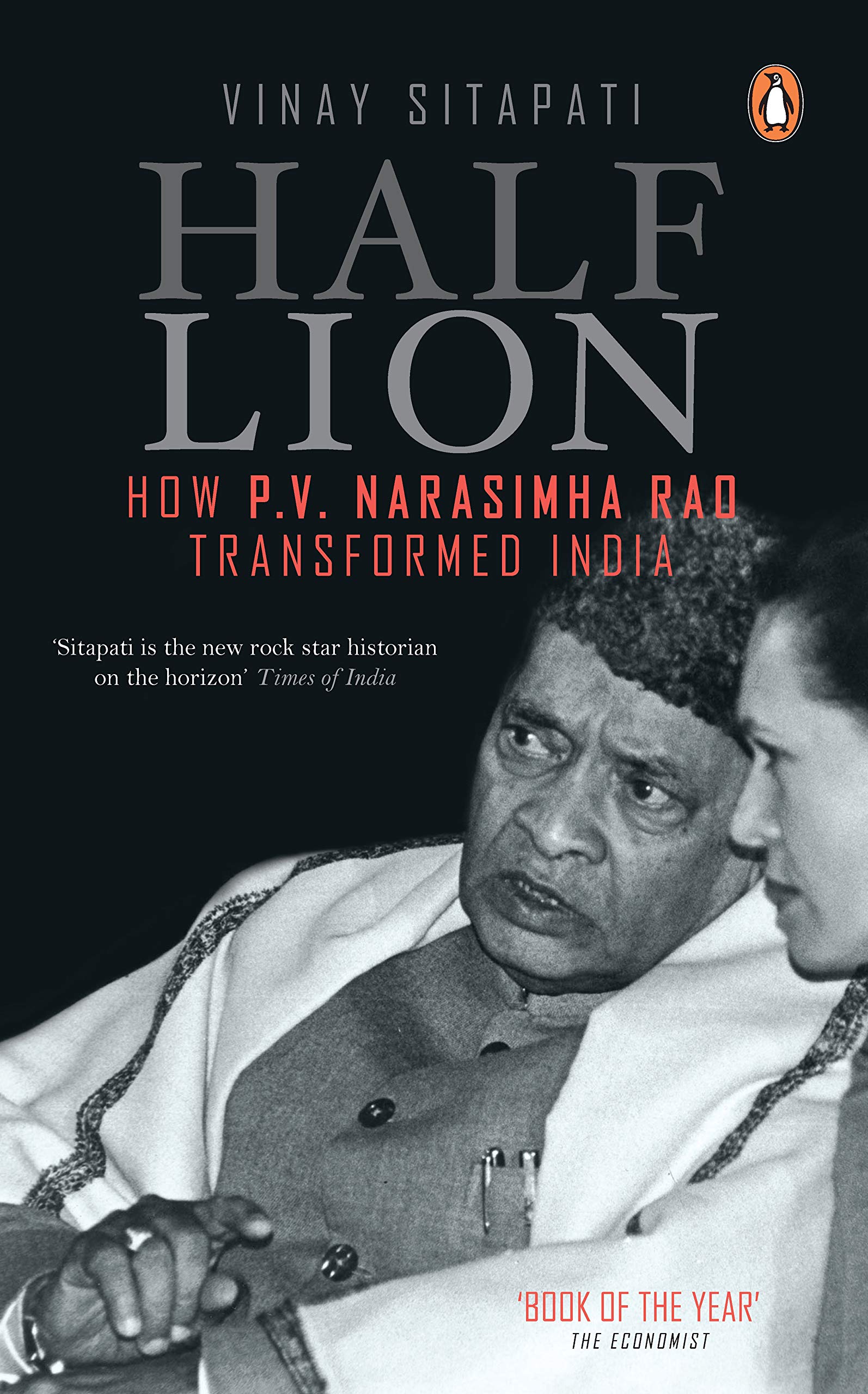
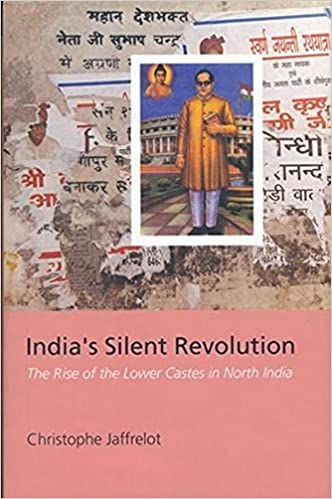
Compiled by Prashant Jha. To see why he picked these books, click here
