
From the gloom of the 1980s, economic reforms and a rising external profile saw India finally finding its space in the world. It helped that domestic politics swung from extreme instability to the institutionalisation of coalitions. But there were alarm bells.
The 1980s left India bruised. It faced the prospect of an economic disaster. Its internal security was in shambles, with Kashmir, Punjab and Assam facing domestic rebellions orchestrated or supported by external adversaries. Two Indian leaders – a former prime minister and a sitting Prime Minister, the mother-son duo of Indira and Rajiv Gandhi – had been assassinated in the span of seven years. Identity-based movements, both of the majoritarian and subaltern kind, had shaken the centre of Indian politics. India’s most powerful friend, the Soviet Union, had collapsed.
But from that potentially ruinous phase arose a new India.
To be sure, this India was not entirely peaceful. It was not economically equitable. It was not always political stable. It was an India where Hindu-Muslim divisions had become deeper.
But this India finally found a political model to reconcile stability at the Centre with political aspirations of regional parties. This India saw the deepening of democracy with the rise of groups which had remained politically on the margins. This India finally unleashed animal spirits of its citizens by lifting economic restrictions that had stalled growth and cautiously, but confidently, integrating with the global economy in 1991. And this India asserted its distinct space in international politics, began to be seen as the next rising power in Asia, managed to de-hyphenate from Pakistan in the global imagination, and deepened ties with a range of external actors.
India’s experience in this period – both its successes and challenges – produced its own set of unintended consequences which eventually led to the fall of the Congress and the rise of Narendra Modi. But we are getting ahead of our story, which is the political story of India’s fourth phase of the post-Independence era between 1992 and 2007.
Finding the political balance
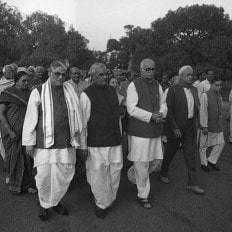
BJP MPs led by Atal Bihari Vajpayee and LK Advani at Rashtrapati Bhavan on November 23, 1992.
The key challenge for India in the 1990s was finding a new political balance which would both provide order and stability on the one hand, and accommodate the deepening of democratic aspirations reflected in the rise of regional and caste-based formations on the other. This tension was evident since the 1977 elections. But a set of unique circumstances – particularly Indira Gandhi’s assassination, which triggered the biggest electoral majority ever for a single party in India’s history in 1984, and Rajiv Gandhi’s assassination, which led to the return of the Congress leading a minority government in 1991 – had arguably delayed its concrete manifestations. The Janata Party government and the National Front government could not last, but they were the harbinger of a broader trend.
This tension manifested itself most acutely in 1996. The Bharatiya Janata Party (BJP) emerged as the single largest party for the first time in Indian history, with President Shankar Dayal Sharma, somewhat controversially, inviting Atal Bihari Vajpayee to form the government. The BJP’s inability to win over allies – it was then seen as a political “untouchable” because of its perceived communal politics – meant that the government fell in 13 days.
A range of regional parties together formed the United Front. Supported by the Congress, HD Deve Gowda first became PM, to be followed by IK Gujral. In both cases, the Congress proved to be an undependable partner, and as a force supporting the government from outside, wielded power without responsibility. Both these governments fell in rapid succession, to be followed by elections in 1998. Vajpayee returned to power, this time winning the support of a set of allies. But once again, the government fell, this time in 13 months, due to the arbitrary demands imposed by All India Anna Dravida Munnetra Kazagham chief, J Jayalalithaa. India was headed to polls for the third time in four years.
Eventually, Vajpayee returned in 1999, forming the government and (almost) completing his full term. Almost because he chose to call the elections early, a decision that would prove to be fateful for his party’s political fortunes. The Congress emerged as the single largest party in 2004, which led to the United Progressive Alliance (UPA) government.
In sum, India underwent a period of political instability, giving rise to despair about the country’s democratic order. Questions were asked about how the Centre would hold, given the level of political fragmentation. India, it was declared, wasn’t ready for coalitions. But it was precisely this period of churn which led to both politicians and the electorate absorbing lessons and produced a new, more stable equilibrium.
A stable core was needed for a coalition to survive. The leading party had to be magnanimous and accommodating and internalise that the electoral mandate called for partnership and not unilateralism. But it also had to impose its writ when necessary and lead from the front. Smaller forces could seek space in the power structure and mechanisms to articulate demands, but if they exercised a veto or behaved like sovereign republics, it would be politically costly for all parties in the arrangement. It was this spirit of give-and-take that eventually saw Vajpayee preside over a large and seemingly unwieldy coalition for five years, and then Manmohan Singh and Sonia Gandhi preside over an equally large and unwieldy coalition for 10 years.
There can be varying assessments of their respective tenures, but the point was that after a period of political instability, India had found its political balance. There was order. Central authority was reestablished. And India was back to having stable governments. At the same time, there was also a plethora of voices from states, social groups, and even civil society that had to be accommodated for both political survival and performance legitimacy. This balance was not perfect. In fact, it also produced disillusionment and eventually gave way to a single-party majority. But underlying it was a story of resilience and triumph. The fragmentation of polity had deepened India’s democratic character. And national and state parties had found ways to compete and collaborate at the same time.
From growth to inclusive growth
This political churn was happening in the backdrop of tremendous economic change. The 1991 economic reforms were both a culmination of the period of crisis that India confronted in the late 1980s, and the inauguration of a new chapter in India’s political economy trajectory.
India became economically free, or more free than it had ever been in the post-1947 period. It became easier to set up businesses. It became easier to import. It became easier to export. It became easier to employ people, though it was still hard to fire them. It became easier to create wealth without the State breathing down your neck, or treating you as potentially suspect. There was a private education boom. The service sector, particularly information technology services, flourished. Employment opportunities opened up.
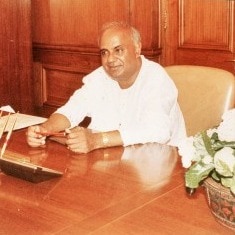
Prime Minister HD Deve Gowda on June 4, 1996.
The pace of urbanisation increased. Indian corporates suddenly found themselves on the global corporate high table. The middle class expanded. The financial markets began maturing. Investment opportunities grew. Infrastructure spending increased. The aviation sector opened up, leading to a competitive landscape which suddenly gave consumers options than they did not have earlier. There was a telecom revolution, with India becoming more connected than ever as mobile telephony grew.
But there were limits to this growth trajectory. This had two elements. On one hand, inequality was growing. The retreat of the State extended to areas where it needed to have a central role, particularly health and education. Growth was not accompanied by employment creation of the scale India needed. Trade unions and social movements weakened, even as the trend of informalisaton of labour intensified. There was restlessness in rural India. Land acquisition battles intensified. And what was perceived to be a rejection of the “India Shining” claims of the Vajpayee-led government gave way to a recognition that growth in itself was not sufficient, it had to be inclusive. And this gave way to a new spate of social welfare legislations in the UPA years. The National Rural Employment Guarantee Act was a radical intervention in the labour market and became what is now an entrenched feature of India’s welfare architecture.
There was, as Montek Singh Ahluwalia, one of the architects of the reforms trajectory, put it, a broad consensus for reforms, but this consensus did not go deep enough. So even as all governments post-1991, including the UF government which had the participation of the Left, and the BJP-led government which had to contend with a strong Swadeshi lobby within its ideological fraternity, continued with reforms, there was hesitation in moving towards second-generation reforms that would generate additional wealth and opportunities. The presence of the Left as a key pillar of the UPA arrangement meant that even reforms on which there had been a broad consensus slowed down. Disinvestment was put on the backburner. Labour reforms were not pursued. Political elites found it hard to balance the competing demands of industry and farmers on land acquisition. And the reforms did not generate what was the only possible pathway to massive employment generation – a manufacturing boom.
But the political economy story between 1992 and 2007 – despite inadequate reforms, despite the absence of a revival in manufacturing, and despite the inequities – was one of hope and optimism. India was finally finding its economic feet. It was willing to give up on semi-socialist dogmas which provided neither wealth nor equality. There was a willingness of the State to step back. The private sector, when given a degree of legislative and operational freedom, showed what it was capable of. Consumer choices increased. And it appeared like India could simultaneously create wealth and battle poverty.
The foreign policy trajectory
This political change and economic transformation was happening even as India faced a different world. The collapse of the Soviet Union intensified trends that had been underway in India’s foreign policy orientation over the preceding decade, but now assumed urgency.
Deepening ties with the United States (US) became a priority – and the US, tempted by the Indian market as well as India’s potential role as a bulwark against China, began to first cautiously and then confidently reach out to India. India’s nuclear tests triggered sanctions and western fury initially, but eventually paved the way for India’s integration into the global nuclear order and forced Washington to engage in the most serious strategic conversation with New Delhi till that point. Strobe Talbott and Jaswant Singh laid the foundations for a historic Bill Clinton visit in 2000. And while Washington had traditionally been seen in India as partisan to Pakistan – indeed, even in the 1990s, its role in pressuring India on international platforms and bilaterally was intense – the Kargil War represented a departure. For the first time, Washington’s political muscle and diplomatic capital was not directed at India, but at Pakistan, with Clinton reading the riot act to Nawaz Sharif at a meeting on July 4, 1999 to withdraw troops. The growing strategic and economic convergence was taken forward by successive American administrations and successive Indian governments. Clinton and Vajpayee, George W Bush and Manmohan Singh, all played their part in deepening ties, eventually culminating in the historic India-US nuclear deal. The 1998 nuclear rupture gave way to the 2008 nuclear pact.
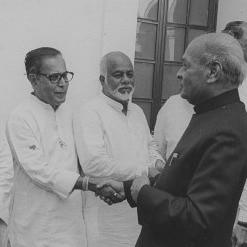
Prime Minister PV Narasimha Rao shakes hands with Planning Commission deputy chairman Pranab Mukherjee as Union Minister CK Jaffer Sharief looks on. HT Archive
Even as a Delhi-Washington rapprochement was underway, India’s ties with China remained stable. The border was largely peaceful. On Kargil, even the Chinese did not come out fully backing Pakistan. High-level engagements continued. In 2003, during Vajpayee’s visit to Beijing, China recognised that Sikkim was a part of India even as India assured China that it recognised Beijing’s claims over Tibet. As former foreign secretary Shyam Saran has recounted, in those years, the key message from the Chinese leadership to India was that while the territorial dispute was a legacy of history, it would be in mutual interest to resolve it early; both countries could grow together; and both could collaborate on a range of multilateral issues, from climate to trade. This moment did not last and it was clearly tactical in retrospect, but it did exist for a brief juncture in recent history.
India continued to face terror attacks emanating from Pakistani soil. But India was also able to create a diplomatic climate where the world began recognising the role of the Pakistani military-intelligence complex as fundamentally destabilising. The 9/11 attacks forced the world to take India’s warnings on terrorism seriously. Unfortunately, the western engagement in Afghanistan meant there were limits to how far the US was willing to pressure Pakistan. But it was during this period that sections of the Pakistani military leadership, including Pervez Musharraf, recognised the limits of the assymetric warfare towards India and made a public declaration not to allow Pakistani soil to be used for terror. The principle was never implemented in full. But it created the room for the most serious back-channel engagement between India and Pakistan, with the two sides coming close to a deal on Kashmir which would have entailed greater autonomy on both sides and softer borders. But domestic developments in Pakistan and the collapse of the Musharraf regime saw an end to the peace efforts.
In sum, here was an India which was economically stronger, whose diplomatic footprint was expanding, and which had been unapologetic about its security posture. Its ties with the superpower of the moment, the US, deepened. Its ties with its most formidable strategic adversary, China, remained stable. And it won the battle against Pakistan, both militarily and diplomatically, and came close to finding a historic breakthrough to what was an intractable dispute. Things were looking good.
The warning signs
But the fragility of India’s domestic story was laid bare by two events that happened a decade apart – 1992 and 2002.
In 1992, as a result of the Ram Janmabhoomi mobilisation, a crime was committed. The crime, in letter, was the demolition of the Babri Masjid by a Hindu mob. The crime, in spirit, was the attack on India’s constitutional values, legal system, political order and social harmony. Ayodhya triggered deep communal polarisation. Hindu groups wanted Muslims to give up a spot that they considered, as a matter of faith, the birthplace of Lord Ram. Muslim groups doubted the historical veracity of the claims, but more importantly, believed that giving in to such a demand would inaugurate a new set of issues where Muslims would be constantly asked to pay for sins of medieval rulers, and eventually stripped of their political rights and religious identity.
The demolition represented the failure of Indian secularism. But the reaction to the demolition also showed that, as a norm, secularism still held value – Atal Bihari Vajpayee distanced himself from the event; even LK Advani called it the “saddest day of my life”; BJP-led governments were dismissed; there was an unprecedented consolidation of liberal and Left civil society groups; and India was embarrassed on the international stage and had to constantly show why the event was an aberration, not the norm.
But Ayodhya would remain on the national consciousness.
Ten years later, another crime was committed. Fifty-nine Hindu pilgrims and kar sevaks who were returning from Ayodhya were killed when their train coach was burnt at the Godhra railway station, allegedly by a Muslim mob. Narendra Modi, who had recently taken over as the chief minister of Gujarat, had to deal with a period of anti-Muslim violence – and did not came across well when he framed it as a reaction to an action. Innumerable fact-finding reports pointed to state’s failure in controlling the riots, and the active role of some Sangh affiliates in the violence.
Like in the aftermath of Babri, liberal and secular India was outraged. PM Vajpayee had to instruct CM Modi to follow his “raj dharma”. India faced severe international condemnation. A large section of the non-BJP political spectrum consolidated against the government, laying arguably the seeds of the wide constellation that would come later become the United Progressive Alliance two years later. And there was a silent Muslim consolidation across the country, when the community engaged in what is often referred to as “tactical voting” – of supporting the candidate best positioned to defeat the BJP – in 2004.
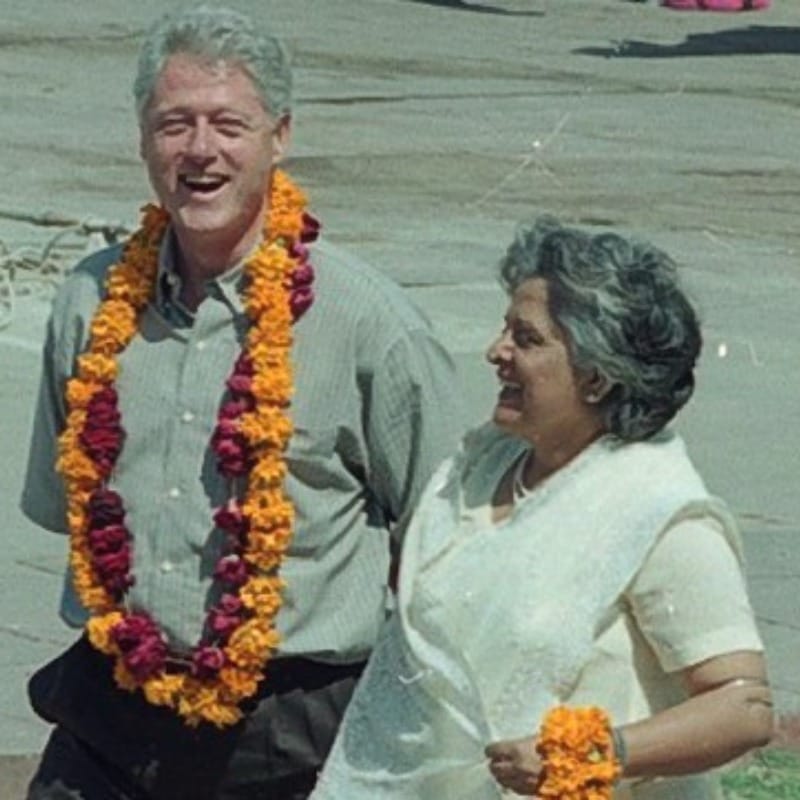
US President Bill Clinton in Jaipur.
But unlike Babri, which pushed the Hindu Right on the defensive, Gujarat 2002 was seen as an instance of Hindus having “shown Muslims their place” in some quarters. Despite initially wanting to dismiss Modi, Vajpayee had to surrender to the party base and shift his rhetoric rightward at a key Goa national executive of the party.
Modi fought and won the subsequent election, cementing his place as the Hindu Hriday Samrat. The victory would eventually give him the base to expand and emerge as a national leader ten years later, aided by the UPA’s policy and political failures as much as his ability to grow Gujarat’s economy.
While the growing communalisation of the Indian polity would eventually transform its character, that story was sometime away.
