E-Paper



Religion-based quota will lead to anarchy, says Venkaiah Naidu on Telangana move
The Union minister was referring to a bill passed by the Telangana assembly to increase reservations for Muslims in educational institutions and government jobs to 12%.


Religion-based reservations will divide the nation and create social unrest akin to what Pakistan is facing, Union minister Venkaiah Naidu said in Bhopal on Monday.
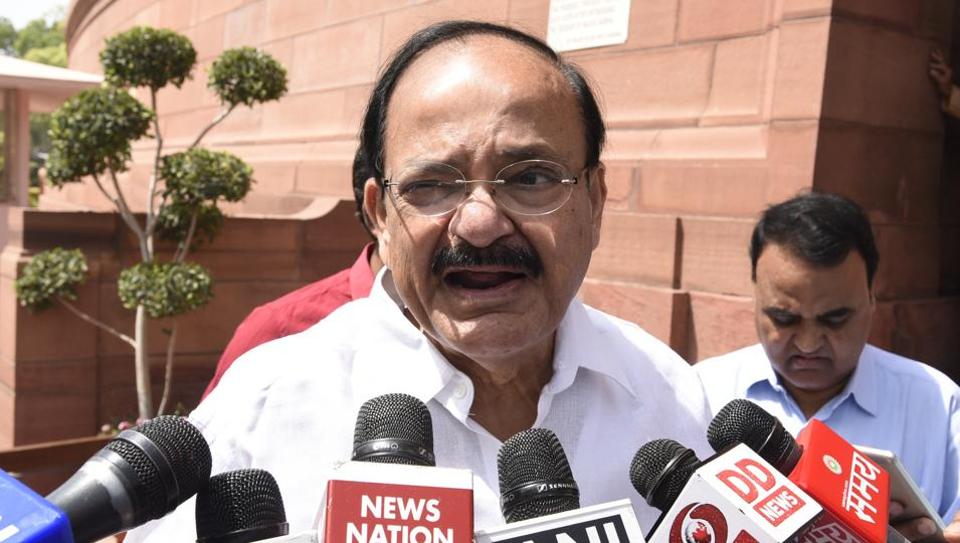
Naidu, who heads the urban development ministry, was referring to a bill passed by the Telangana assembly to increase reservations for Muslims in educational institutions and government jobs to 12%. “The NDA is in favour of reservation on the basis of social and educational backwardness, but we never favour religion-based quotas. Even our Constitution doesn’t allow it,” said Naidu, adding that many politicians in the past had made similar attempts to promote people of a certain community.
Naidu had come to the Madhya Pradesh capital with Union power minister Piyush Goyal to attend an MoU-signing ceremony for the Rewa Ultra Mega Solar Limited (RUMSL) project, intended to provide 24% electricity to the Delhi Metro Rail Corporation (DMRC) and two other companies.
In his address, chief minister Shivraj Singh Chouhan said RUMSL will provide electricity to the Delhi Metro at Rs 3.30 per unit. “This is half the rate at which electricity is currently being obtained by the DMRC. The project will be completed by October 2018,” he added.
The Mahendra Renewables Private Limited (Mumbai), Acme Solar Holdings Private Limited (Gurgaon) and Solanergi Power Private Limited (Mauritius) had won the bids to produce 750-MW electricity in the 33-hour-long bidding process to develop the world’s largest solar power project.
Goyal praised the efforts of the Madhya Pradesh government, and expressed confidence that the Rewa power project agreement would inspire other states across the country. “Our target of producing 20,000-MW electricity through solar power plants will be achieved by 2018, and Madhya Pradesh will play an important role in it,” he said.
Naidu, for his part, said the government’s objective was to provide electricity to over 18,000 villages “still living in the dark” across the country. He also spoke on the importance of water, and how saving the precious liquid was tantamount to saving lives.