
The fifth and final phase of India’s post-Independence politics has marked a shift. And Narendra Modi is both its engineer and its product.
In the middle of December in 2007, India changed.
Or more accurately, Gujarat threw up an electoral outcome that would change India.
The unexpected face of that transformation – or new India, as his government likes to call it – has been Narendra Modi, a Rashtriya Swayamsevak Sangh (RSS) pracharak-turned Bharatiya Janata Party (BJP) organiser-turned Gujarat chief minister (CM)-turned Prime Minister (PM) of India.
In 2007, he decisively won a second term as CM of Gujarat with a fusion of Hindutva and economics, setting the stage for his eventual rise in national politics. Seven years later, Narendra Modi’s national victory reflected the transformation that had already been underway in Indian society; his win then shaped a new set of changes.
The fifth phase of Indian politics will eventually give way to a sixth. Modi will eventually depart the Indian political theatre, as everyone must. But as a product of underlying changes and an engineer of those changes, what he has done to the Indian political system will outlast him.
Narendra Modi as a product of his times
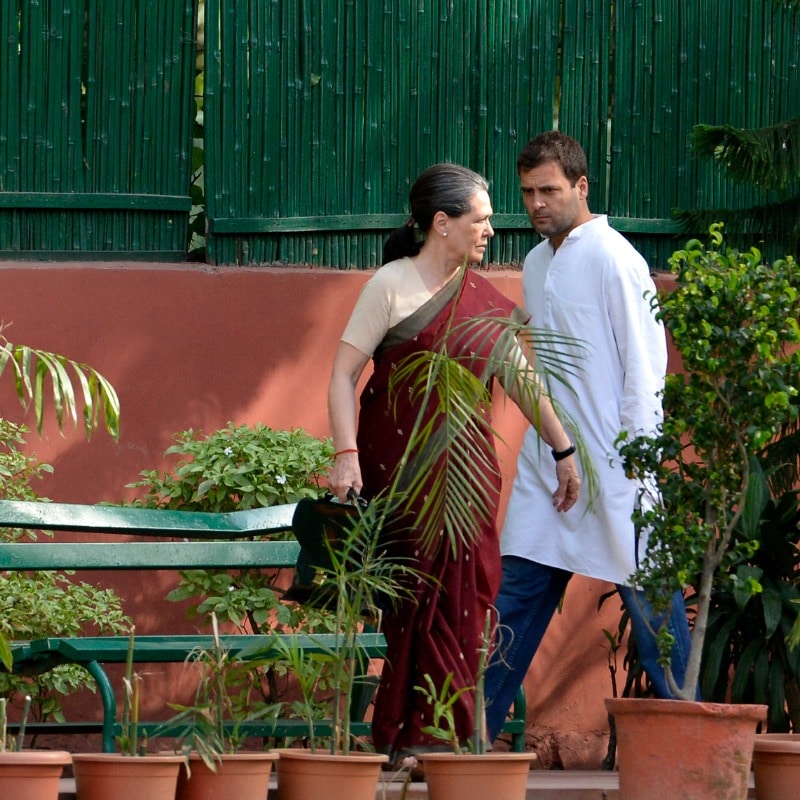
Congress leaders Sonia Gandhi and Rahul Gandhi after attending a Congress Working Committee meeting following the party’s defeat in the 2014 general elections.
Delhi in 2007 did not know that a radical shake-up of the power structure was in the offing in less than a decade.
The United Progressive Alliance (UPA) was in power under a dual power arrangement, where Prime Minister Manmohan Singh and Congress president Sonia Gandhi divided responsibilities with mixed results. It was a period of a string of social welfare and rights-based legislation. The global financial crisis was still a year away, but when it struck, India did better than most other economies. India’s external trajectory was on an upward swing. Strategic relations with the United States (US) had deepened and a nuclear deal was in the works even as India’s ties with China remained largely stable. It was the heyday of liberalism and secularism, and the BJP, under LK Advani, was seen as a spent force.
But beneath the surface, a set of changes were taking place.
The era of coalition politics had deepened democracy and given regional parties, and, by extension, states, a voice in national decision-making. But it had also produced disillusionment about the erosion in central state authority and the transactional day-to-day politics that is often the hallmark of coalitions. Over the next seven years, the UPA would come to be associated with precisely this transactional politics, where every minister behaved like a sovereign republic unto himself and the Congress’s dual-power arrangement struck at prime ministerial authority. India was searching for a strong party, a strong leader.
The politics of secularism had managed to ensure minority representation in political structures, a voice for minorities in civil society, and maintained, despite episodic bouts of mass crimes and riots, social harmony. The landmark Rajinder Sachar committee report showed how secularism had not gone far enough, by pointing to the dismal plight of Muslims on all socioeconomic indicators. But despite the data, secularism had begun to be increasingly associated with “appeasement” of minorities and turned hollow due to its opportunistic, non-principled application. Ever since the 1990s, it had begun losing legitimacy among large segments of Hindus who, in turn, were buying into the disingenuous narrative of how the majority was the victim in India. The UPA pointed to the threat of right-wing extremist groups, but its framing of it as “Hindu terror” mobilised the RSS politically in a manner that had not been since 1977. Despite the BJP’s depleted electoral strength, which was visible in the 2009 defeat, the Hindutva tradition within Indian politics was present and preparing for its moment.
The post-1991 political economy consensus had led to an unprecedented expansion in the middle class, reduction in poverty, made business and entrepreneurship respectable, tied India into the global economy, and unleashed aspirations. But it had begun cracking, with the UPA’s final years in office marked by a series of corruption scandals, a perception of plutocracy, inflation, and a mismatch between the rising aspirations and the cold reality of limited opportunities and growth that did not create enough jobs. The India Against Corruption (IAC) movement, led by Anna Hazare and Arvind Kejriwal in public, and supported by a gamut of anti-Congress forces in private, capitalised on precisely this perception of crony capitalism and the search for a “clean leader” who would shake up the manner in which Delhi operated. IAC neither had the political machinerynor the leadership to capitalise on the disillusionment with the status quo that it had done so much to deepen. But the disillusionment was real, and the search was leading citizens towards a leader perceived as “clean” and honest, with no family interests nor a history of corruption.
The politics of social justice, reflected in the rise of Mandal politics, had brought newer social groups into power structures and shaken upper-caste hegemony across the Hindi heartland. But its very success had produced both restlessness among upper castes looking for a political home and a search for a broader political identity among smaller, marginalised and fragmented caste groups who felt they did not get the dividends of political and economic empowerment post-Mandal.
India’s foreign policy had notched up a set of successes – deeper ties with the US, a fragile but stable enough framework governing relations with China, successful de-hypenation from Pakistan and a growing global consensus about Pakistan’s role as an exporter of cross-border terrorism, and the rise of Indian soft power. But restraint against Pakistan, especially in the wake of the 26/11 attacks in Mumbai, had clearly left a yearning for stronger action against Pakistan.
Into this void walked Narendra Modi.
He was a product of the times and fulfilled a certain desire within the Indian electorate – the desire for a strong leader (he had run Gujarat as a one-man show for the preceding 12 years); the desire for a Hindu leader; the desire for a clean leader (his rhetoric against corruption struck a chord, as did his remarkable personal story which remained untainted by any scandal); the desire for a pan-India leader beyond caste divide (he leveraged his social background as a member of a backward class, but his focus on the larger identities spoke to the electorate, both urban and rural, both “upper caste” and the more marginalised); and the desire for a stronger national security hand (he had made Pakistan an issue in both his elections in Gujarat and nationally). He projected himself as all of this, enabled by shrewd and innovative use of social media and a return to mass rallies as a form of political campaigning. With this narrative, Narendra Modi arrived in Delhi.
Narendra Modi as an engineer of his times
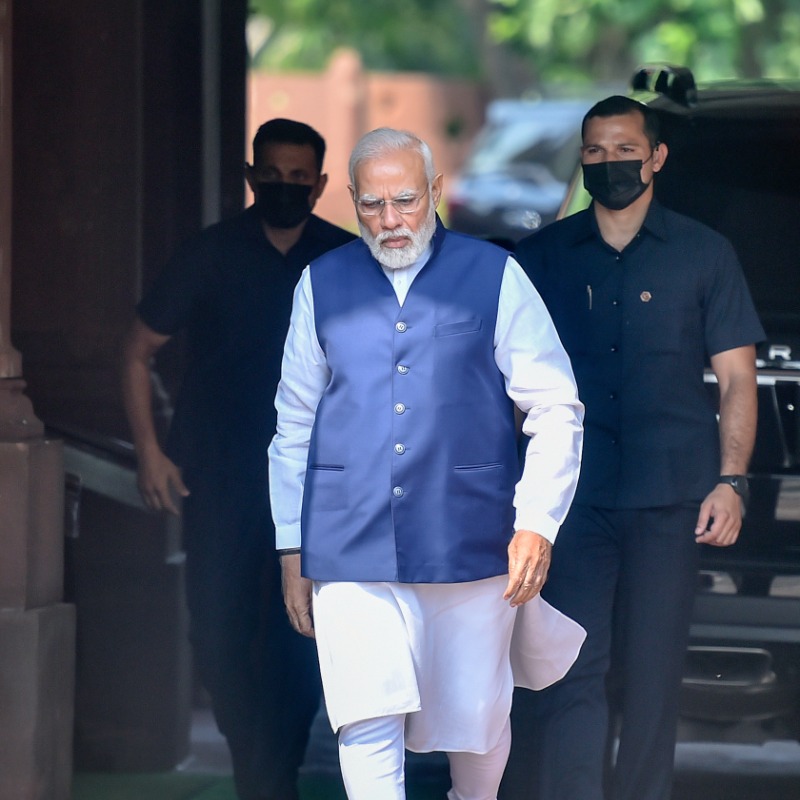
Prime Minister Narendra Modi arrives in Parliament on July 18, 2022.
Modi’s victory may have been a product of a unique set of circumstances. But the fifth phase in Indian politics has also been marked by Modi as an engineer of change
The first change – and this remains work in progress – is political. Who would have thought just a decade ago that it was possible for a party to win a majority of the seats in the Lok Sabha? The BJP under Modi has done it twice. Who would have thought that it was possible to create a large coalition of extremes, bringing together both the most powerful so-called upper-caste groups with the most marginalised caste groups, in the Hindi heartland and sustain this coalition? The BJP has done that not one, not twice, not thrice, but four times in Uttar Pradesh – in 2014, 2017, 2019, and 2022. Who would have thought that it was actually possible for India to actually head towards a political landscape where the Congress would be stripped of power across large swathes of India, merely have two states to govern, and win less than one-tenth of the seats in the Lok Sabha? But that is precisely what has happened, with the party getting wiped out in north, west and central India in two national elections and left in power in just Rajasthan and Chhattisgarh. Who would have thought that the politics of Mandal, represented by “social justice parties” in UP and Bihar, would see a radical reset? But the dwindling political fortunes of Lalu Prasad and Mulayam Singh Yadav and their families reflects precisely that. Who would have thought that the BJP would become the dominant force in the Northeast? But with consecutive victories in Assam, and displacing the Left in Tripura, supplemented with a string of successes in forming governments in other states in the region, that is what has happened. And who would have thought that the BJP would not just be in a position to nominate and elect a president of their choice, but use the moment to first pick a Dalit and then a tribal woman to become the head of State? But that is what happened with Ramnath Kovind and now Droupadi Murmu. Indian politics is dictated by the BJP’s agenda.
The second change is administrative. The BJP’s electoral victories, both in 2014 and 2019, were driven by Modi; this meant he had absolute authority. In terms of decision-making, as prime ministerial authority rose, the cabinet system weakened. The Prime Minister’s Office, after a period of steady erosion under UPA, centralised decisions with only select ministers enjoying any meaningful autonomy. This has reduced everyday corruption which was the hallmark of Delhi, but also led to policymaking without the adequate checks, balances and filters that are perhaps needed.
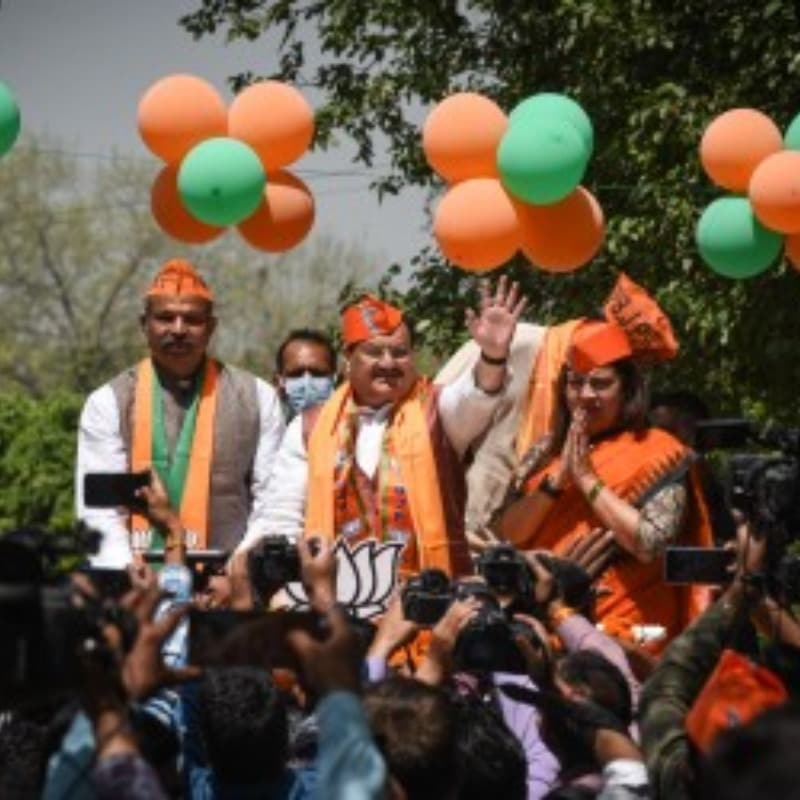
BJP president JP Nadda with party leaders Adesh Gupta, Meenakshi Lekhi and their supporters in a roadshow in New Delhi on April 6, 2022. HT Archive
But the major overhaul has been in terms of delivery mechanisms. Building on the infrastructure that the UPA created, but politically owning it and scaling it up, Modi has revolutionised how welfare is delivered on the ground. From gas cylinders to toilets, rural housing to direct income assistance to farmers, provision of piped water to households to provision of free ration during the pandemic, the India administration today has an infrastructure which can minimise leaks. Modi has displayed laser-like focus on setting ambitious targets and monitoring project implementation. The Indian State became more both more centralised, but also a more efficient welfarist State.
The third change is ideological. The politics of secularism, from being a badge of honour, lies discredited. Even the symbolic representation of minorities in the political structure was eroded with the BJP unapologetically fashioning its electoral and policy appeal around Hindu sensibilities. Long-held ideological promises were finally met. Article 370 in Jammu & Kashmir was effectively abrogated, the state was bifurcated, and from a state, its status was diluted to that of two Union territories. An enabling environment was created for the judicial verdict in favour of the construction of the Ram Temple in Ayodhya. The Citizenship (Amendment) Act was passed, promising expedited citizenship to non-Muslim minorities from neighbouring countries. In line with a judicial order, an exercise to update the National Register of Citizens exercise was conducted in Assam.
BJP-ruled states passed a raft of laws against inter-faith marriages. In educational institutions seen as liberal or Marxist entered saffron apparatchiks. The Indian State became more Hindu, in its representation patterns, ideological beliefs, and governing norms.
And the fourth change is institutional. India’s governing party, particularly the Congress, during its years in power, consistently undermined India’s democratic and watchdog institutions. But in its scale, intensity and frequency, the intervention by the current political executive in criminalising political dissent, ramming through key legislation, weakening state rights, expanding the power of the police and federal agencies, and influencing social media and sections of traditional media, has been significant.
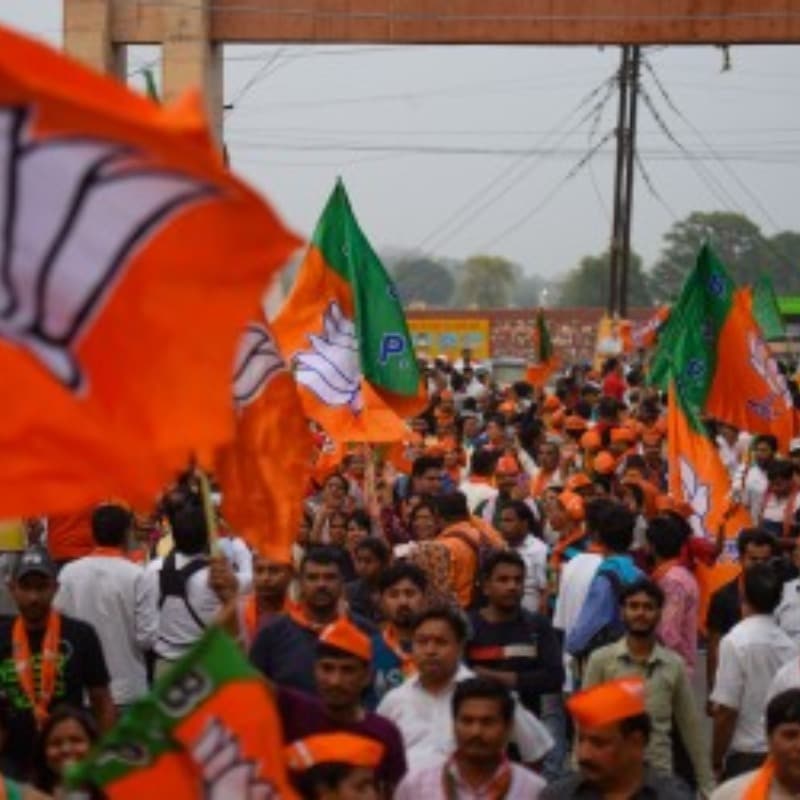
BJP supporters during a roadshow for the by-elections to the Rajinder Nagar assembly constituency in New Delhi on June 19, 2022.
In this fifth phase of politics, symbolised by the rise and then the reign of Narendra Modi as the most powerful Prime Minister the country has seen in at least four decades, India has changed. Democracy has deepened, but it has also faced new, more grave, challenges. Welfare has become more efficient, but economic challenges have increased. New Delhi’s strategic value in the international system has grown, but its vulnerabilities and security challenges have increased.
The legacy of this period will shape India’s trajectory as it heads towards the centenary of its Independence.
