
While the Bharatiya Janata Party (BJP) would a big defeat in the 2009 general elections, the stage for creative destruction of the party’s old politics was being set in the state of Gujarat. Narendra Modi, who was the chief minister of Gujarat, married his Hindutva appeal to an economic narrative, catapulting him to the BJP’s prime ministerial candidate in the 2014 elections.
While the Bharatiya Janata Party (BJP) would face an even bigger defeat in the 2009 general elections, the stage for creative destruction of the party’s old politics was being set in the state of Gujarat.
Narendra Modi, who had been appointed the chief minister of Gujarat in 2001, courted a lot of criticism when he decided to prepone the assembly elections in Gujarat in the aftermath of the 2002 communal riots. In realpolitik terms, the decision paid off and the BJP achieved its biggest ever victory in Gujarat in 2002. Any speculation that the BJP’s 2002 success in the state was a one-off phenomenon was laid to rest when the 2007 and 2012 results were declared and the BJP almost replicated its 2002 performance in the state.

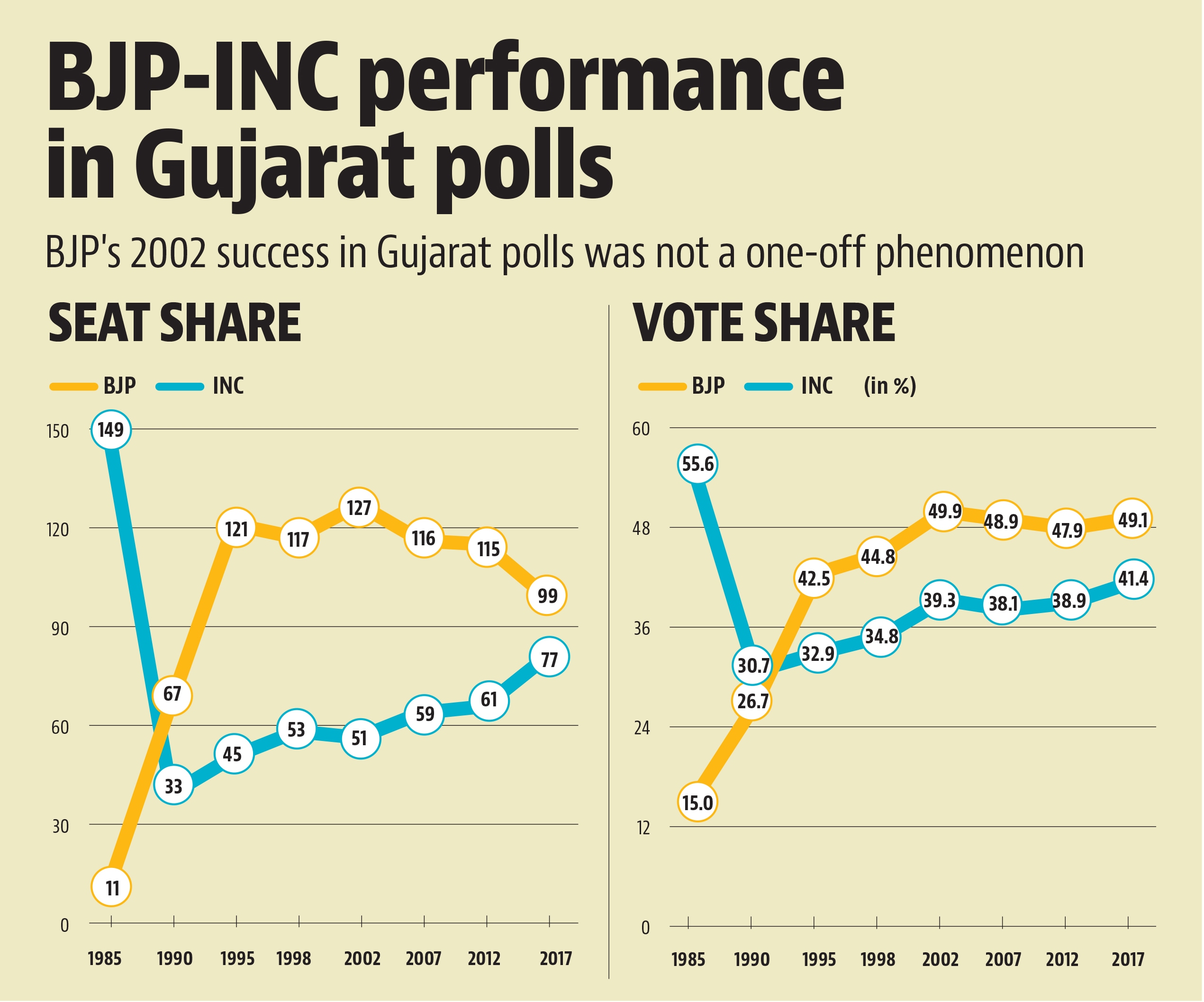
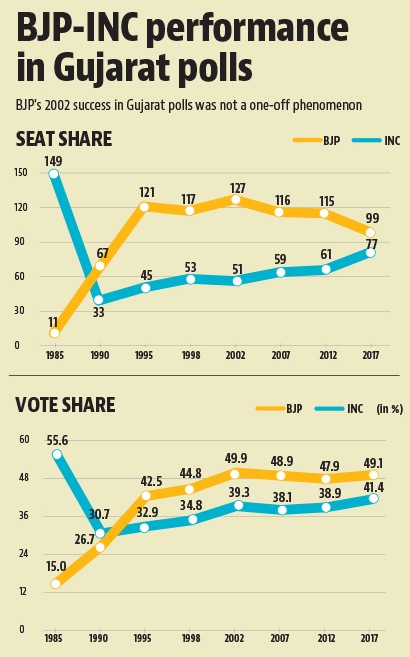
The political genius of Narendra Modi lay in fact that he married his Hindutva appeal to an economic narrative. The signs of this were visible as early as in 2003, when Modi, as the chief minister of the state, launched the first Vibrant Gujarat summit courting both domestic and international capital. In the later years of Modi’s chief minister-ship, the summit would become the biggest stage of what came to be known as the Gujarat Model of economic development. It was this formidable mix of Hindutva and development appeal which catapulted Modi to the BJP’s prime ministerial candidate in the 2014 elections.
While the BJP’s rank and file was galvanized behind Modi’s appeal – to be sure, some old allies such as Nitish Kumar of the Janata Dal United did walk out of the NDA – the incumbent Congress government was facing a double whammy of a macroeconomic crisis and multiple allegations of corruptions. Large-scale anti-incumbency coupled with a powerful campaign by Modi led BJP made the BJP the first party after 1984 to achieve a majority of its own in the Lok Sabha in the 2014 elections. The Congress recorded its worst ever performance, managing to get just 44 seats in the Lok Sabha. 166 out of the 282 BJP MPs came from constituencies where the Congress candidate was their nearest rival, suggesting that the BJP exploited the Congress’s vulnerability to the hilt. The BJP would achieve an even bigger victory in the 2019 general elections, once again performing much better against the Congress candidates than the other parties.
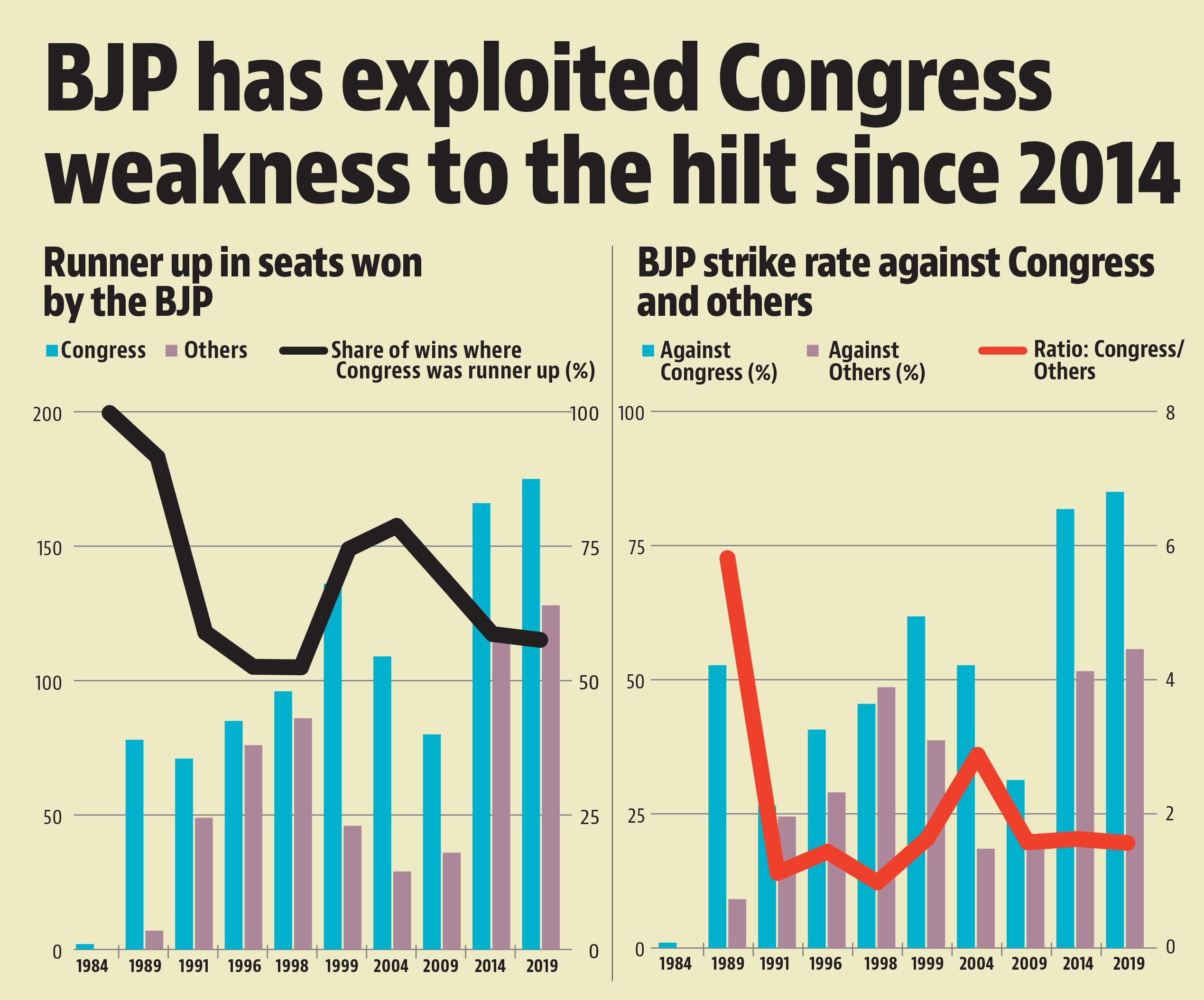
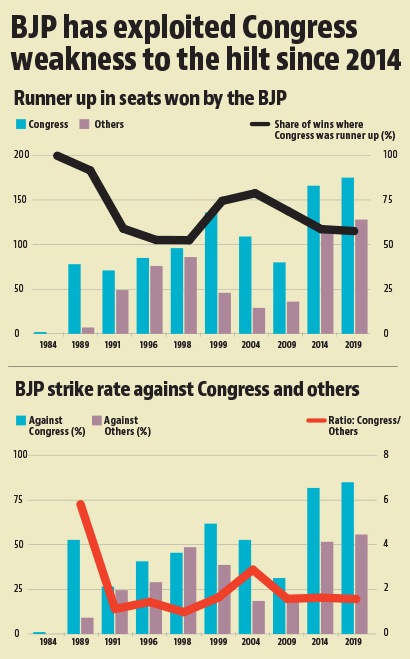
While the BJP under Narendra Modi has a clear edge in terms of national contest vis-à-vis the Congress or other regional players – this is best seen in the difference in the BJP’s vote share in national and assembly elections – questions remain about its political strength in contests at the state level. This was seen in the Gujarat elections of 2017 (which the party won), Rajasthan, Madhya Pradesh and Chhattisgarh elections of 2018, Delhi elections in 2015 and 2020 and the West Bengal elections of 2021. To be sure, the BJP did manage to retain its governments in Assam in the 2021 elections and Uttar Pradesh, Uttarakhand and Goa in the 2022 elections. India will enter yet another long state election cycle later this year beginning with Gujarat and Himachal Pradesh in the run up to 2024 general elections – and the outcome of each could help answer the question whether the BJP can reach even greater heights under Narendra Modi’s.
“Despite the substantial majority won by Mrs. Gandhi in the AICC, the Congress (R) had lost about forty percent of its organisational strength compared to that of the undivided party”, Frankel writes.
The fact that Indira Gandhi became the undisputed leader of the Congress after the split, also sowed the seeds of individualism bordering on cult within the party’s ranks, the worst manifestations of which were to be seen when Gandhi imposed the emergency in 1975. The fact that the first non-Congress prime minister, Morarji Desai was a former Congressman who walked out of the party after a factional battle with Indira Gandhi is the biggest vindication of this argument.
