
The first fifteen years of independent India were marked by the domination of the Congress. But a major turning point was the 1967 election which heralded the rise of the Opposition. It is this push-and-pull, the transformation of the Congress and the rise of the BJP and regional parties that signified the politics of this era.
Representation data can help us understand the larger political transformations in India’s democratic journey – and since this data is available only from 1962, that’s the year from which we start our journey.
The rise of the opposition in the 1960s, the transformation of the Congress Party under Indira Gandhi, fluctuations in politics in the 1980s, and the rise of the Bharatiya Janata Party (BJP) and new regional parties in the 1990s have all played a key role in transforming political representation at the national level.
Did the rise of the opposition in the 1960s lead to an immediate re-composition of India’s political class? Have elections become more competitive at the individual level over time? What did major processes of change mean for the representation of women and minorities? To what extent has political power been concentrated or distributed over time?
1947-1962: Congress dominance
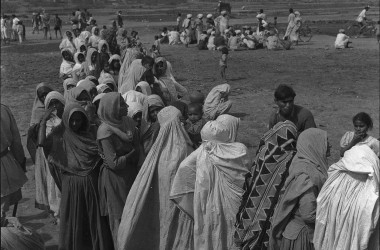
People stand in line to cast their vote at a polling station.
The first fifteen years following Independence were marked by the dominance of Congress. The centrality of the party in the national imagination, its control of the state machinery, the towering presence of Jawaharlal Nehru and a fragmented, regionalised opposition enabled Congress to win three of the four largest majorities ever seen in India (74.2% average over the first three elections), with the three highest vote shares obtained by a single party (45.8% average over the same period). The Congress was to better its own performance only in 1984.
The Congress’s dominance also came from the deployment of a formidable organisation, theorised by Rajni Kothari in 1964 as the “Congress system”.
This system integrated everything one needed to build and consolidate an organisation — ideological pluralism (there was room for all kinds of views and ideas), officeholders with an elitist profile recruited among locally dominant groups, and the right caste-based networks, adapted to local social, political and economic circumstances.
1962-1977: the rise of the opposition
The Congress system worked for the first 29 years or so, but ultimately cracked under both internal and external pressures. The rise of Indira Gandhi soon after her father’s death, and the internal tussles that followed her elevation, led the Congress to split both nationally and regionally in at least five instances between 1964 and 1969.
At the same time, successful alliance experiments among regional parties would lead to the re-organisation of the opposition space, increasing the competitiveness of India’s elections and challenging the Congress at the regional level first.
In 1967 came the first major electoral turning point after India’s Independence. The Congress lost 60 seats in the Lok Sabha, though it remained the most dominant party by far. More importantly, for the first time, it lost six major state elections in one go, mostly against opposition alliances.
From there on, the formula to defeat the Congress was on the table. Indira Gandhi’s authoritarianism gave the impetus the opposition needed to temporarily set aside their differences and rally behind the figure of Jayaprakash Narayan. The rest, as they say, is history. A united opposition defeated the Congress for the first time in 1977, at the end of 18 excruciating months of the Emergency.
What did these massive shifts mean in terms of representation? The short answer to this question is — not much. Groups that were under-represented under the Congress regime remained by and large under-represented under new governments, too. At least initially, the rise of the opposition did not lead to a significant reconfiguration of India’s national political class. Three examples illustrate that point.
Muslims representation at its lowest
Between 1962 and 1977, 111 Muslims were elected out of 2074 MPs. 62 of them won on Congress tickets, against 18 elected on socialist party tickets (mainly the Bharatiya Lok Dal in 1967). Ten Muslim MPs were elected under the Muslim League banner in Kerala, seven under the two main communist parties. The remaining 18 were elected under various other affiliations, including seven independent candidates.
Even though the Congress still received wide support from Muslim communities, it never felt compelled to provide them with substantial representation. What is also striking is that even if some Muslim MPs found a place among the socialists, they remained extremely marginalised. In fact, at 5%, their share of representation among the socialists is identical to that in Congress.
Women’s representation
Women were also absent from the Lok Sabha in the early years. Between 1962 and 1977, only 310 women contested, out of 9577 candidates. 114 were elected, of whom 76 won on a Congress ticket. Only three of the 57 Jan Sangh MPs elected over the period were women.
Despite socialist icon Ram Manohar Lohia’s professed commitment to gender equality, the socialists did not provide any space for women’s participation. Of the 356 MPs elected on a socialist party ticket between 1962 and 1977, only 8 were women. In fact, women’s representation hit its lowest point in 1977, at 3.5% — arguably, the dissident factions of the Congress and other components of the Janata government also shared responsibility for this. Compared to 1971, the number of women elected to the Lok Sabha dropped from 27 to 19 in 1977.
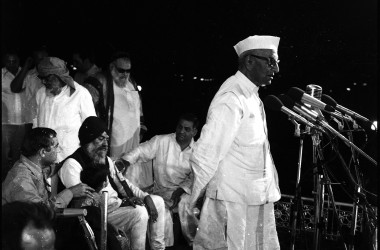
Morarji Desai takes oath as Prime Minister at the Ramlila Ground, New Delhi.
The age of savarnas
Finally, despite the significant political shifts that took place during these 15 years, the caste profile of the Lok Sabha did not change much, at least in the Hindi belt, for which data is available.
Between 1962 to 1977, upper castes formed the largest contingent of Hindi belt MPs (53.2% of all MPs on average), ahead of intermediary castes and Other Backward Classes (11.7% and 4.1% of all Hindi belt MPs) and way ahead of Muslims (4.6%).
The representation of upper castes was way more than twice their demographic weight.
When we look at opposition parties, we see that the caste profile of major players did not differ much from the Congress’, the only variation being the degree of upper-caste dominance.
Until the rise of Chaudhary Charan Singh, socialist MPs elected in general seats mostly belonged to the upper castes. In the Hindi belt, the upper castes made up 45% of all socialist MPs between 1962 and 1977, or 61% of all socialist MPs elected in general seats (120 out of 198). This dominance of the upper castes was even more pronounced among the leadership. Thus, when the BLD swept the Hindi belt, it got more upper caste MPs elected from these states than the Congress ever did since 1962 (104 out of 220 MPs).
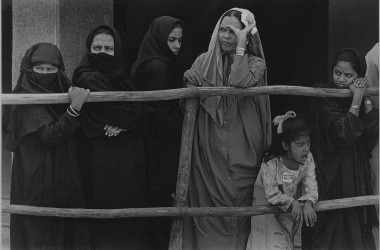
Women stand in a queue at a polling booth in New Delhi’s Nizamuddin.
Upper caste representation was even higher in the Jan Sangh, then a weaker party. In the Hindi belt again, 39 of their 44 MPs elected in general seats belonged to the upper castes. Overall, they made nearly 70% of all Jan Sangh’s MPs.
The rise of the opposition took place through alliances between parties that, for the most part, were divided houses but at the same time sociologically homogeneous. The divisions were ideological and strategic, and elections were not fought alongside ascriptive identities. This would take place in subsequent phases of India’s electoral history.
As Rajni Kothari has explained, the brand of electoral politics that the Congress built during the first few decades would also lead to the development of practices and a political culture that would define and shape modern democratic politics in India. Underneath this world of ideas lay the reality of factionalism, patronage, corruption, and elite accommodation. Such has been its lasting influence that every party that thrived in a post-Congress system India emulated some of these practices and adopted some elements of this culture of ruthless pragmatism that characterises party politics in India even today.
