
From the era of Nehruvian stability, India entered a period of political transition, intensified strategic challenges, and a social churn. Through all of it, Indira Gandhi’s rise both deepened and subverted democracy.
For the first 15 years of independence, Prime Minister Jawaharlal Nehru’s leadership had provided political stability. The legacy of the freedom struggle, and the fading away of his contemporaries and seniors, had left him as the unchallenged leader of the Congress.
The Congress’s political hegemony gave him the ability to deal with internal challenges — national consolidation was imperative after centuries of foreign rule and Partition; democracy and federalism had to be institutionalised even as various regions and social classes began to seek space in the power structure; the economy needed direction to both create foundations for growth but also meet social objectives; and India’s diversity and social cleavages needed to be carefully navigated to create a sense of common nationhood.
On the security and strategic front, Kashmir had remained a contentious issue since Independence and Pakistan had revealed its revisionist character ever since the first war in Kashmir. China was beginning to get aggressive and the early years of bonhomie were slowly fading away. The world was divided into two blocs and India had pioneered the non-aligned approach, seeking to intervene autonomously on each foreign policy issue rather than get tied down in superpower rivalries.
All of these were extraordinary challenges for the young republic. But irrespective of whether one agreed with Nehru’s approach during those years, his very presence lent a degree of stability. But by the early 1960s, India was entering a new political phase.
In the span of a decade, India fought three wars. By the late 1960s, Congress hegemony was finally being challenged, both by a set of Opposition parties in states and due to internal factionalism at the Centre. The economic policy took a definite leftward orientation. Social unrest was intensifying. And for the only time in modern Indian history, India suspended its experiment with democracy and declared an internal emergency, only for citizens to resoundingly reject this turn towards authoritarianism. And it was Nehru’s daughter, Indira Gandhi, who was the face of India through this churn as India turned, for better and for worse.
A defeat, a win, a triumph, a test
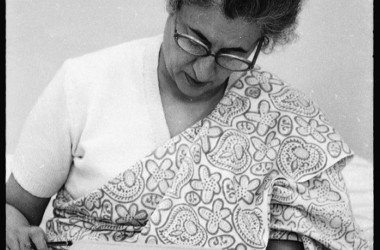
Prime Minister Indira Gandhi attends a Congress Working Committee meeting on January 6, 1971.
Despite the communists taking over and establishing the People’s Republic of China in 1949, Nehru did not let the difference in the political system, ideological outlook and method of attaining power influence his approach towards the northern neighbour. Instead, at a time when China faced international isolation, India recognised the People’s Republic. It advocated China’s inclusion in international organisations, including the United Nations. It recognised Chinese suzerainty over Tibet and struck a bilateral agreement based on the principles of Panchsheel. And it saw China as an invaluable partner in its quest to deepen the solidarity between Asian and African countries, most visibly in Bandung Conference of 1955.
Indeed, Patel’s letter anticipated some of the challenges India would face through the following decade. China took over Tibet, forcing the Dalai Lama to seek refuge in India in 1959. After being ambiguous about it in initial years, China began disputing India’s claims based on the McMahon Line and its official maps began showing territory India considered its own as a part of the communist republic. Border talks didn’t succeed. Nehru’s “forward policy”, an attempt to expand Indian military presence to prevent Chinese ingress, intensified tensions — India wasn’t military prepared to back up the forward policy with adequate strength. In October 1962, China revealed its true intentions as it invaded India both in the eastern and western theatres. And within a month, it had overrun parts of Indian territory, especially in the east — but more significantly, sent a message of dominance and superiority.
Nehru’s vision of friendship with China, and his huge strategic error in not negotiating the terms of the border settlement in the years when India’s bargaining power was higher vis-a-vis China, had led to a loss of precious political capital. His subsequent adoption of a hardline, non-negotiable position on boundaries during talks, but without the adequate investment in the military component of the battle, eventually allowed the communist regime to defeat India. Nehru was a broken man; India, 15 years after Independence, was a wounded nation.
But this military defeat also led to a reset in India’s military focus.
As scholars Stephen Cohen and Sunil Dasgupta have noted, “The foremost lesson of 1962 was that India could not afford further military retrenchment. The Indian government launched a significant military expansion program that doubled the size of the army and raised a fighting air force…A less recognized lesson of the war was that political interference in military matters ought to be limited. The military – and especially the army – asked for and received operational and institutional autonomy, a fact most visible in the wars of 1965 and 1971.”
Indeed, within three years of the war with China, India faced its old adversary, Pakistan. Deluded by a sense of military superiority and geopolitical strength due to its integration into western military alliances, and persuaded that Kashmir was ready to rebel against India, in August 1965, General Ayub Khan launched Operation Gibraltar —sending trained Pakistani armed personnel to foment trouble in the Valley. Within days, India learnt of the attempt. Kashmiris did not rebel. And New Delhi launched a military counteroffensive to repel and defeat the Pakistani intruders. The second India-Pakistan war had begun.
Lal Bahadur Shastri was now India’s prime minister. A low profile leader from Uttar Pradesh, who had risen up through the national freedom struggle and Congress organisation, Shastri aurhorised the Indian Army to open up a line of attack in Pakistan’s Punjab. Lahore was now within Indian grasp; India had also taken over key critical passes in Pakistan-occupied Kashmir. While Pakistan made limited territorial gains, the widespread consensus in strategic and academic community is that it lost the war, failing in its objective of taking over Kashmir. By September 1965, there was a ceasefire, pushed by the international community and a UN resolution. And in January 1966, at Tashkent, with Soviet mediation, India and Pakistan signed a declaration agreeing to revert to pre-August lines.
But it was soon after signing the agreement that Shastri died in Tashkent itself, inaugurating a new chapter in Indian politics as Indira Gandhi took over as the new Prime Minister.
Within five years of her ascendancy, India — yet again — was embroiled in a war. This time, West Pakistan’s decision in 1970 to dishonor the electoral verdict which would see the East Pakistan leader, Mujibur Rahman, become the elected leader of the country triggered civil unrest in east Pakistan and a refugee crisis of unprecedented proportions for India. Contrary to Pakistani narratives, Indira Gandhi did not set out to divide the country; but in her finest moment, she did not let the crisis go waste.
The lessons of 1962 had been heeded. Through 1971, India slowly built international opinion against Pakistan’s genocidal campaign in the east. It signed a treaty with the Soviet Union to pre-empt the expected American and Chinese support for Pakistan. Indian intelligence agencies worked with Mukti Bahini to mount a challenge to Pakistani forces. Indira Gandhi listened to the counsel of her military leadership and gave the forces time to prepare. National opinion favoured an intervention. And much before the idea of “humanitarian intervention” or “responsibility to protect’ became fashionable policy buzzwords in international diplomacy — often used by the West to score strategic points — India decided to help. With Pakistan launching an air aggression against India in December, New Delhi finally responded with a robust offensive in the east. In less than a fortnight, Pakistani troops surrendered, handing India its greatest geopolitical triumph as the accompanying essay by military historian Arjun Subramaniam describes.
East Pakistan was now Bangladesh. The two nation theory — that held that Hindus and Muslims were two different nations, a premise that India never accepted — was blown apart, as culture and language emerged as a primary fault line between the east and west. The geographically absurdity of the post-1947 Pakistan, where two parts of the country had no access to each other except through Indian territory and the seas, collapsed. The Simla Agreement, signed exactly five decades ago, would see India hand over Pakistani prisoners of war back, but in return, Pakistan agreed to resolve Kashmir bilaterally and informally consented to treating the Line of Control as the border, an agreement from which it subsequently backtracked.
But the big picture was that less than a decade after the China had defeated India, India had emerged into its own as South Asia’s pre-eminent power. Four years after that, India would go on to undertake a “peaceful nuclear explosion” in Pokhran, signaling its tentative arrival in the club of nuclear-haves.
The domestic churn
Even as India faced external challenges, it was going through a period of deep internal political churn.
Indira Gandhi’s elevation in 1966 was sponsored by the old guard of the Congress, including regional chieftains, who saw her as a pliable leader they could control. But in 1967, the reduced Congress majority in the Lok Sabha and the formation of non-Congress governments across north and east India, as well as in Madras and Kerala, led to the end of the party’s political hegemony. The “Congress system”, as Rajni Kothari described the party’s broad tent approach of accommodating and mediating various interest groups and social classes, was showing cracks. Tensions between the Indira Gandhi and the Syndicate grew, eventually culminating in a split in India’s grand old party in 1969.
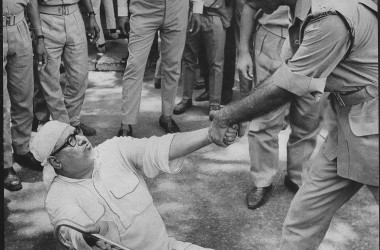
Samyukta Socialist Party leader Raj Narain is detained after a protest in front of Parliament House in June 1971.
Aided by her key advisors, who largely belonged to the Left, Gandhi also used the tensions to signal a change in India’s economic direction. She nationalised banks. She abolished privy purses. She stepped up State control of the economy and squeezed the private sector, except when it was politically lucrative. The license raj system got more entrenched. She adopted a left wing rhetoric that was, often, even sharper than that of her father. And economic freedom shrunk.
The pro-poor rhetoric, encapsulated in that iconic slogan of “Garibi Hatao”, even if it was without adequate pro-poor policies, saw Indira Gandhi defeat a united opposition which had banked on the slogan of “Indira Hatao” in the 1971 elections. By the early years of that decade, Indira Gandhi had succeeded in establishing herself as the true inheritor of the Congress legacy, sidelined her rivals, planted loyalists in key position and ensured control over key institutions. The Bangladesh victory made her seem invincible.
But as the 1967 elections had shown, there was discontent brewing in other forms. Backward communities in the Hindi heartland, who felt excluded from the Congress’s Brahman-Muslim-Dalit electoral base, had begun to assert themselves politically. Peasant and backward politics intersected in key parts. In the political theatre, the Congress dominance was bringing together strange and unlikely partners, from communists to the Bharatiya Jana Sangh, from socialists to Congress breakaway factions. In most states, these unwieldy coalitions fell under the weight of their contradictions, but a template had been set.
Even as Indira Gandhi stamped her dominance politically, there was growing economic distress. In the absence of mainstream political avenues to express discontent, student unrest hit Gujarat and Bihar in 1973. If the 1967 experiment was primarily led by Ram Manohar Lohia, the 1970s resistance was led by the Gandhian leader, Jayaprakash Narayan, who called for a “Total Revolution”. Young activists who would go on to become India’s top national leaders in subsequent decades got politically socialised during these years. And even as Indira Gandhi faced her first strong mass-based resistance in key pockets of the country, an adverse judgment of the Allahabad High Court about her electoral practices in the 1971 polls raised questions about her legitimacy.
Instead of reading the public mood, following the constitution in spirit, and exhibiting political propriety, the increasingly dictatorial Gandhi — prodded on by her young and rash son, Sanjay — declared the Emergency on June 26, 1975. For the first time, India stepped back from democracy. Fundamental rights were suspended. The freedom of press was severely curtailed. Censorship became the norm. Opposition leaders — from old Gandhians to younger student leaders — were packed into prison in thousands. Parliament was dissolved, and state governments run by the opposition were dismissed. The Congress used its unchecked power at the Centre to amend the Constitution, introducing the terms socialism and secularism in the Preamble itself. And it announced a populist programme, which led to a State-sponsored coercive approach to population control through forced sterilisations.
But while it appeared to the Congress that citizens were happy — the trains ran on time in this new authoritarian India, after all — there was anger brewing right beneath the surface. With the opposition in disarray in prison, Indira Gandhi — either due to international criticism or due to intelligence inputs that her party would win — announced elections in 1977. For the first time in independent India’s history, the Congress lost. And a conglomeration of opposition outfits, now clubbed together as the Janata Party, formed the government with Morarji Desai as Prime Minister. India had rejected Indira’s dictatorship.
The first phase of politics after India’s independence, from 1947-1962, had seen the nation arrive at a constitutional compact and slowly embark on nation-building process despite external challenges, under the broad Congress umbrella. But in the second phase, from 1962 to 1977, there was both a deepening of Indian democracy with newer social groups finding a voice as well as an attack on Indian democracy with the Emergency in a climate of intense external challenges and wars. The Congress was no longer the hegemonic player in the game. Pakistan and China were real security threats, with India defeating the former and losing to the latter. But by the end of the phase, India had proven its resilience. Democracy was back. And 1971 had eroded the stain of 1962. A new political experiment, in the form of the first non-Congress government, was about to commence. The next 15 years would bring its own challenges. And this time internal security, deepening social unrest and an economic crisis would become India’s primary focus.
