
Thanks to the leadership role it played in the freedom struggle, the Congress was the hegemonic political party when India won independence, and in the three general elections held in 1951, 1957 and 1962, the party secured either a three-fourth majority or came very close to it. Things changed drastically in the 1967 elections.
1962 was the last national election fought by the Congress party under Jawaharlal Nehru’s leadership. 1977 was the first general election when the Congress lost power in the country. This second 15-year period is best described as the phase of the dismantling of what is popularly referred to as the Congress system in Indian polity.
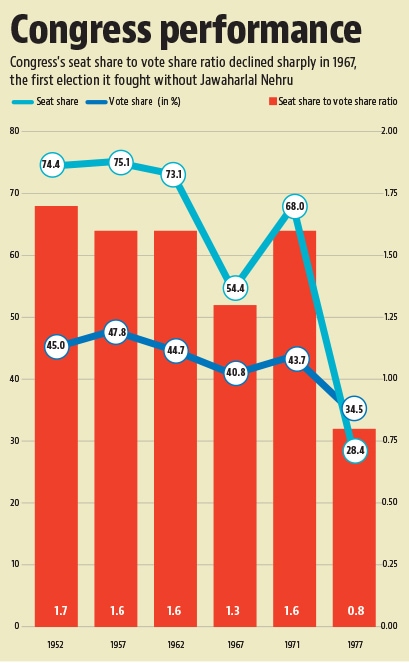
Thanks to the leadership role it played in the freedom struggle, the Congress was the hegemonic political party when India won independence. It will not be an exaggeration to say that the Congress’ narrative and programmes for nation-building had a large degree of support among the masses. The fact that no other politician outside the Congress even came close to the stature of Jawaharlal Nehru made things even more difficult for the opposition. All these factors meant that the Congress’s parliamentary strength was disproportionate to its popular support. Election statistics show that the seat share to vote share ratio of the Congress was 1.6 or higher in the three general elections held in 1951, 1957 and 1962. In all these elections, the Congress secured either a three-fourth majority or came very close to it.
Things changed drastically in the 1967 elections, which were fought under the leadership of Indira Gandhi. Even though the Congress vote share dipped only marginally – it came down from 44.7% in 1962 to 40.8% in 1967 – its seat share fell drastically. While the Congress had 73.1% of the seats in the Lok Sabha in 1962, it could win just 54.5% of the seats in 1967, coming dangerously close to losing its majority for the first time since independence. While the Congress would stage a temporary bounce-back with a two-thirds majority in the 1971 elections, it did eventually lose power in the 1977 general elections, which were held after an almost two-year period when Indira Gandhi suspended basic democratic rights during the emergency.


What exactly led to the dip in the fortunes of the Congress party during the 1962 and 1967 elections?
The best explanation of this comes from the Congress party itself, which saw it as a sign of growing discontent among the masses. In her classic text India’s Political Economy 1947-2004 political scientist Francine Frankel quotes from the Congress’s review of the 1967 general elections.
“The anti-Congress vote did not exactly represent opposition to the Congress ideology…There were certainly sections among voters for those opposition parties who supported the ideologies which these parties preached but there were those among their supporters who just wished to express their resentment against the Congress for the hardships they suffered and for other reasons”, the Congress said in its statistical analysis of the elections.
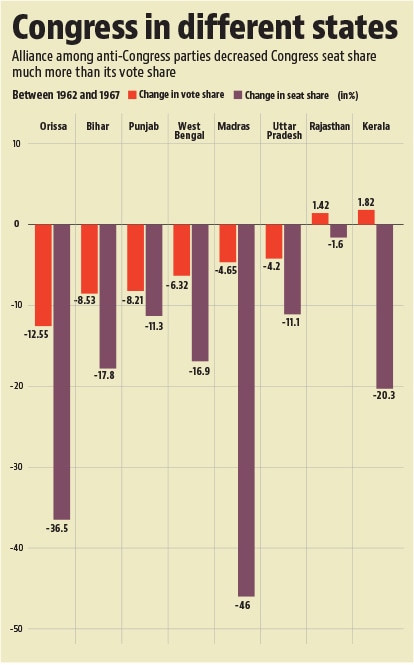
What hurt the Congress even more during this period was the ability of opposition parties, both to its right and left to exploit electoral alliances which led to a huge reduction in the number of seats won by the Congress even though its vote share did not fall by a large amount. This damage was more evident at the level of the states where even less than a five percentage point reduction in vote share led to a loss of more than 45 percentage points in terms of seat share for the Congress.
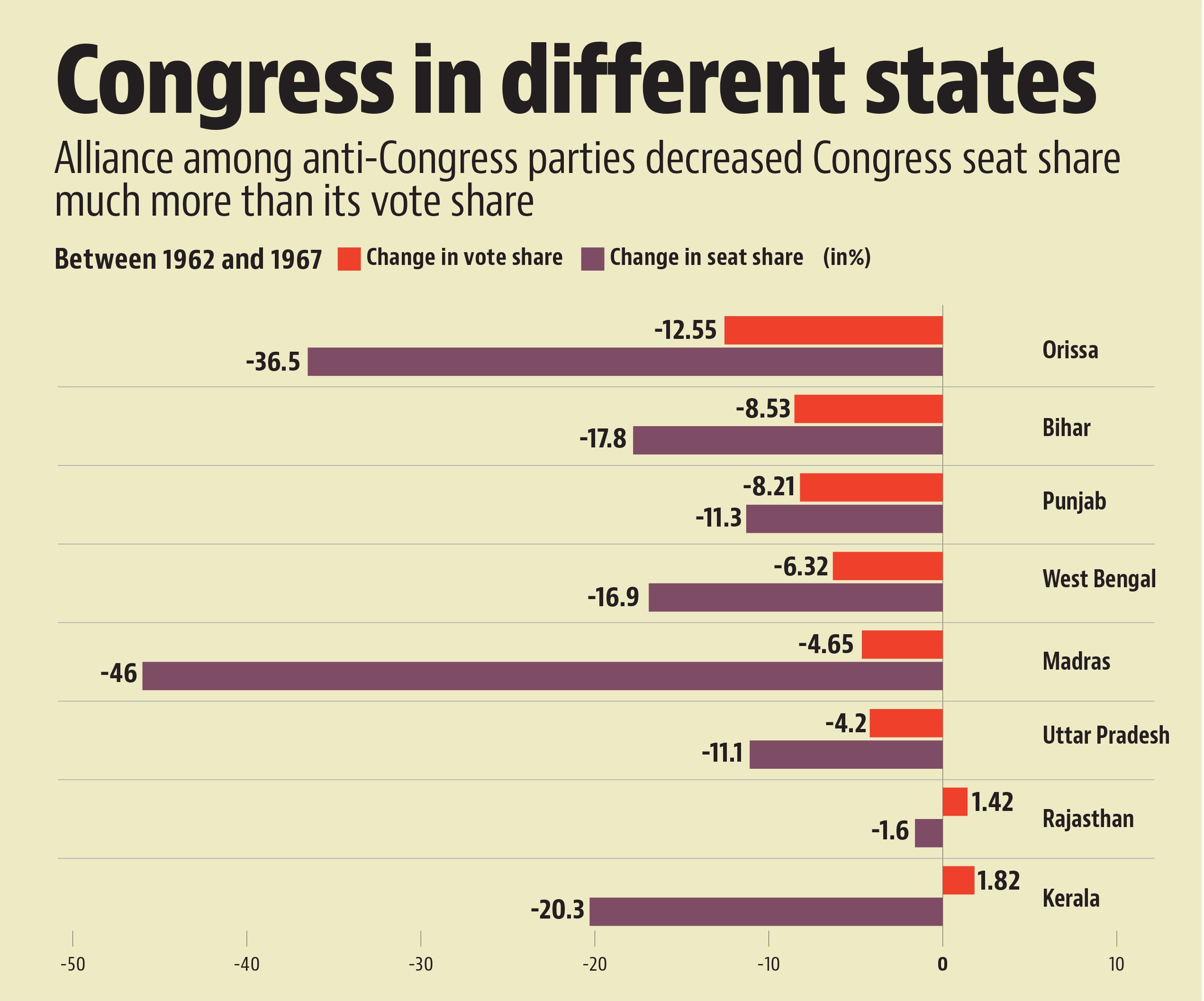
Such endeavours were helped a great deal by defections from the Congress party itself. Many chief ministers of first-time non-Congress state governments, such as Mahamaya Prasad Singh in Bihar and Ajoy Mukherjee in West Bengal were former Congressmen.
The 1967 election setback to the Congress also opened the leadership question within the party which was ultimately settled in favour of Indira Gandhi.
In the 1969 presidential elections, Indira Gandhi supported the incumbent vice president V V Giri against the Congress’s official candidate Neelam Sanjeeva Reddy. Giri managed to get elected and remains the only president who has got elected despite getting less than 50% of the votes. While this was an important political victory, it did not put an end to the factional fight within the party ultimately leading to a two-way split in November 1969. The old-guard of the party led by what was popularly known as the ‘Syndicate’ was called Congress Organisation or Congress (O) while the faction under Gandhi’s leadership was called Congress Requisition or Congress (R). While Gandhi’s faction prevailed in the short-run and managed to bounce back with a two-thirds majority in the 1971 Lok Sabha elections, the split did inflict a large damage on the Congress organisation in more ways than one.
“Despite the substantial majority won by Mrs. Gandhi in the AICC, the Congress (R) had lost about forty percent of its organisational strength compared to that of the undivided party”, Frankel writes.
The fact that Indira Gandhi became the undisputed leader of the Congress after the split, also sowed the seeds of individualism bordering on cult within the party’s ranks, the worst manifestations of which were to be seen when Gandhi imposed the emergency in 1975. The fact that the first non-Congress prime minister, Morarji Desai was a former Congressman who walked out of the party after a factional battle with Indira Gandhi is the biggest vindication of this argument.
