
1977 saw the first non-Congress government at the Centre and 1992 was the year when the Babri Masjid was demolished. While the former was the culmination of what has been described as the dismantling of the Congress system, the demolition, ironical as it sounds, laid the foundations for the hegemonic rise of the Bharatiya Janata Party (BJP) in Indian polity.
Both 1977 and 1992 are landmark years in the history of independent India. 1997 saw the first non-Congress government at the Centre and 1992 was the year when the Babri Masjid was demolished. While the former was the culmination of what has been described as the dismantling of the Congress system in the second part of this series , the demolition, ironical as it sounds, laid the foundations for the hegemonic rise of the Bharatiya Janata Party (BJP) in Indian polity. The third fifteen-year interregnum in the seventy-five years of India’s independence is about the story of churning in India’s anti-Congress politics where the political stream of the Hindu right eventually emerged as the biggest challenger to the Congress party. While it may sound preposterous at the moment, the BJP’s dominance was hardly a foregone conclusion for a large part of this fifteen-year period. The political evolution from Janata Party to the Bharatiya Janata Party is best understood by looking at three data points.
There was no pan-India political backlash of the Emergency against the Congress
While the Congress’s Lok Sabha tally fell sharply from 352 to 154 between the 1971 and 1977 elections, there was a large regional difference in its performance. In the southern states, the Congress actually increased its seat tally from 73 in the 1971 elections to 94 in the 1977 elections. The actual loss came in the rest of the country, especially in large north Indian states such as Uttar Pradesh and Bihar, where the Congress could not even win a single seat.

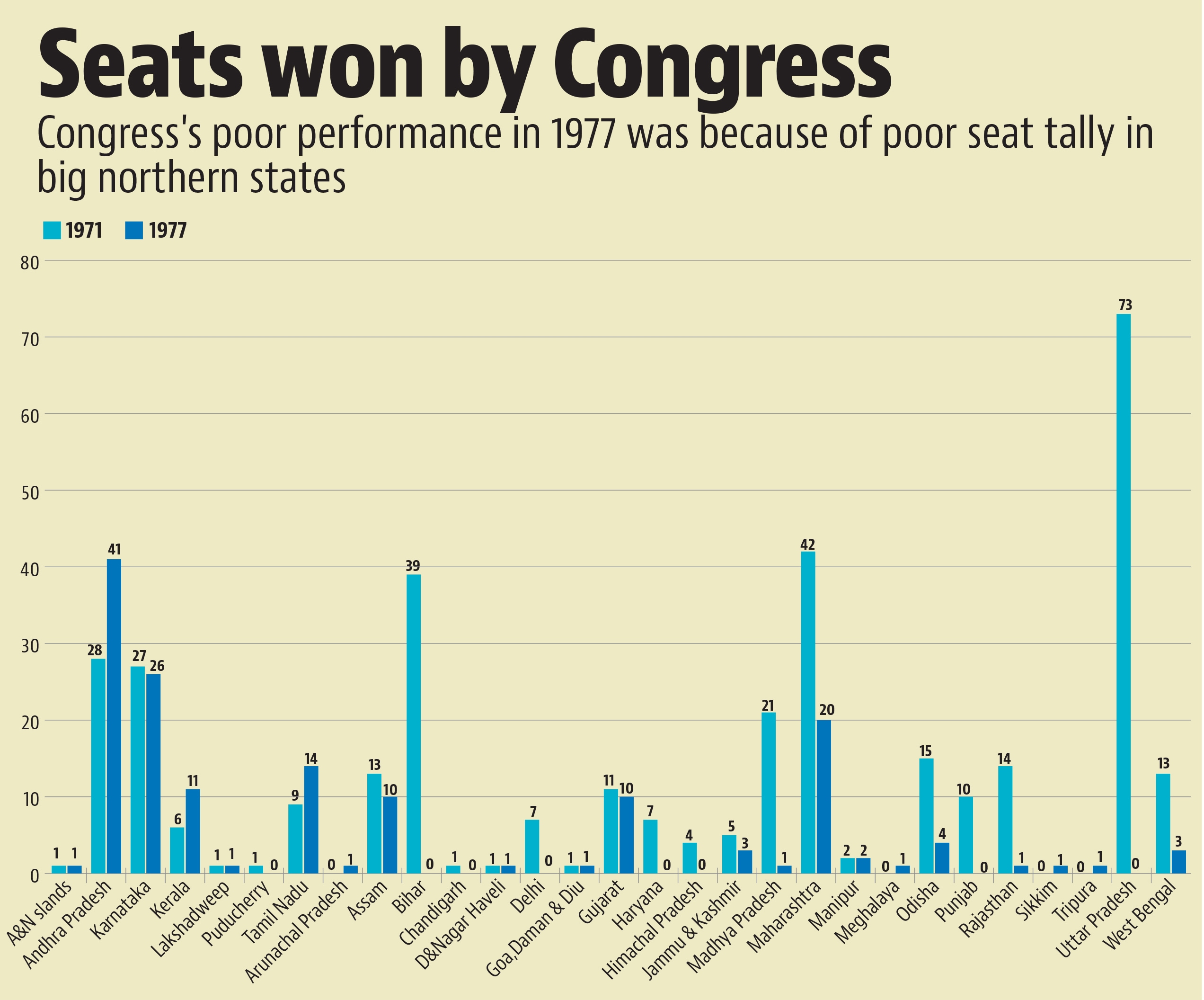
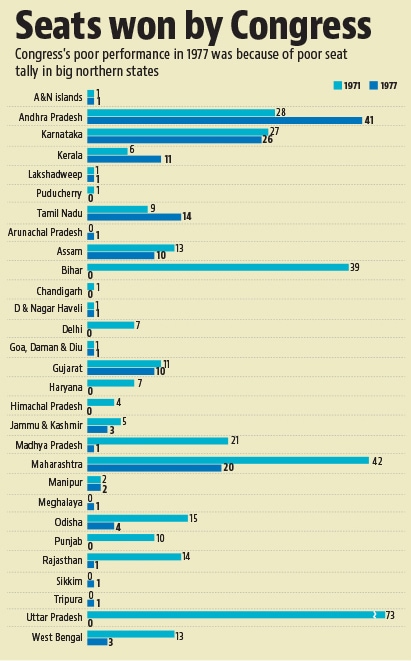
Once the Janata Party collapsed under its own contradictions, there was no real challenger to the Congress until 1989
The massive anti-emergency mandate of the 1977 elections was not enough to manage the ideological contradictions and factional fights within the Janata Party. The issue which precipitated the government’s fall was difference over dual membership – erstwhile Jan Sangh constituents of the Janata Party retaining their membership of the Rashtriya Swayamsevak Sangh – between various constituents of the Janata Party.
Morarji Desai, who became the prime minister in 1977 was toppled by Charan Singh in 1979. Singh himself lost majority in the parliament even before he could prove it, only to continue as caretaker prime minister until the 1980 elections.
Not only did the Congress recapture power with a comfortable majority in the 1980 elections, its majority became even bigger in the 1984 elections, which were held after the assassination of Indira Gandhi. Also, no opposition party could cross the 100-seat mark in the Lok Sabha in the 1980 and 1984 elections. It was only in the 1989 elections, that the Janata Dal managed to get 143 seats. The BJP, which was formed in 1980 and had managed to win just two seats in the 1984 elections, became the third largest party in the Lok Sabha with 85 seats in the 1989 elections. This was widely seen as the result of it adopting the demand of building a Ram temple in Ayodhya after the Palampur resolution of 1989.
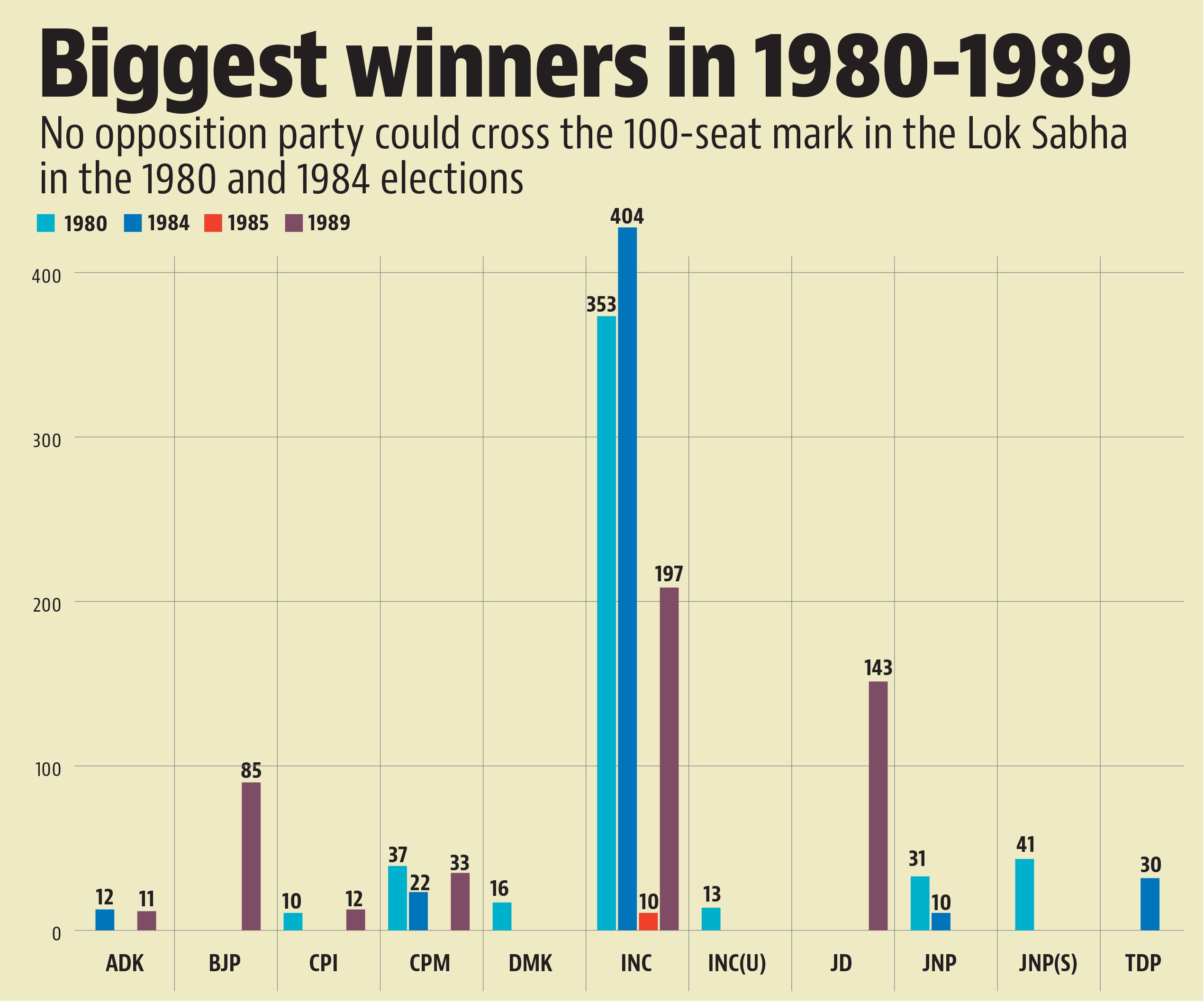
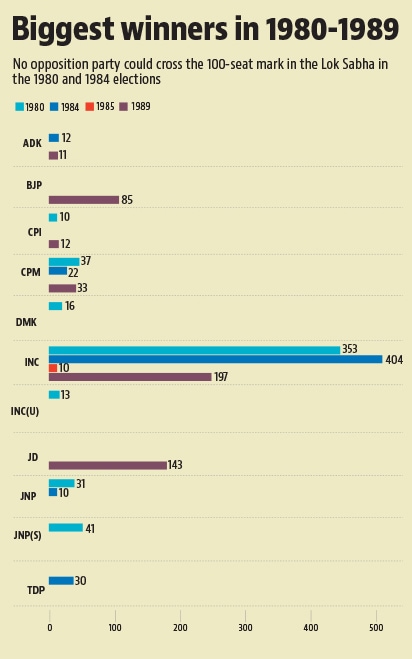
Rath-yatra takes the BJP past the 100 mark
The V P Singh-led National Front government, which came to power in 1989 was yet another exercise in anti-Congress politics bringing mutually incompatible political forces together. Singh was a former Congressman who walked out of Rajiv Gandhi’s cabinet and floated the Janata Dal. While the Janata Dal managed to get 143 seats in the Lok Sabha, the government depended on both the Left and the Right for political survival. Its downfall, like the 1977 Janata government’s came because of competing and contradictory political machinations. As Singh tried to cultivate a subaltern support base for himself by announcing the implementation of Mandal commission recommendations which announced reservation in government job for other backward classes, the BJP aggressively deployed its Hindutva card with Lal Krishna Advani embarking on a Rath Yatra to from Somnath in Gujarat to Ayodhya demanding the construction of a Ram temple in Ayodhya where the Babri mosque stood. Advani was arrested by Janata Dal’s chief minister Lalu Prasad Yadav in Bihar, and the BJP withdrew support from the government bringing it down. While the Congress propped yet another temporary government with Chandrasekhar as the prime minister, this was short-lived and elections were held in 1991.
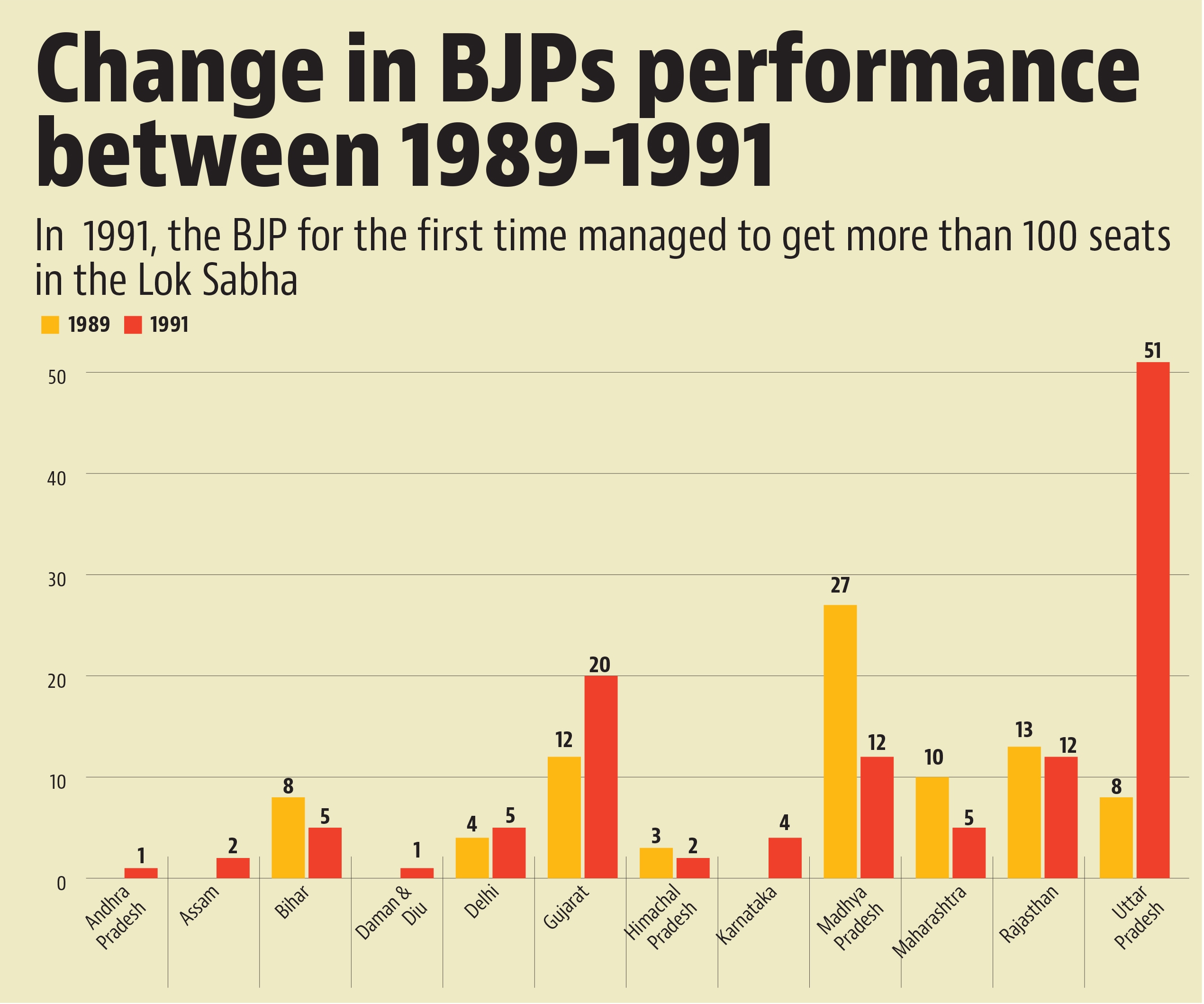
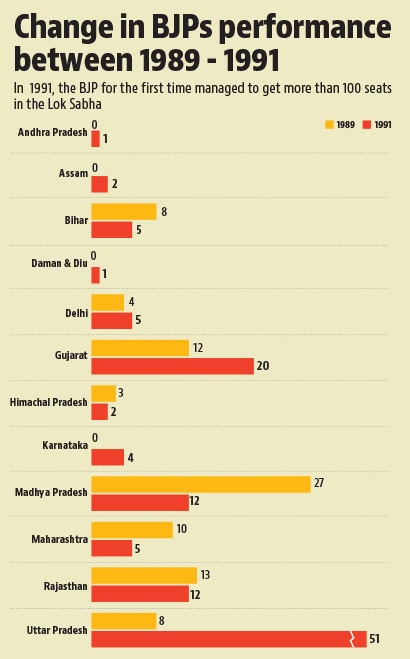
Rajiv Gandhi, who was leading the Congress’s campaign was killed in an election rally. While the Congress managed to form a minority government after the 1991 results, the BJP for the first time managed to get more than 100 seats in the Lok Sabha. In 1992, a mob which had purportedly gathered to perform kar-seva demolished the Babri mosque, triggering widespread communal violence in the country.
