
Violence and disorder were hardly new in India. But the 1980s stand out in the degree to which India’s internal security deteriorated. The turn of the decade marked the onset of something new — large scale massacres of innocent people by marauding mobs with official complicity. How did it come to this?
Public violence and systemic disorder were the defining themes of the 1980s. By the end of the decade, books such as VS Naipaul’s India: A Million Mutinies Now (published in 1990) and Atul Kohli’s Democracy and discontent: India’s growing crisis of Governability (published a year later), reflected concerns about the growing challenges to political order and stability in India.
The causes were multiple and stemmed substantially from the weakening of India’s institutions the previous decade. A powerful political executive with few checks, a deeply entrenched culture of subservience to power and a politics that had taken to heart Machiavelli’s advice that “It is necessary for a prince wishing to hold his own to know how to do wrong” were a combustible mix.
In attempting to hold their own, the country’s princes would inflict multiple wrongs on the country’s body politic and whose wounds continue to inflict pain across generations.
A history of unrest
Violence and disorder of course were hardly new in India. Independence came with vivisection that led to a communal carnage. That was soon followed by a communist-led peasant insurrection in the erstwhile princely state of Hyderabad.
The 1950s began with an insurgency in Nagaland and later in the decade in Mizoram. As the conflicts in the country’s North East festered, challenges to order mounted after the 1967 elections. While the burgeoning Naxalite movement was crushed with heavy loss of lives, the violence presaged what was to come in the “Red Corridor” a few decades later.
Intensifying electoral competition and a struggling economy, led to multiple challenges to order from labour strife, student protests, agrarian unrest and localised caste and communal conflicts from the late 1960s to end-1970s.
The rupture of the 80s
But the 1980s stand out in the degree to which India’s internal security deteriorated. The turn of the decade marked the onset of something new in Independent India — large scale massacres of innocent people by marauding mobs with official complicity.
In 1979, the killing of hundreds of Namasudra refugees (a Dalit sub-caste) in Marichjhapi island in the Sunderbans went largely unreported. The Nellie massacre of around 2000 Bengali Muslims in rural Assam in 1983 was followed by murders of around 3000 Sikhs in Delhi in 1984 in the aftermath of Indira Gandhi’s assassination, and approximately a 1000 (mostly Muslims) killed in the Bhagalpur riots in 1989. More violence was to follow.
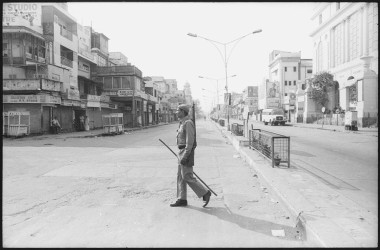
Security forces during a curfew in Old Delhi.
However, unlike the past, the violence in this decade posed a serious security threat to the nation itself. The Punjab crisis revived the incendiary cocktail of religion and politics, which had already resulted in the partition of India, and now brought a full-fledged insurgency at the doorstep of India’s capital. From dozens of people killed annually in the beginning of the 1980s, hundreds were being killed mid-decade and thousands by the end of the decade.
The terribly short-sighted partisan moves that stoked the Punjab crisis were replicated with even greater vengeance in Kashmir that exploded into an uprising by the end of the 1980s. The Kashmir insurgency would emerge as India’s bloodiest insurrection in the following years.
The 1980s also saw the emergence of the threat of terrorism that would claim lives of common citizens as well as political leaders, including two Prime Ministers. And internal security became fused to external security as outside powers began to hyperactively fish in troubled waters.
As the decade ended, the country was wracked by violence and disorder from caste violence stemming from the implementation of the recommendations of the Mandal Commission, worsening violence in Punjab and the Northeast. Electoral violence further claimed hundreds of lives.
In another instance of cynical use of religious politics for electoral gains, in 1986, the government facilitated the breaking of the locks of Babri Masjid to allow Hindu devotees access to the disputed site to “balance” its legislative nullification of the Shah Bano judicial verdict that followed soon after. Two political wrongs do not make a right – they make for a destructive politics.
In this polarised backdrop, the agitation to build a Ram temple in place of the Babri Masjid gained momentum and kept communal fires burning into the next decade and beyond. India’s meddling in the Sri Lankan ethnic conflict brought the violence home, with the side that India had originally supported, the LTTE, assassinating Rajiv Gandhi in 1991.
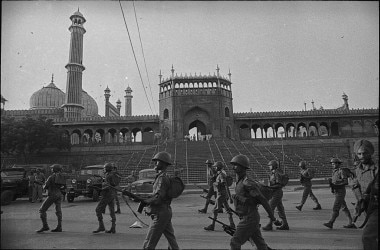
An armed police personnel on vigil at Chandni Chowk after curfew was declared on November 2, 1984.
The loss of Indira and Rajiv Gandhi in quick succession hastened the weakening of the Congress Party, the pivotal pole of Indian politics, although the extent of its decline would be evident only later. The country was poised for a new era of coalition governments for the next quarter century.
In many ways, the apprehensions of this dangerous decade did not come to pass. The country would soon make an audacious break from past economic policies leading to two decades of unprecedented economic growth. Many (but not all) indicators of violence and order — from homicides to hijackings, from electoral violence to labour strife, from riots to insurgencies — would decline markedly over the next three decades.
The disturbing legacy
But the legacy of the 1980s did not disappear and is still manifest. The human costs have been appalling, with tens of thousands of civilian, security forces personnel and militant casualties — mostly citizens of the country. Families have been torn asunder.
Punjab, which was poised to become India’s leading state in the late 1970s, has never really recovered and for many of its young, migration is their main hope. And the diaspora’s support for Khalistan has continued to be a thorn in the flesh of Indian foreign policy. The alienation of the people of Kashmir from the Indian state has only deepened and while an iron-fist approach has undoubtedly lowered violence, it continues to bleed the treasury and the people of that tragic region.
Then there are the institutional and financial costs. The size of the Central Armed Police Forces (CAPFs) doubled over the last three decades and simultaneously, the institutional infrastructure overseeing internal security at the federal level ballooned. Since all of this came under the Ministry of Home Affairs, its power vastly expanded.
The institutional costs to the army have also been manifest. The 1980s marked a serious expansion in the army’s counterinsurgency role. Initially inducted into Sri Lanka for peace keeping operations, it was suddenly asked to fight the Tamil insurgency in that country, before being withdrawn in 1990. It was called out to confront insurgencies in Punjab and Jammu and Kashmir in addition to its ongoing counterinsurgency role in the Northeast. Triggered by rumors related to Operation Blue Star, the army faced a widespread upheaval for the first time when a section of Sikh soldiers mutinied across some of its units.
To combat the insurgency in Kashmir the army created the Rashtriya Rifles, which has sucked in large resources in personnel and treasure. The army's successes notwithstanding, there were substantial opportunity costs as these scarce resources could otherwise have been used for military modernization. Moreover, an enhanced counterinsurgency role reinforced the army’s manpower heavy strategic culture in a world where technology is fundamentally changing the nature of warfare. That legacy lives on.
But perhaps more than anything, what the 1980s established was the withering of accountability of those who played fast and loose with institutions and democratic norms and in the process caused so much damage to the nation. A culture of impunity became deeply ingrained in the political system as other political parties first copied and then stooped lower, further weakening – perhaps fatally – not just institutions, but that democratic sensibility that is the fundamental guarantor of a democratic polity.
