
The loss of the Congress in the watershed 1977 election inaugurated an era of churn that saw the rise of farm politics and assertion from intermediary castes and backward groups even as the fragmentation of the Janata Party facilitated the return of Indira Gandhi. In all, the 1980s were a decade of deep transformation, both of the party system and of parties themselves.
The Congress lost the 1977 election, but was not routed. While it was crushed in the north (shrinking to two seats in the Hindi belt), it did reasonably well in many other states, particularly in the South, which was less affected by the abuses of the Emergency.
An amalgamation of socialists, ex-Congress and the Jan Sangh formed India’s first national coalition government under the Janata Party banner. But internal contradictions led to the collapse of the government soon after. The Congress swept back to power nationally in 1980 with 43% of vote share and 67% of the seats.
The 1980s were a crucial decade of deep transformation, both of the party system, and of parties themselves.
Caste representation
The first key feature of the period was the rise of Chaudhary Charan Singh and kisan politics. After decades of splits and mergers, the socialist camp at last found a leader from the ranks of the backward classes willing to transform his party and create political space for subaltern groups.
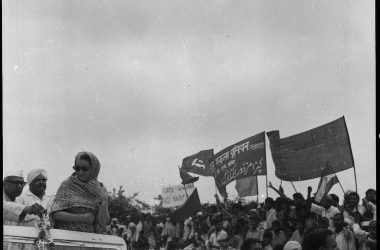
Prime Minister Indira Gandhi passes a Jan Sangh demonstration on July 5, 1972.
The share of representation of intermediary castes and Other Backward Classes (OBCs) in the Lok Sabha, from the Hindi belt states, steadily increased from an average of 15.7% in the 1960s and 1970s to 24% through the 1980s and early 1990s. In 1989 and 1991, they made up 29% of all Hindi belt MPs, but were still ten percentage points behind the upper castes.
Of the 150 MPs elected from the Hindi belt between 1989 and 1991, 80 belonged to the upper castes, i.e. 53% of the total number of MPs elected in these states, or 69% of their MPs elected in general seats.
The signs of fragmentation
The Janata Parivar first broke down first on state lines, and subsequently on caste lines within states. Through the 1980s, various state branches of the Janata Party claimed autonomy and formed new parties across India. The tussle for leadership within these new formations often led to splits, usually occurring along caste lines. This process would result in the formation of many caste-based regional parties, particularly in the North.
This fragmentation of the party system favoured the Congress briefly. It remained strong by default at the Centre, despite many of its state-level branches crumbling. Following the assassination of Indira Gandhi in 1984, it returned with a thumping victory under the leadership of Rajiv Gandhi. Congress won 76.5% of the seats with 48% of the votes, the highest vote share ever scored by a single party in India.
The young prime minister would not, however, succeed in retaining his position in 1989, losing to his own Finance minister, V.P. Singh, who broke away from Congress and steered a new coalition to victory under the Janata Dal banner. With the support of various parties, including the BJP, V.P. Singh formed the National Front government in 1989. Most of its MPs came from Uttar Pradesh, Bihar and Odisha, and presented a more diverse composition than any other party previously in power in Delhi.
Of the Janata Dal’s 143 elected MPs across India, only 43 belonged to the upper castes (30%), against 55 OBC and intermediary caste MPs (38.5%).
But though the rise of OBC and intermediary caste representation was one of the most significant developments of this period, Muslim and women’s representation continued to lag behind.
Muslim representation peaked and declined
157 Muslims MPs were elected between 1980 and 1991. Their representation peaked in 1980, when 49 Muslims were elected, mainly from Uttar Pradesh and Bihar, a majority on a Congress ticket (29).
Over this period, 85 Muslims were elected on Congress tickets, 25 on socialist party tickets, and 47 on tickets of various other parties, mostly from West Bengal, Kashmir and Kerala.
The scale of the Congress’s victory in the North is credited with the rise of Muslim representation in 1980. In subsequent elections, this would gradually dwindle to the 1960s numbers. Despite succeeding in garnering significant support from Muslims in a context of rising communal violence, the Janata Dal did not open its ranks to many Muslim politicians.
And in the Bharatiya Janata Party (BJP), formed after the collapse of Janata, Muslims found little space. Only one Muslim MP, Arif Beg, was elected in Madhya Pradesh on a BJP ticket.
The continuing political exclusion of women
Women’s representation followed a similar trajectory. Only 145 women were elected between 1980 and 1991 (out of 2120 MPs). The Congress led the representation for women (98). Only five women were elected on a Janata Dal ticket (out of 202 MPs) and only 15 women were elected on a BJP ticket (out of 207 MPs).
Here again, the modest rise of women’s representation (from 30 in 1980 to 43 in 1984) is attributed to the Congress’s strong performance. What is more significant however is that the share of women among candidates remained extremely low (3-4%), and that the number of women represented in the Lok Sabha would actually decrease through the rest of the period right into the late 1990s.
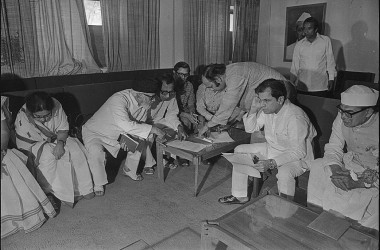
Congress (I) MPs meet acting President Basappa Danappa Jatti with a memorandum requesting him not to oblige the government by dissolving nine State assemblies.
Aaya Ram, Gaya Ram
Lastly, the late 1970s and 1980s are also notorious as a period of political defections. In the 1980 General Elections, 80 turncoats got elected, mostly on a Janata ticket (48) or on a Congress ticket (16). Their numbers fell to 44 in 1984 but surged again five years later, with the Janata Dal fielding 68 of the 88 successful turncoat candidates who ran that year.
This phenomenon was much more pronounced at the state level, leading Rajiv Gandhi’s government to pass the anti-defection bill.
The late 1970s and 1980s were also a period when India’s political class underwent a replacement of sorts.
In 1977, 60% of all MPs were elected for the first time. The 1980 and 1984 elections also saw an intense reshuffling of power holders (52% and 47.5% new MPs) Few MPs succeeded in getting re-elected. The success rate of re-running incumbents in 1977 and 1980 was 25% and 28.7%, respectively. It increased in the following years, but remained below the 50% bar. Till date, a majority of MPs in India remain single-term representatives.
