
It was a time of political instability. It was a time of political assassinations. It was a time of politics of identity. And it was a time of an economic crisis. India faced its most severe challenges, but eventually emerged stronger
If India, as an infant republic, consolidated its domestic constitutional order in the first fifteen years after independence, in its adolescence, it grew in ways good and bad — amid both a domestic political churn and three wars — between 1962 and 1977. And then, in the third phase, India faced a set of extraordinary challenges that were perhaps inevitable with being a young adult republic.
Both at the top, and on the ground, there was a period of political renegotiation -- between the Centre and states, which culminated in the rise of regional parties; between different caste groups, which culminated in reservations for backward classes and an anti-Mandal agitation; between different visions of India and the role of religion in public life, which culminated in the Ram Janmabhoomi Mandir agitation of the late 1980s; and between the Centre and identity based secessionist movements in Punjab, Assam and then Kashmir, which saw armed rebellions threatening India’s territorial integrity and sovereignty but eventually culminated in the Union prevailing.
Through the 1980s, the Indian leadership was also slowly making a shift towards a more open economic regime, and rapprochement with western powers. But these shifts weren’t adequate as the country confronted an unprecedented economic crisis with a balance of payments crisis and a new world order with the collapse of its old friend, the Soviet Union.
But while it wasn’t visible in the 1980s, the 1990s would see India become more open, more free, more confident, more prosperous, and a more powerful country. But that was still to come, and the Indian leadership as well as society would be tested first.
The political theatre
1977 inaugurated a new era in Indian politics. Voters had decisively rejected the Congress for its authoritarian turn, with Morarji Desai leading the first non-Congress government in post-Independence history. But the Janata Party struggled to reconcile its internal contradictions and got embroiled in leadership battles, in a prelude to what would happen to the next non-Congress experiment, when the VP Singh-led National Front government lasted for just over a year, a decade later.
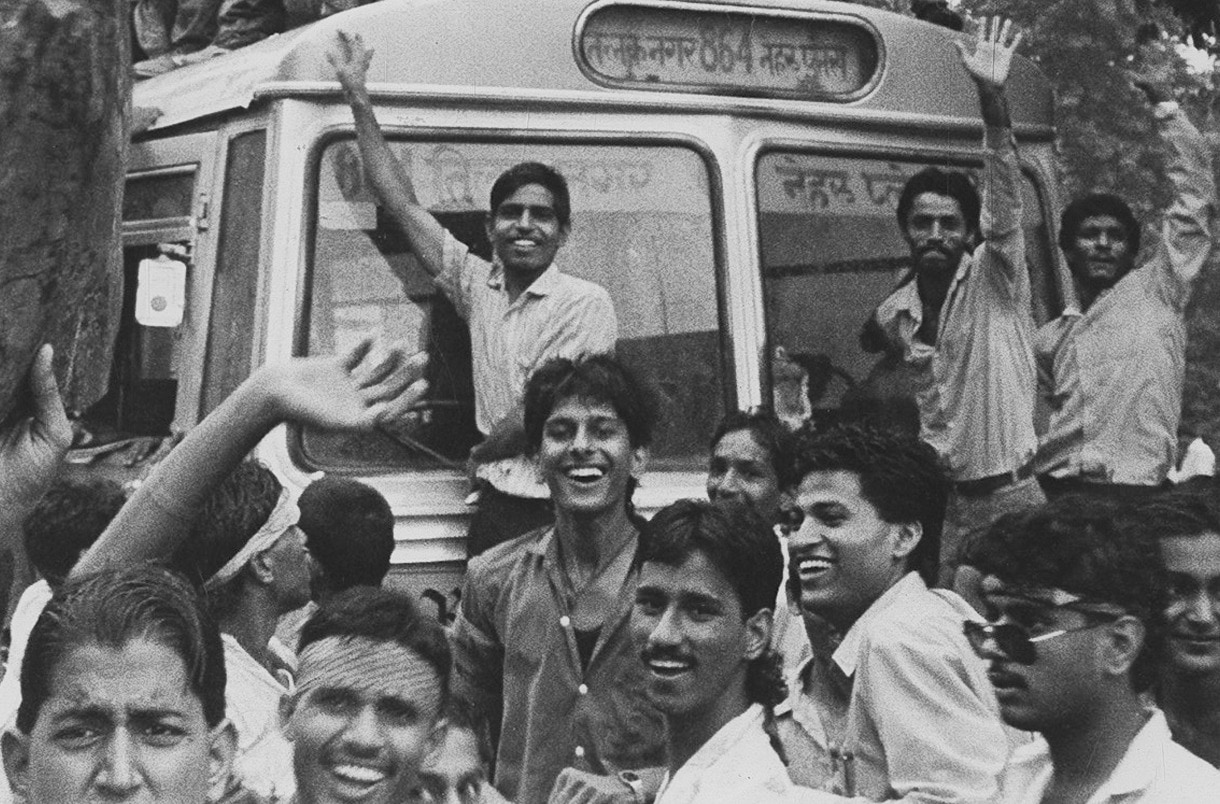
Students protesting the Mandal Commission report block traffic on Parliament Street in New Delhi on August 22, 1990.
While the Janata played a credible role in restoring Indian democracy, after a period of disarray and disorder, citizens were craving for order and stability. During Janata rule, Indira Gandhi had shown she was down but not out, reconnecting with grassroots issues, evoking political theatre with a trip to Bihar after a massacre of Dalits, taking on the Shah Commission set up to investigate Emergency excesses, reorganising her party, and winning by-elections. In 1980, Indira Gandhi returned to power.
But this was a different Indira, in at least three ways. One, she flirted with the politics of religion, asserting her Hindu religious identity in a way that she had done not earlier.
Two, she had moved on from the economic policy template of the late 1960s and 1970s and showed a willingness to embark on a set of limited reforms. And three, despite the American intervention on behalf of Pakistan in 1971 and her suspicion of the West (her accusations of a conspiracy by a “foreign hand” was seen as an allusion to the Americans), she embarked on a process of rapprochement with the United States. In 1982, during a visit to the US, she succeeded in building bridges with Ronald Reagan and battling American stereotypes about India’s political orientation.
With her assassination in 1984, the mantle of leadership passed on to Rajiv Gandhi. His elevation marked the institutionalisation of dynastic politics in the Congress — there could be a case made that while being Jawaharlal Nehru’s daughter was a big reason for Indira Gandhi’s elevation back in 1966 as PM, she had spent decades in politics in different capacities. Rajiv, picked after Sanjay Gandhi’s sudden death in an air crash, transitioned from a quiet professional existence as a pilot to a Congress functionary and MP to PM, all within a span of four years.
But riding on the sympathy wave generated by his mother’s assassination, and unprecedented majoritarian consolidation, Rajiv Gandhi led the Congress to its biggest victory in the 1984 elections — with over 48% of the vote share and over 400 seats in Lok Sabha.
Rajiv Gandhi’s arrival was seen as a break from the old ways of doing politics. His technocratic advisors, many from his Doon School years, constituted the core circle of trust. He brought energy and freshness to policymaking, with innovations in telecom and technology. He spoke out against the degeneration of political culture within his own party at the centenary of the Congress in 1985. He continued to engage with the US, while paying a historic visit to China in 1988. Both Delhi and Beijing arrived at a broad agreement to keep the border peaceful and shift focus from disputes to engagement in other areas — an agreement that held for two decades before Chinese revisionism through the 2010s saw a dip in ties.
At the same time, Gandhi’s experiments with identity politics eroded the centrist secular space and empowered both Hindu and Muslim conservatives. His military intervention in Sri Lanka, in the form of the Indian Peacekeeping Force, would rank as one of independent India’s biggest strategic and foreign policy setbacks. His reliance on a close set of friends for political advice, and inability to accommodate veterans such as VP Singh, weakened him politically. And with the Bofors allegation tainting his tenure, Rajiv Gandhi’s clean image was in tatters by the time of the next elections.
The 1989 election saw the Congress lose its majority, and while it was still the single largest party, Rajiv Gandhi recognised the electorate had rejected him. A conglomeration of opposition parties came together to enable the rise of VP Singh as the prime minister. But the coalition faced leadership tussles — Singh versus Devi Lal versus Chandra Shekhar stories were legion — and political differences, which wasn’t a surprise as both the communists and the BJP were providing outside supporting to what was ostensibly a socialist government. Singh’s government gave way to a short-lived government led by Chandra Shekhar, with Congress support.
The National Front government did not last, but it did two things. It set the foundations for the rise of backward politics in the Hindi heartland. And it marked the assertion of regional parties in national politics, a trend that would intensify over the subsequent two decades.
But as India headed towards another election in 1991, the country saw a second political assassination — this time of a former PM, Rajiv Gandhi. If Sikh extremists had killed his mother, Sri Lanka’s Tamil extremists now assassinated the son. Identity based violent politics from the northern-most, and then southern-most, parts of the subcontinent had taken away two of India’s most important leaders in seven years.
The identity battles — region, religion, caste
Indeed, this was a period where the Indian leadership had to face some of the most serious internal security and political challenges as a republic. This largely stemmed from identity-based issues — fundamentally caste, region, religion. Some were accommodated within India’s democratic framework; others challenged this very democratic and constitutional framework and had to be fought by all means, fair and foul.
The Assam Agitation brought to fore issues of migration, identity-based battles on who was an Assamese and who was an outsider, and the cross-border flow of people from Bangladesh. It deepened cleavages between Assamese-speakers and Bangla-speakers, and between Hindus and Muslims. The Nellie massacre of 1983 shocked the nation.
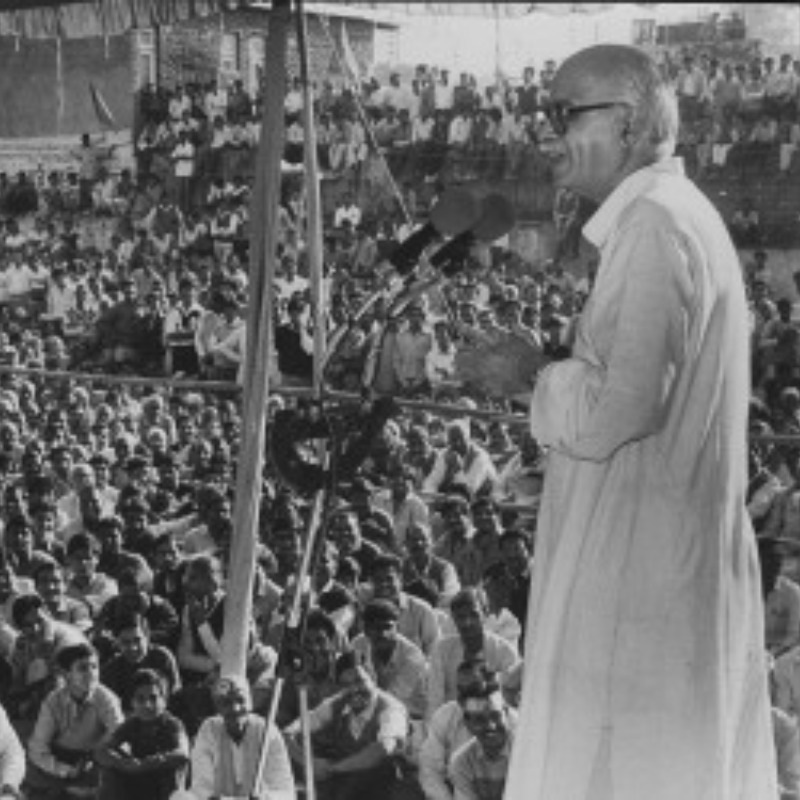
BJP leader LK Advani addresses an election meeting at Muzaffarnagar.
Secessionist sentiment grew, with insurgent outfits challenging the authority of the Indian State with reckless violence, fear and terror. It was only in 1985 that the Centre arrived at an Assam Accord with agitating forces, but as recent events have shown, the chapter did not end then, and immigration and identity remained salient issues in Assamese politics, as did the presence of violent secessionist forces.
At the other end of the country, Punjab was witnessing the rise of the Khalistan movement. Delhi’s encouragement of radical elements, including Jarnail Singh Bhindranwale, for political purposes was coming back to haunt the Republic. Pakistan was happy to support secessionist and violent elements, in a prelude to what they would do within half a decade in Kashmir. Matters eventually came to a head in the summer of 1984, when Indira Gandhi decided to send the army into the Golden Temple, which Bhindranwale and his associates had made their home. She saw Operation Bluestar as not an ideal choice, but a necessary choice to re-establish the authority of the Indian State. But it deepened the alienation of Sikhs, who saw it as an assault on their fundamental religious identity, and eventually led to the first political assassination of a serving Prime Minister in India. Indira Gandhi was shot by her own bodyguards on October 31, 1984. An era had ended.
But the residues of the era were to engulf India in a bloody bout of anti-Sikh pogrom in subsequent days. With encouragement from elements of the Congress leadership, and the tactic silence of the State, the anger against the assassination turned into violence against Sikhs, particularly in the national capital. With Rajiv Gandhi now in charge as PM, the episode represented a dismal failure of the State in preventing anti-minority violence. Sikh alienation would only deepen. Mass violence with state complicity would inaugurate a new chapter in impunity and would recur in future decades. And India would never be able to live down the shame of the early days of November 1984 when a minority community, which had always stood up to defend the nation, now found itself the object of fury and violence of majoritarian politics. Indeed, the 1984 elections had a strong Hindu majoritarian imprint. Rajiv Gandhi attempted a peace accord in 1985, but his counterpart in the agreement, Akali leader Harchand Longowal was assassinated soon after; the state was to remain a site of violence for almost another decade, before effective (and often brutal) policing and smart political cooption defused the agitation.
Identity-based battles weren’t over yet, for religion and caste made a comeback in the public sphere in unanticipated ways.
Rajiv Gandhi, in a decision that would haunt the idea of Indian secularism for decades to come, catered to the Muslim orthodoxy by passing a law that reversed a progressive court judgment in favour of alimony to a Muslim woman, Shah Bano. To then cater to Hindu conservatives, his government was widely seen to have influenced a lower court judgment to open the locks of the Babri mosque to allow Hindu worshippers in. Gandhi subsequently allowed a shilanyas by the Vishwa Hindu Parishad in Ayodhya.
But the Congress’s turn to what can be called opportunistic secularism, with little heed to principles and all attention to vote banks, would come back to bite the party — for this enabled the rise of the Bharatiya Janata Party (BJP). Winning only two seats in 1984, Atal Bihari Vajpayee’s moderate BJP which espoused Gandhian socialism as a core principle when the party was set up in 1980 quickly transformed into Lal Krishna Advani’s BJP which was unapologetic about practising the politics of faith and demanding the construction of the Ram Temple at the disputed site in Ayodhya. On December 6, 1992, this process would result in the destruction of the mosque.
Mandir politics was, of course, intersecting with Mandal politics. The VP Singh government retrieved an obscure report by the BP Mandal commission and announced reservations for other backward classes (OBCs) in government jobs. The implementation of the commission recommendations both reflected the rise of backward communities in politics, and also inaugurated a period of their political assertion, as Lalu Prasad and Mulayam Singh came to dominate the politics of the heartland. It also led to the anti-Mandal student agitation, reflecting the anxieties of upper caste students who feared losing government jobs and grew resentful of affirmative action.
But most significantly, the Mandir-Mandal contradictions of the period led to a two-decade long rift between the politics of religion — with the BJP focusing on carving out a common Hindu identity — and the politics of caste — with “social justice” parties focusing on mobilising citizens on the basis of caste and marrying them into an electoral alliance with Muslims. This identity clash would only transform post-2014, when Narendra Modi’s BJP became a party of both Mandir and Mandal, an inclusive Hindu party that espoused majoritarian politics externally but accommodated diverse caste groups internally.
Trouble in paradise
But the story of identity-based challenges and churn wasn’t over, for India then faced what was to become its most serious internal security, and external diplomatic, challenge in its history.
Years of flawed Indian political management in the Valley — promises of autonomy to be followed by long periods of de facto or de jure central control, promises of listening to the voice of Kashmiris coupled with active efforts by the Centre to rig elections, particularly in 1987 — had created a fertile ground for Islamists and their external backer, Pakistan, to create trouble.
Terror groups sprang up, challenging the authority and legitimacy of the Indian State and calling for azadi. The daughter of the then home minister, Mufti Mohammed Sayeed, was kidnapped by militants — only for the government to cave in and concede to the demands.
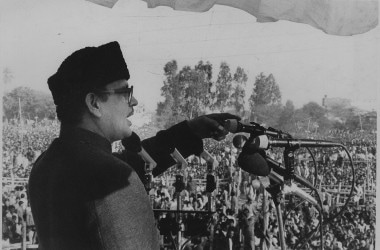
Prime Minister VP Singh addresses a public meeting at Fatehpur on January 5, 1990.
There was a systematic and orchestrated campaign to kill and force Kashmiri Pandits out of the Valley. Young Kashmiris were indoctrinated with propaganda against India in militant training camps across the Line of Actual Control in Pakistan-occupied Kashmir, trained, supplied with arms, and sent back to conduct terror attacks. The Soviet exit from Afghanistan saw freelance jihadi activists shift focus to Kashmir.
And through all of it, Pakistan’s Inter-Services Intelligence played the role of a pilot, shepherding the rise of state-sponsored cross border terrorism as a tool of asymmetric warfare against a militarily, politically and economically stronger India. To many, it seemed that India would lose Kashmir, but India’s coercive apparatus, as well as its democratic and secular political character, ensured that those fears didn’t come true.
Put it together and it is clear that on one hand, largely non-violent identity-based political mobilisation deepened democracy — both Mandal and Mandir reflected the views of citizens, and found voice within the electoral system. But on the other hand, violent identity-based mobilisation, imbued with territorial aspirations and religious extremism or cultural chauvinism — Punjab, Kashmir and Assam represented different shades of this — challenged democracy and Indian unity.
Over the next decade, peace would return to Punjab. Democracy would deepen in Assam. And Kashmir, while remaining violent and troubled, would see the return of an elected government. But the 1980s showed that a diverse polity and society like India needed astute political management. The results could, otherwise, devastate the nation.
Even as India’s political leadership was dealing with these internal political and social challenges, the economy was sending warning signals. And the world was about to change with the end of the Cold War. But the twin crises would also create an opportunity for India to make a break with the past, enhance economic freedom for citizens, and engage with all powers in the world, especially the US, while retaining its distinct identity. India had been challenged. But it had proven its resilience.
