E-Paper



Number theory: The changing profile of new civil service recruits
The top three candidates in the merit list of the 2022 Civil Services Exam, announced recently were women who studied economics, commerce and engineering.
Updated on: Jun 15, 2023, 03:32:42 IST

 Prefer HTon Google
Share via


Copy link

An HT analysis of Union Public Service Commission (UPSC) annual reports shows that Ishita Kishore, Garima Lohia and Uma Harathin N, who secured the first, second and third positions respectively, are representative of the changing profile of India’s young civil servants in a slightly counter-intuitive way. Here are five charts which explain this in detail.
The charts that matter
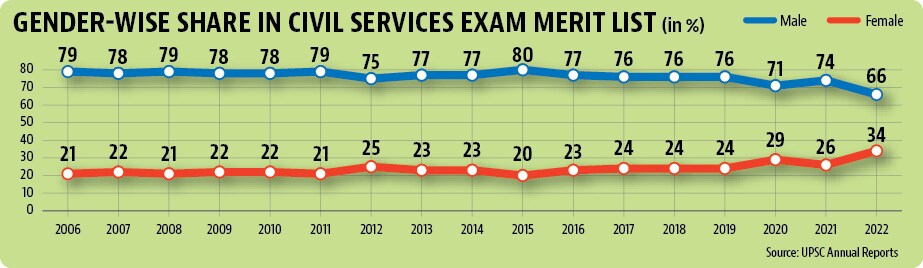
 Women are still significantly outnumbered by men in the Civil Services, but their 2022 share is the highest everWhile three women occupying the top slots in the CSE merit list is a rare phenomenon, women candidates have bagged one of the top three positions in the past as well. However, an analysis of the gender-wise break-up of the entire CSE merit list shows that women are still significantly outnumbered by men in what is among the most difficult exams in not just India but the world. To be sure, the 2022 CSE merit list does not just have women in the top three candidates but also the highest ever share of women. It remains to be seen whether it is a tipping point, or an aberration.
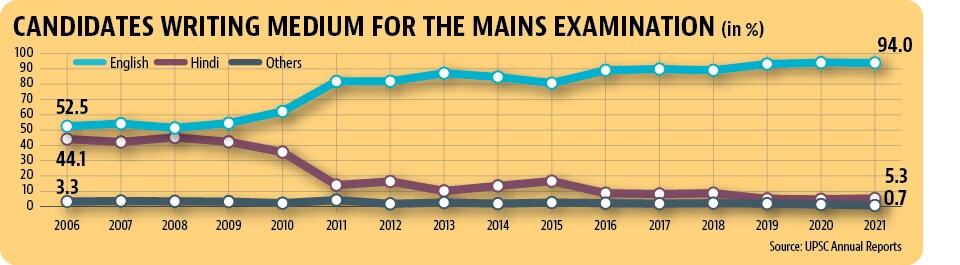
- The rise and rise of English and engineering in CSEThe UPSC annual reports give data on the medium in which candidates take the main written examination in the CSE. This number was almost equally divided between English and Indian languages through the 2000s. Today the share of English medium candidates is more than 90. There is a similar increase in the proportion of successful candidates who are engineers by training. The change, the data clearly shows, came after 2011, when the UPSC implemented Civil Services Aptitude Test (CSAT) at the level of the preliminary examination. CSAT aims to evaluate the analytical skills, reasoning capabilities, and overall aptitude of the aspirants, but it also has a mandatory English comprehension section. When UPSC introduced CSAT, the decision ignited large-scale protests, especially by Hindi medium aspirants who were arguing that a mandatory English and reasoning test - the old preliminary examination rewarded rote-learning – would create an unfair advantage for candidates from English-language and technical backgrounds, while putting those hailing from Hindi, and other regional medium schools and colleges at a distinct disadvantage. The results post-2011 show that their fears were justified. To be sure, the CAST’s impact on the quality of civil servants post-2011 requires deeper research.
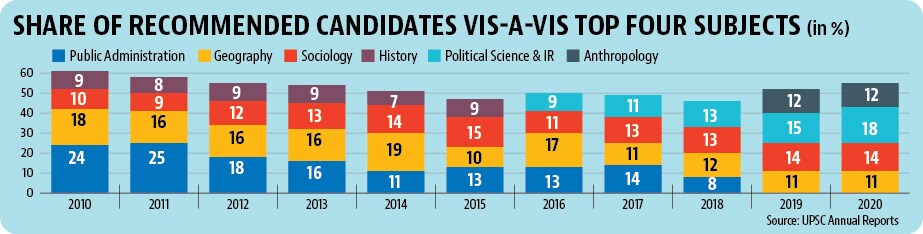
- But engineers do not opt for engineering subjects in the CSEAn analysis of the CSE merit list by the subjects which candidates opt for in the main examination shows that young Indian engineers are living up to their reputation for creating “jugad” or workaround in preparing for the exam. While the share of candidates who have studied engineering is now more than 60%, only 2.7% of the candidates who make it to the merit list opt for core-engineering related subjects in the main examination between 2011 and 2020, the latest year for which this data is available. A subject-wise analysis of the CSE merit list shows that Anthropology and Political Science-International Studies have replaced old favourites such as Public Administration and Philosophy. Uma Harathin, who studied civil engineering in IIT Hyderabad but chose anthropology in the UPSC main examination is a good example of this established pattern.
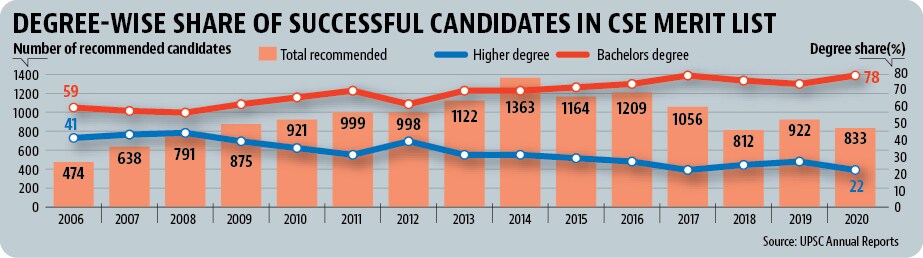
- The fall of researcher to civil servant and the rise of technocrats to civil servantThe rise of English medium engineers in the UPSC is also the story of weakening dominance of students who would enrol in research in universities and prepare for CSE. Data on the highest educational qualification of candidates who make it to the CSE merit list shows this clearly. The proportion of successful candidates with bachelor’s degrees far surpasses those with higher degrees. During the pre-CSAT era, this discrepancy was smaller compared to the post-CSAT period. In the year 2020, the disparity between the percentages of successful candidates with bachelor’s degrees and higher degrees reached a staggering 56 percentage points difference. Ishita Kishore, this year’s CSE topper, for example had taken up a job at Ernst and Young for two years after finishing her BA in Economics rather than enrolling in a post-graduate course. To be sure, it is important to exercise caution when interpreting these figures, as a significantly larger number of candidates with bachelor’s degrees apply compared to those with advanced degrees.