
 E-Paper



Experts bat for fitness plans tailored for female cricketers at World Congress on Science & Medicine in Cricket
Various other concerns pertaining to women’s cricket and players’ mental health were deliberated on the second day of the World Congress on Science & Medicine in Cricket hosted in Chandigarh


Cricket fitness programmes in India are designed primarily to cater male players and need an overhaul to cater to women and their unique needs, fitness experts said at the 7th World Congress on Science and Medicine in Cricket, hosted at Hotel Taj on Saturday.
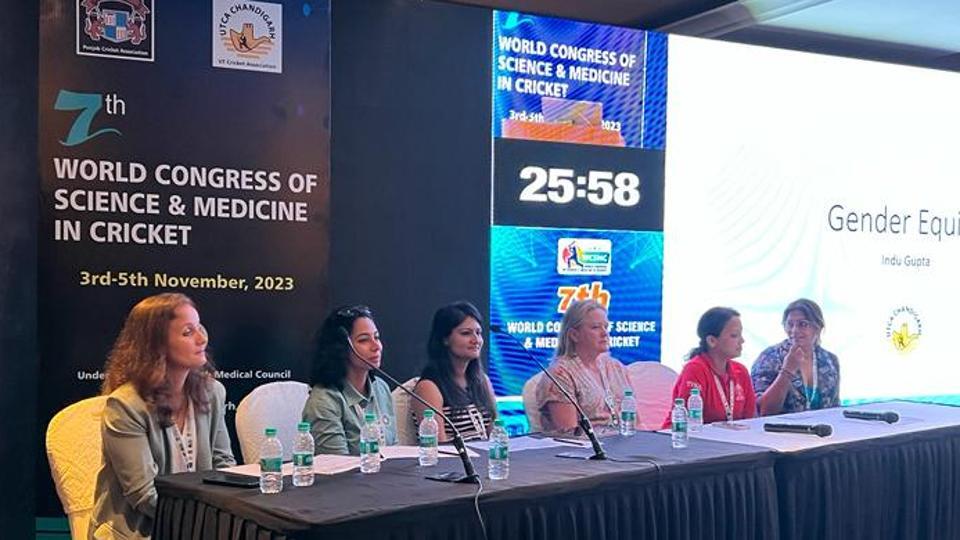
Various other concerns pertaining to women’s cricket and players’ mental health were deliberated on the second day of the international conference.
In a conversation with HT, Harpal Soni Bansal, the physiotherapist for the women’s team at the England and Wales Cricket Board (ECB), highlighted that approach to like bowling technique, problematic actions, shoulder angles have predominantly been tailored to suit men’s cricket, with insufficient consideration for women’s cricket. She stressed the necessity for a dedicated biochemical approach designed for female cricketers.
Bansal underscored the absence of sufficient data for the study of Indian women cricketers’ biochemistry, emphasising the need for a sample size of at least 1,000 to understand prevalent patterns effectively.
“It’s not a matter of insufficient participation, as there are thousands of players representing state teams. However, the lack of comprehensive data and dedicated full-time physiotherapists for them is a critical issue,” she added.
The expert said the problem, surprisingly, was not related to funding either as each state receives substantial financial support for cricket. According to her, the Australian women’s cricket teams are significantly ahead, with a lead of 10-15 years over others in the field. Several factors including the shortage of sports medicine information, she said, contributed to this.
She stressed the necessity for India to revise its approach to women’s cricket and invest in its development.
Furthermore, Bansal also presented her study on a comparative analysis of injuries among elite women cricketers from both India and England at the conference.
She had reached the conclusion that continuous injury surveillance can provide valuable insights to guide data-driven strategies for optimising healthcare for athletes and implementing preventive measures.
It is crucial to concentrate on particular types of injuries prevalent in women’s cricket, such as wrist/hand, thigh, and shoulder injuries, as they exhibit higher occurrence rates, she added.
Discussing the menstrual challenges faced by women cricketers, Neha Karnik, the physiotherapist for the Indian women’s cricket team, explained that players cannot afford to miss matches. Instead, they employ specific strategies to address it.
“By the time most female players reach international cricket, they are familiar with the recurring patterns. Before each tour, collaboration with gynaecologists is routine to explore options when players experience back pain dueto their menstrual cycle, and when they feel physically and mentally drained,” she further added.
The three-day congress will conclude on Sunday.
