
 E-Paper



Punjab: Border farmers forced to offer govt acquisition of beyond fence land
The Punjab Border Area Kisan Union delegation recently met MoS Jal Shakti, Tribal Affairs Bishweshwar Tudu and expressed their inabilities to till land located beyond the fence


Hundreds of farmers whose fields are situated between the barbed-wire fence and the zero line at the India-Pakistan border in Punjab are fed up over persistent problems causing difficulties for cultivating their land.
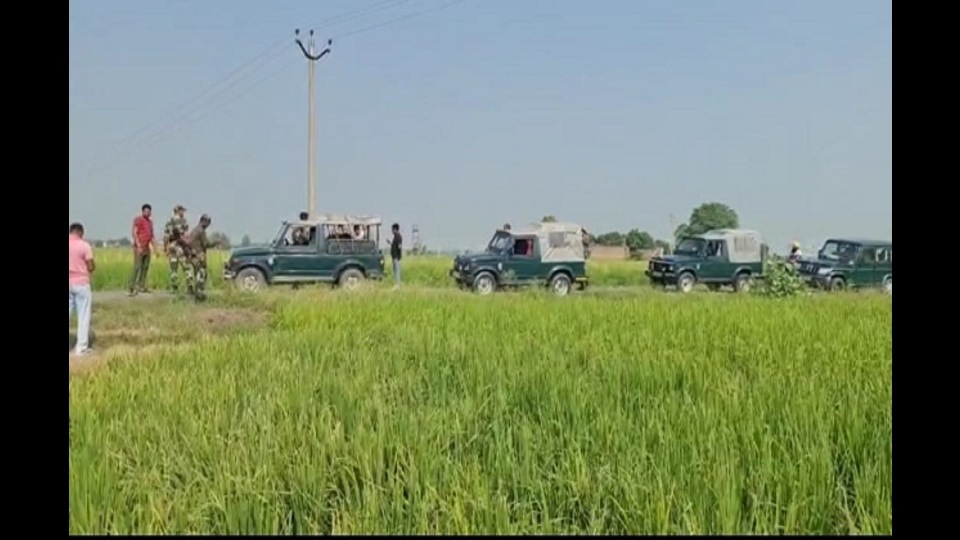
The farmers of six border districts—Amritsar, Gurdaspur, Pathankot, Tarn Taran, Ferozepur and Fazilka—are now ready to give affidavits for selling their land to the Central government.
A delegation of the Punjab Border Area Kisan Union (PBAKU)-led by its president Raghubir Singh Bhangala and vice president Surjit Singh Bhoora recently met Minister of State Jal Shakti and Tribal Affairs Bishweshwar Tudu and expressed their inabilities to till their land located beyond the fence, which is manned by border security force (BSF). “We have several difficulties which we have been facing for the last many years for cultivating our land. The government of India should solve our problems immediately or it can acquire our land which is situated beyond the fence. Even the government can hand over the land to private companies for the cultivation and we will have no problem,” said Bhangala while talking to HT over phone.
Talking about the problems, he said, “The heavy flash and radar lights installed to keep vigil at the border continue to damage our crop up to 100 meter area. However, we are not getting any compensation of the damaged crop.”
“There are two pathways along both sides of the barbed fence which are used by the BSF. At some locations, BSF doesn’t allow farmers to use these ways to reach their fields. Due to the conflict, some farmers have been facing difficulties for cultivating their land,” he said.
Bhangala further said, “Stray animals from Pakistan side, such as pigs, destroy 70% crops of both seasons. To prevent this loss, 3 feet barbed wire should be installed to prevent the entry of pigs towards India. Similarly, some area of Fazilka is not conducive for wheat and paddy cultivation and the farmers there should be should be allowed to grow mustard crop.”
Vice president Bhoora said, “At present farmers are doing farming as per the orders of respective Company Commanders/Platoon commanders. A central rule should be applicable for doing farming beyond the fence in whole Punjab. Similarly, there are 4-5 BSF gates at every post for crossing the fence for farmers. We request to open all the gates and care should be taken that no farmer has to travel more than 1 km to cross the fence to reach the fields.”
He said, “Farmers need to visit their fields daily to look after the crop and BSF closes the their gates sometimes for two or more days in a week. The gates should be kept opened every day at a given time.
“During harvesting of wheat crop if fire breaks out by chance, there is not any arrangement for extinguishing it. At least one fire brigade unit should be arranged for each BSF Battalion.”
He further said, “The policy of the central government was that the wire was to be installed at least 50 meters and maximum 150 meters behind the zero line, but in many villages barbed wire has been installed at a distance of 2 km. We have been requesting the government to make this wire installed not beyond 150 meters from the zero line. This will not only reduce the burden of BSF, but also the difficulty of farmers in farming.” Meanwhile, Bhangala said DIG of BSF has given them time to meet on Monday. Around 21600 acres of land of 220 villages is situated across the fence.