E-Paper



Every AAP worker must be prepared to go to jail: Kejriwal
The AAP national convener said the party’s ideology is based on three pillars — honesty, patriotism and humanity. He said the party has managed to bring the political discourse to matters related to education, health, free electricity and public welfare, etc.

 Prefer HTon Google


A day after the election commission of India (ECI) granted national party status to the Aam Aadmi Party (AAP), chief minister Arvind Kejriwal on Tuesday said that the short time that the AAP took to reach the coveted status is “nothing short of a miracle” and an “incredible achievement”.
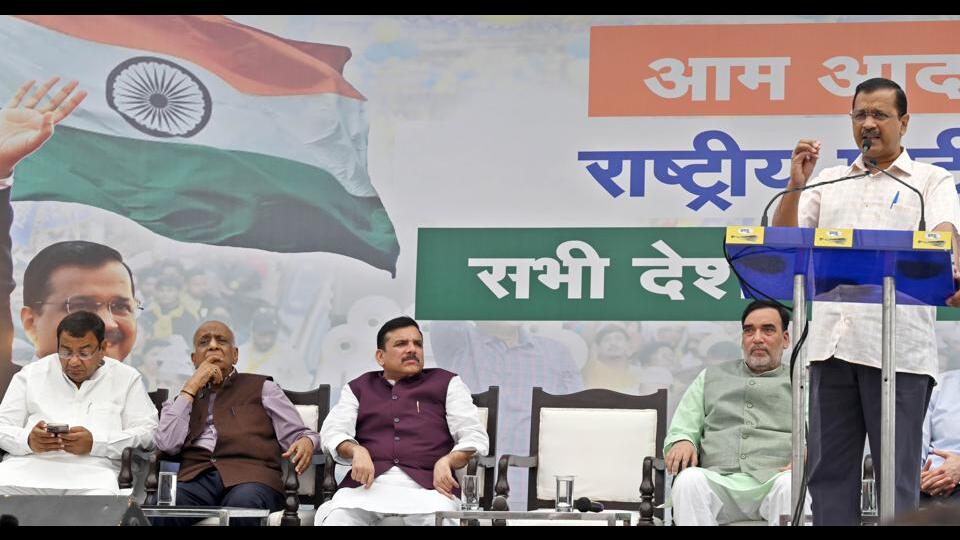
Addressing AAP workers at the party’s headquarters on Rouse Avenue, Kejriwal thanked the assembled for their sacrifices, adding that the party faces many challenges as “anti-national forces want to stop the party from progressing”, pointing to the arrest of AAP leaders Manish Sisodia, the former deputy chief minister, and Satyendar Jain, the former health minister.
“With the way our political opponents are targeting us at the moment, each party worker will be attacked and may have to spend even as much as 8-10 months in jail. They will eventually get bail as they have not done anything wrong, but if any worker is scared of these consequences, then I urge you to leave AAP and go somewhere else,” Kejriwal said in a 16-minute speech.
Sisodia, who held the excise portfolio, was arrested by the Central Bureau of Investigation in connection with alleged irregularities in the Delhi excise policy 2021-22 in February, while Jain was arrested by the Enforcement Directorate (ED) on May 30, 2022 in connection with an alleged money laundering case.
The Bharatiya Janata Party hit back, saying the cases against Sisodia and Jain are contrary to claims of honesty made by AAP.
Founded in 2012 after the Anna Hazare-led anti-corruption movement, the AAP in 2013 won 28 seats in the 70-member Delhi assembly and formed the government with external support from the Congress. Thereafter, the party won a massive 67 seats in the 2015 elections, repeating its landslide victory with 62 seats in the 2020 polls.
Kejriwal said that on November 26, 2012, no one could have imagined that AAP could have won even one MLA. “Out of 1,300 political parties, only six are national parties and just three have governments in more than one state. We are among the top three parties now,” Kejriwal said.
The AAP national convener said the party’s ideology is based on three pillars — honesty, patriotism and humanity. He said the party has managed to bring the political discourse to matters related to education, health, free electricity and public welfare, and has defeated the idea that elections cannot be fought and won honestly.
“For the first time in the country, political parties are talking about schools, mohalla clinics, hospitals wherever we go to fight elections. All of them promise to provide free electricity...,” he said.
Mentioning jailed AAP leaders Manish Sisodia, the former deputy chief minister, and Satyendar Jain, the former health minister, Kejriwal said, “Sisodia was targeted by political opponents and jailed in a fake case for providing a new model of education. For 75 years since Independence, the children of poor families ended up remaining poor because of inferior quality of education and we ended up breaking this pattern. Jain, who came up with mohalla clinics and a new healthcare model, was jailed by political opponents for the same reason.”
Kejriwal further claimed that the AAP will become the medium to make India the number one country in the world. “In Punjab, Goa and Gujarat, we went to the people on the basis of our guarantees. We have never indulged in the politics of abuse and hatred,” he said. “Only with AAP playing a greater role in national politics can India become the number one country in the world… Even if I have to sacrifice my life working for the betterment of India, I would consider myself to be extremely fortunate.”
Delhi BJP president Virendra Sachdeva, responding to Kejriwal, noted that his party was given the national party status in its first year of formation.
“For the last two days, Kejriwal is projecting as if getting the status of a national party in the 11th year of AAP’s establishment is a big achievement. While praising himself, Kejriwal forgot that the BJP was recognised as a national party in the very first year of its formation, and that the TMC and NCP, who lost their national party status, too had attained national status in a few years of formation,” he said.
Countering Kejriwal’s statement of AAP only doing positive politics, Sachdeva said, “Kejriwal’s claim that he does positive politics is completely hollow as the country is witness that he has progressed only by politics of allegations and political inducements. In the last eight years, his government has stalled the development of Delhi.”