E-Paper



Wall of trees worth ₹1 crore coming up around Bhalswa landfill
Pegged at an estimated cost of ₹1 crore, the horticulture wing of the agency will over the next one year plant around 12,600 trees and 1.15 lakh shrubs between the Mukarba Chowk-Burari stretch near the landfill

 Prefer HTon Google


The Public Works Department will undertake major horticulture work on a 4km stretch in the vicinity of the Bhalswa landfill for aesthetic upgradation and to reduce the impact of odour and pollution on neighbouring areas, officials aware of the matter said on Monday.
Pegged at an estimated cost of ₹1 crore, the horticulture wing of the agency will over the next one year plant around 12,600 trees and 1.15 lakh shrubs between the Mukarba Chowk-Burari stretch. Of the total cost, the agency plans to spend around more than ₹27 lakh on greening of the area near the landfill to develop a buffer near the highly polluting site, the officials said.
A PWD official said that the project will help in visual upgradation of the Outer Ring Road portion which is also used by the interstate commuters using the GT Karnal road, while also creating reducing the effect of dust and smoke in the area.
The agency has invited bids for the project. “The bids will be finalised in first half of May and the estimated cost for the dense greening of the landfill area and Mukarba chowk is ₹27,23,575 while ₹67,60,710 will be spent on the overall stretch starting from the landfill site till Burari,” a PWD official, requesting anonymity.
The private agency responsible for the development of the green buffer will also be made responsible for the daily maintenance and watering and upkeep of the plants. According to PWD, 12 gardeners will be deployed for upkeep of the area near the landfill site, while 25 gardeners will look after the remaining section.
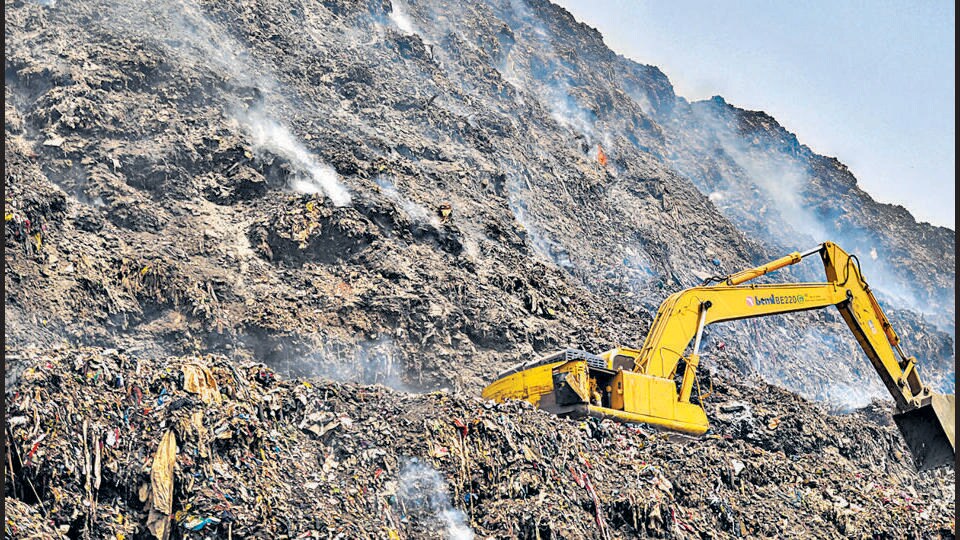
The 70 acre Bhalswa landfill site, one of the three oversaturated dumpsites of the city, greets visitors entering the city from North and North West Delhi. In 2019, when the biomining project started, it was estimated to hold 80 lakh tons of accumulated legacy waste and garbage dumping on the location started in 1994. The site reached a height of 62 meters in 2019. Every summer, the site witnesses multiple landfill fires due to generation of methane from rotting organic waste.
The government, however, plans to curb the growing waste at the site. On March 16, chief minister Arvind Kejriwal announced that the Bhalswa landfill will be flattened by March next year.
Jai Prakash Chaudhury, a resident of the nearby Bhalswa dairy, said that the smell from the dumpsite becomes overwhelming during the rainy season. “The landfill site is a cause for breathing problems and diseases,” Chaudhury said.
Raj Kumar Sharma, a resident of nearby Rajiv Nagar, echoed similar sentiments and said that Bhalswa landfill is the prime reason for smoke and dirt in the area.
Once the flattening of the Bhalswa landfill site is completed, the municipal corporation of Delhi also plans to develop a dense green belt along the periphery of the Bhalswa site.
“The land will be used for compensatory afforestation for other projects. Out of the 70 acre area, the corporation plans to set up an engineered landfill site, bio-methanation or waste-to-energy plant, while rest of the space will be covered by the dense forest,” an MCD official said, requesting anonymity.
According to action plans issued by the high-level committee on solid waste management on April 6, around one third of the reclaimed site may be used to develop a dense forest .