
 E-Paper



Honouring an Indian hero who lobbied against the apartheid regime in South Africa
A festschrift honoring Indian diplomat ES Reddy, who fought against apartheid in South Africa, was launched in Mumbai, highlighting historic ties between the two countries. The book includes essays from various fields and was co-edited by scholars from South Africa. The event took place at the Mani Bhavan Gandhi Sangrahalaya, a focal point of Gandhi's activities in Mumbai. Speakers emphasized the need to counter negative portrayals of Gandhi and celebrate the deep ties between India and South Africa. Reddy's contributions to anti-apartheid actions were recognized, and his work has been honored by both India and South Africa.


MUMBAI: While cricket teams from India and South Africa were pitted against each other in a One Day International match in Paarl, on Thursday, a diplomatic initiative building on historic ties between the two countries was unfolding in Mumbai. A festschrift in honour of Enugu Srinavasulu Reddy (1924-2020), an Indian diplomat who lobbied tirelessly against the apartheid regime in South Africa, was launched at the Mani Bhavan Gandhi Sangrahalaya.
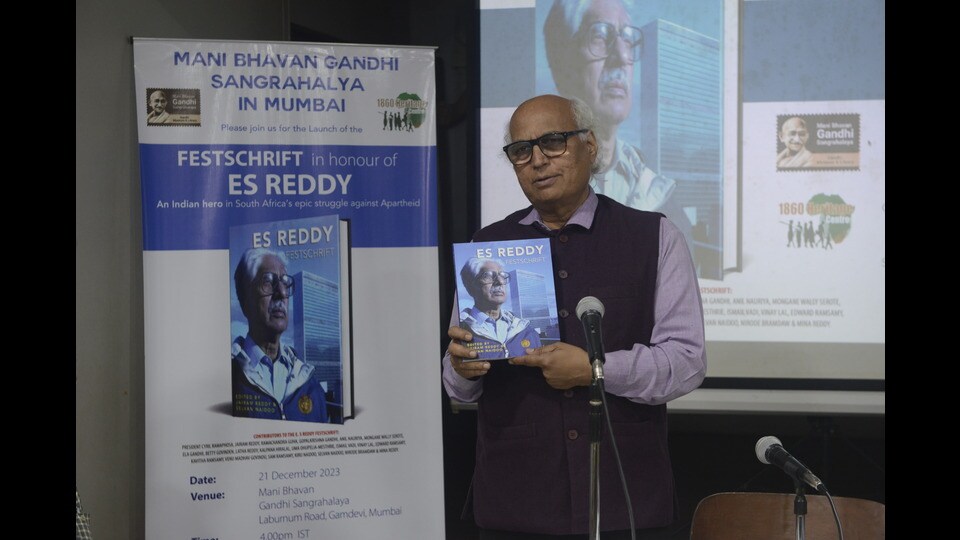
The ES Reddy Festschrift includes essays written by people from the fields of academia, politics, diplomacy and activism – Ramachandra Guha, Mongane Wally Serote, Ela Gandhi, Betty Govinden, Latha Reddy, Kalpana Hiralal, Uma Dhupelia-Mesthrie, Ismail Vadi, Gopalkrishna Gandhi, Vinay Lal, Edward Ramsamy, Kavitha Ramsamy, Venu Madhav Govindu, Sam Ramsamy, Anil Nauriya, Nirode Bramdaw, Kiru Naidoo and Mina Reddy.
The book is co-edited by scholars Jairam Reddy and Selvan Naidoo who work at the 1860 Heritage Centre at Durban, South Africa. It is a museum that aims to document the rich history and contributions of the Indian community in South Africa. Naidoo, the museum’s director, released the festschrift in Mumbai along with peace activist Sudheendra Kulkarni and political scientist Usha Thakkar, president of the Mani Bhavan Gandhi Sangrahalaya.
Thakkar reminded the audience that the two-storey building in Mumbai’s Gamdevi neighbourhood, where the event was being held “was the focal point of Gandhiji’s activities in Mumbai between the years 1917 and 1934”, and that she was proud to host an event that would help the people of Mumbai learn more about the Gandhian legacy in South Africa.
Kulkarni said, “It is important to counter the malicious propaganda that depicts Mahatma Gandhi as anti-Black and anti-Dalit. For that to happen, we need to deepen our understanding of the deep ties between India and South Africa that were nurtured by Gandhi.” He added, “It is unfortunate that E S Reddy’s work is not as widely celebrated in India as it should be.”
E S Reddy joined the United Nations in New York in 1949 and became the Assistant Secretary General in 1983. During his time with the organization, he played a key role in Indian-South African ties. He served as the principal secretary of the UN Special Committee Against Apartheid, as the chief of section for African Questions, as the director of the UN Centre Against Apartheid, as the director of the UN Trust Fund for South Africa, and a Member of the Council of Trustees of the International Defence and Aid Fund for Southern Africa. He is highly respected in South Africa for leading anti-apartheid actions including economic boycott, which brought international attention to the human rights violations under the apartheid regime. He also campaigned for the release of Nelson Mandela from prison.
His work has been recognized by the governments of India and South Africa. He got the Padma Shri in 2000, and Order of the Companions of O.R. Tambo in South Africa in 2013.
Naidoo gave a presentation on the archival work of the 1860 Heritage Centre, which hosted a webinar with ES Reddy shortly before the COVID-19 pandemic, and has been the driving force behind this festschrift. Naidoo said, “ES Reddy held on to his Indian passport until the very end when he passed away in the United States. His identity as an Indian national, and his solidarity with the cause of South African liberation were profoundly significant to him.”
Naidoo also revealed that he is a direct descendant of the first lot of indentured workers from India who arrived in South Africa in the 19th century. He discovered this in June 2023. He noted that he is deeply committed to fostering partnerships between India and South Africa so that the “institutional memory of Gandhi” is preserved for future generations of both nations.
When Renu Modi, Professor and Director of the Centre for African Studies at University of Mumbai, asked a question about Gandhi being branded as racist thanks to Ashwin Desai and Goolam Vahed’s book ‘The South African Gandhi: Stretcher-Bearer of Empire’, Naidoo responded, “There needs to be a rebuttal to that book. To call Gandhi racist is unacceptable.”