
 E-Paper



Police identify 10 traffic hot spots in Ghaziabad ahead of festival season
Officers of the Ghaziabad traffic police on Tuesday identified at least 10 major road junctions that witness a heavy volume of traffic and frequent snarls and could add to the air pollution in the coming days and said measures will be taken to rectify faulty road engineering where needed to streamline traffic flow


Officers of the Ghaziabad traffic police on Tuesday identified at least 10 major road junctions that witness a heavy volume of traffic and frequent snarls and could add to the air pollution in the coming days and said measures will be taken to rectify faulty road engineering where needed to streamline traffic flow . .
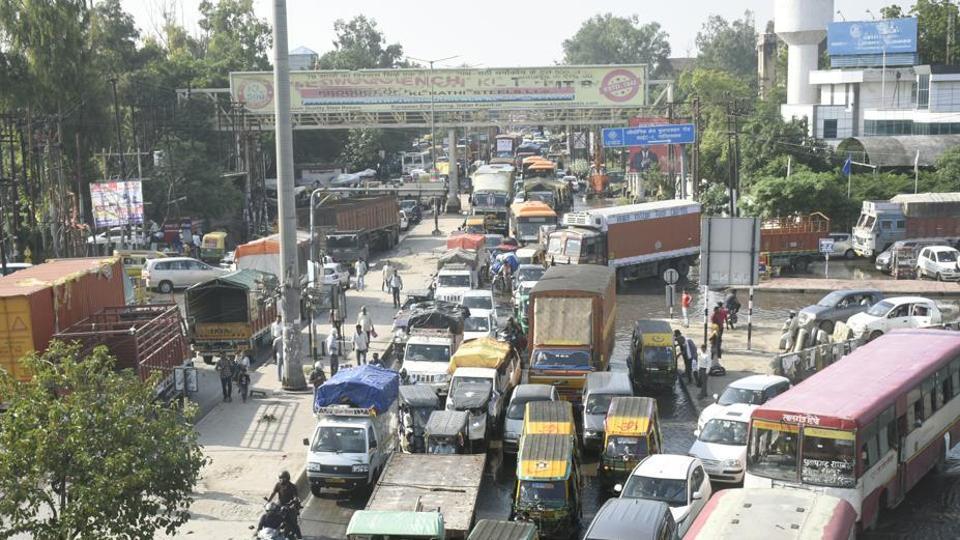
The identified hot spots are Bhopra crossing, New Bus Adda roundabout, Delhi Meerut Road, major markets in Indirapuram and Vaishali, Apsara Border and Lal Kuan, among others, the traffic police said.
“These spots need proper road engineering to streamline traffic. Some of the hot spots are also a result of bad roads, on road parking and encroachments. During the festival season, the volume of traffic will increase and will further lead to congestion and snarls. On our part, our personnel will remain deployed to ensure smooth flow of traffic,” said Ramanand Kushwaha, superintendent of police (traffic).
The figures from the Uttar Pradesh Pollution Control Board (UPPCB) indicate that the air quality in Ghaziabad deteriorates in the months of October, November and December.
The average AQI in the month of September in 2019, 2020 and 2021 was 93, 132 and 77, respectively. The average AQI figures shot up to 262, 281 and 211 during these years, respectively, in the month of October, and it further rose to 340, 351 and 378 in the month of November in three respective years.
The month of December in 2019, 2020 and 2021 witnessed an average AQI of 367, 370 and 314, respectively.
“Apart from external factors, we can safely say that vehicular emissions, among all local factors, contribute the highest share to city’s air pollution. However, there is no scientific study that could point out its exact share. Apart from the identified hot spots, which need proper road engineering, more hot spots will surface during the festival season,” said Utsav Sharma, regional officer of UPPCB.
Environmentalists said the city has at least 15 major traffic hot spots.
“It is estimated that traffic conditions and the resultant vehicular emissions account for over 40% of the city’s air pollution levels. There are at least 15 or more hot spots on major roads such as GT Road, Delhi-Meerut Road, Link Road and others. Over the years, officials have not carried out proper road repairs, road engineering of major intersections and others essential works. And these hot spots in every major area contribute majorly to air pollution,” said Akash Vashishtha, a city-based environmentalist.
“A proper study is needed by a nationally renowned agency for betterment of road engineering. But officials seem disinterested in improving road infrastructure,” he said
Ghaziabad is among the 16 “non-attainment” cities in the state of Uttar Pradesh and its pollution levels generally remain on the higher side during the onset of winter. Cities are declared “non-attainment” if they do not meet the national ambient air quality standards for particulate matter (PM10) or nitrogen dioxide (NO2) over a period of five years.
Earlier in April, the city ranked as the second-most polluted city in the world after Bhiwadi in Rajasthan on the World Air Quality Report, 2021. The annual report, prepared by Switzerland-based organisation IQAir, surveyed 6,475 cities across the world.
