
 E-Paper



Menstrual hygiene awareness: Varanasi teen encourages peers to use matka incinerators to dispose of sanitary pads
Hailing from a family of farmers, Sakshi says that a lot of people carelessly throw away their used sanitary napkins in unhygienic ways.


LUCKNOW Young social activist and IIT aspirant, Sakshi Singh, has taken up the noble cause of spreading awareness about menstrual hygiene in Varanasi. Originally from Mirzapur, the 18-year-old is encouraging girls to dispose of their sanitary waste in environmentally friendly ways -- like disposing of pads using matka incinerators installed outside their homes.
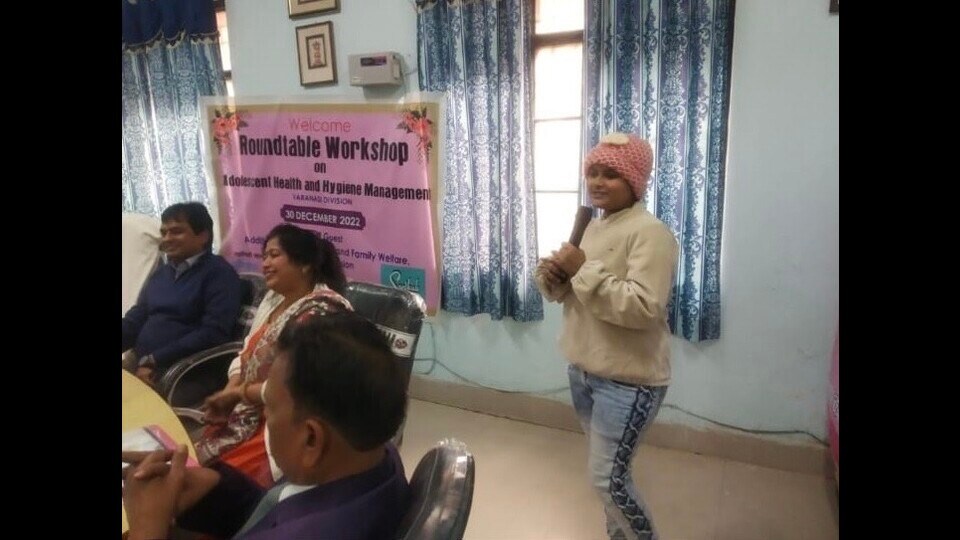
A former student of St. Atulanand Residential Academy in Varanasi, Sakshi has been part of the Swachh Garima Vidyalaya Scheme, a menstrual hygiene management scheme conducted in association with UNICEF and WASH (Water, Sanitation and Hygiene), since her school days. When asked about her awareness drive, Sakhsi said, “I was too young to be able to take up these issues while in my hometown Mirzapur. However, after I came to Varanasi (from Class 9th), I took up this cause as I realised that disposing of sanitary waste is a day-to-day problem.”
Hailing from a family of farmers, Sakshi says that a lot of people carelessly throw away their used sanitary napkins in unhygienic ways. She believes that students at her alma mater can benefit from what she has learned about menstrual hygiene. “At first, I started the drive by telling a few of my friends about matka incinerators. It is a simple installation they can set up in their homes -- you take a clay pot and make small holes in it and bury it in the soil with twigs and leaves. Once your menstrual cycle is over, you can throw all these pads in the matka and burn them,” she said. “So far, almost 30 girls have started doing this at their homes.”
According to the International Journal of Gynaecology and Obstetrics, it takes sanitary pads about 500-800 years to completely break down, and non-biodegradable material usually never break down in any case. With incinerators, although they result in fumes and air pollution, the impact on the environment is not as damaging.
Acknowledging this, Sakshi and her friends got girls in her neighbourhood to install these incinerators outside their homes. They also managed to convince their school principal to have a sanitary napkin incinerator installed at their campus. “With a male school principal, things weren’t easy for girls in my school. However, I was confident in talking about these problems openly. I told him that I was representing all girls of the school and thus, the management must take some steps in this regard. It took us six to seven months to convince him to install it. Once he noticed that the girls were having issues with hygienically disposing of pads, he agreed to install an incinerator in the school,” she said.
While Sakshi aims to become an engineer, she is certain that she would continue her work on menstrual hygiene awareness. “I am also asking girls to switch to reusable cloth pads. Although it will be difficult for me to make the switch as I have gotten used to using disposable sanitary napkins, if I do not make the change, I cannot ask others to do so. The advantage of cloth pads is that they are affordable, and can be washed and reused multiple times. Moreover, they do not need to be burned. That’s why they don’t cause air pollution and are good for the environment,” she added.