
 E-Paper



The changing dynamics in Chhattisgarh’s Maoist heartland
The Chhattisgarh police claim that in the history of anti-Naxal operations in the state, 2024 was significant for troops in Bastar range on all crucial fronts.

 Prefer HTon Google


Until a few years ago, no outsider had dared to enter Purvati village of Chhattisgarh’s Sukma district—home of Maoist commander Mandvi Hidma and over three dozen other top Maoist cadres. There was no school, hospital, or even a gram panchayat building there. However, things are changing in the region now, thanks to a series of measures by the security forces and the district administration. A school is being built in the village and other amenities are being provided by the district administration with the help of security forces. This December 14, the village got its first television set since the product came to India in the late 1950s.
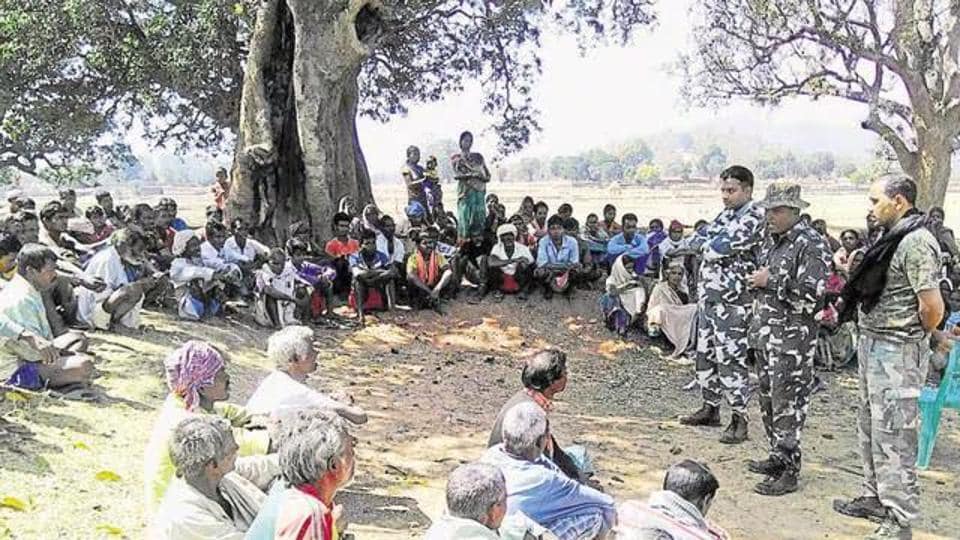
“It is like a dream. No one had ever watched TV in my village. No one had seen solar lights and fan,” said Banjam Madgu , a resident of Puvarti.
“Things have been changing in Bastar in the last one year as the security forces are entering deep forest which was the core area of Maoists. Recently, we have opened a new camp in Golaguda, which is about seven km deeper than Puvarti in the jungles. These camps will give a significant boost to the government’s campaign against Left-wing extremism,” said a senior police officer posted in the district.
Puvarti is on the border of Sukma and Bijapur districts of Chhattisgarh’s Bastar range- a Maoist battle ground. Since 2019, the state and central governments have expanded their reach into Maoist-affected regions by establishing 98 new security camps. This year, 28 camps were set up in the core Maoist areas in the Bastar region, which comprises the districts of Kanker, Kondagaon, Narayanpur, Bastar, Dantewada, Bijapur, and Sukma.
According to officials aware of the matter, there has been an impressive increase in surrender by the Maoists in the region.
“With increase in security camps in core areas, both low and middle rung Maoists started surrendering. Many security camps got opened in villages where Maoists belonged to, and this made them feel secure in surrendering,” said an officer who did not want to be named.
The official said that continuous assaults by security forces have created fear in the mind of Maoists, leading many to surrender in the region. The launch of Niyad Nellanar Yojana helped the district administration in providing benefits of various developmental initiatives and led to family members motivating the Maoists to surrender, the officer added.
Notably, since 2000, a total of 6,509 Maoists have surrendered in Chhattisgarh, with the highest number, 1,210, recorded in 2016.
However, the number sharply declined to 368 in 2017. In the years following, 2024 saw the most surrenders, with 802 Maoists laying down arms in Maoists affected districts till December 25.
Similarly, the arrests of Maoists have also increased in Bastar in comparison with the previous years. Since 2000, the security forces have arrested 12,492 Maoists with the highest number of arrests-- 1,134-- recorded in 2018. The arrests dropped significantly in 2019, with only 499 recorded. However, it rebounded in 2024, with 837 Maoists apprehended.
“The arrests number has improved this year because of the improvement in human and technical intelligence which helped pinpoint arrests of many Maoist cadres including the recent arrest of senior rank cadres. Two days ago, senior Maoist cadre Prabhakar was arrested-- one of the biggest achievements of the security forces,” said a senior officer posted in the region.
“Secondly, the curtailment and choking of supply lines have led to successful arrests of the cadres. Thirdly, the coordination between state and central agencies like the National Investigation Agency (NIA) and the Enforcement Directorate (ED) too have led to many arrests,” the officer added.
The Chhattisgarh police have claimed that since 2000, a total of 1,308 Maoists were killed in exchanges of fire with security forces, the highest number being 207 in 2024.
“It all happened because of the continuous monitoring of the Union Home Ministry and the state government. There was a clear mandate of deadline and resource allocation by the central and state governments. Secondly, the number increased because of the push of specialised trained anti-Maoist security forces in Bastar (the District Reserve Guard or DRG, the Bastar Fighters, the Commando Battalion for Resolute Action or CoBRA). And lastly, border choking/sealing and inter-state operations were done intensively,” said a senior Central Reserve Police Force (CRPF) officer.
It is worth mentioning that the security forces also suffered losses, with 1,303 personnel killed between 2001 and 2024. The highest toll occurred in 2007 during the Salwa Judum movement, a controversial government-backed civilian militia initiative. While casualties declined to 80 in 2008 and 95 in 2009, they rose sharply to 171 in 2010, just before the Supreme Court deemed Salwa Judum unconstitutional in 2011.
Civilians bore significant casualties, with 1,791 lives lost between 2001 and 2024. The deadliest year for civilians was 2006, with 281 deaths during the height of Salwa Judum. Civilian casualties gradually decreased in subsequent years but rose again to 76 in 2018, coinciding with increased operations in Bastar. In 2024, the number of civilian deaths stood at 68, despite intensified anti-Maoist actions.
Inspector general of police, Bastar range, Sunderaj P, said that in the history of anti Naxal operations in Chhattisgarh, the year 2024 was significant for troops in the Bastar range on all crucial fronts.
“We made vital inroads even in those areas which were considered to be impenetrable Maoist strongholds. Unprecedented breakthroughs in Abhujmaad and South Bastar have not only boosted the morale of the security forces but also given the people hope that the Naxal menace would come to an end sooner than expected. It is not only the numerical counts of the Maoist bodies recovered but also the grade of the cadres like state committee-level cadres who got removed from the Maoist ecosystem has provided us the operational edge in this season,” the IG said.
He further explained that in 2024, so far, the bodies of six state committee-level cadres, including that of Joganna, Rupesh, Niti and Karthik, were recovered after exchange of fire with Maoists.
The bodies of 16 DVCM (Divisional Committee Members) level cadres and 32 ACM (Area Committee Members) level cadres were also recovered this year, which indicates that the Maoist suffered severe losses in the top level and middle level leadership, he said.
On the weapons front, a total of 263 weapons were seized between January 2024 and September 2024 by the security forces.
The security forces seized 10 AK 47s, eleven SLRs, the same number of pistols and 9 INSAS rifles from the Maoists. In the same period the forces seized 23 BGL (rocket launchers).
“Increasing our operational and developmental reach in the otherwise deprived parts of South Bastar, West Bastar, Abujhmaad region have turned the table around. Providing basic amenities like PDS shops, Anganwadi, household electrification, etc to the villagers have bridged the development deficit and increased the trust between the native population and the government,” Sunderaj said.
The security forces have also re-activated many roads which were closed for decades including Basaguda-Jagargunda road, Aranput-Jagargunda road, Tarrem-Pamed road, Narayanpur -Kutul road, Narayanpur -Garpa road, Palli-Barsur road, Chintlnar-Kistaram road.
Experts believe that Maoists have shrunk in most of their divisions and are weak now.
“If the current trend of aggressive operations continues in Abujhmad and South Bastar, the Maoist activities can sufficiently be brought under control. The Maoists have certainly shrunk in most of their divisions and their military formations has weakened. It has also affected their fresh recruitment and their sources of funds. They are in a defensive mode. Therefore, if the security forces continue to move forward, Maoist will go into the setback stage, leaving behind many areas,” said former special director general of police, Chhattisgarh, RK Vij.
Meanwhile, human rights activists and organisations have claimed that the year 2024 was worst in terms of human rights violation.
“The year 2024 has been one of the deadliest in Bastar since the Salwa Judum era (2005–2011), marked by increased violence, human rights abuses, and militarisation. Security forces reported over 235 killings since December 2023. Villagers have contested many of these “encounter” killings, alleging staged executions, with investigations revealing that numerous victims, including children, were unarmed civilians. Parallelly, in 2024, over 60 villagers were allegedly killed by Maoists on accusations of being police informers,” said a statement issued by the People’s Union for Civil Liberties (PUCL), a human rights organisation.
“At the forefront of these controversial operations is the District Reserve Guard (DRG), accused of carrying out extrajudicial killings. The recruitment of DRG personnel, which includes surrendered Naxalites and local tribal youth, directly contravenes the Supreme Court’s 2011 ruling, prohibiting the use of affected youth in counter-insurgency operations” the statement added.
Adding to the crisis are reports of indiscriminate bombings in some rural civilian areas, besides intensifying fear and insecurity among the local communities, the statement added.
“In a parallel development, after many attempts to suppress the peaceful and democratic youth movement, Moolvasi Bachao Manch (MBM), through arrests of its leaders and members, the Chhattisgarh Government took a contentious step on 30 October 2024 to ban the organisation. MBM, a group advocating for Indigenous rights, was declared an “unlawful” organisation under the Chhattisgarh Special Public Security Act (CSPSA). On 28 November 2024,” the statement said.
-kW0H-U20214218012MgB-250x250%40HT-Web.jpg)


