
 E-Paper



Rohith Vemula report misses trees for the forest
The Vemula report shows remarkable ignorance about how caste operates in institutional settings.

 Prefer HTon Google


The Telangana government has said the 2016 Rohith Vemula suicide case would be reinvestigated following the controversy over the closure report filed by the state police. This is not surprising since this was no simple suicide case but a politically-charged and layered matter that foregrounded a host of issues including Dalit discrimination, institutional insensitivity and bias, student politics, and the involvement of political actors in shaping student and faculty responses inside the campus. Among the accused were senior leaders of the BJP, including the Secunderabad MP Bandaru Dattatreya and then minister for education Smriti Irani. The Congress government in Hyderabad, which has promised a Rohith Vemula law to fight caste discrimination, surely could not be seen as endorsing a report that absolves all the accused, and, worse, accuses the dead student and his family of claiming Dalit status by fraudulent means. The suicide led to student mobilisations across the country that year.
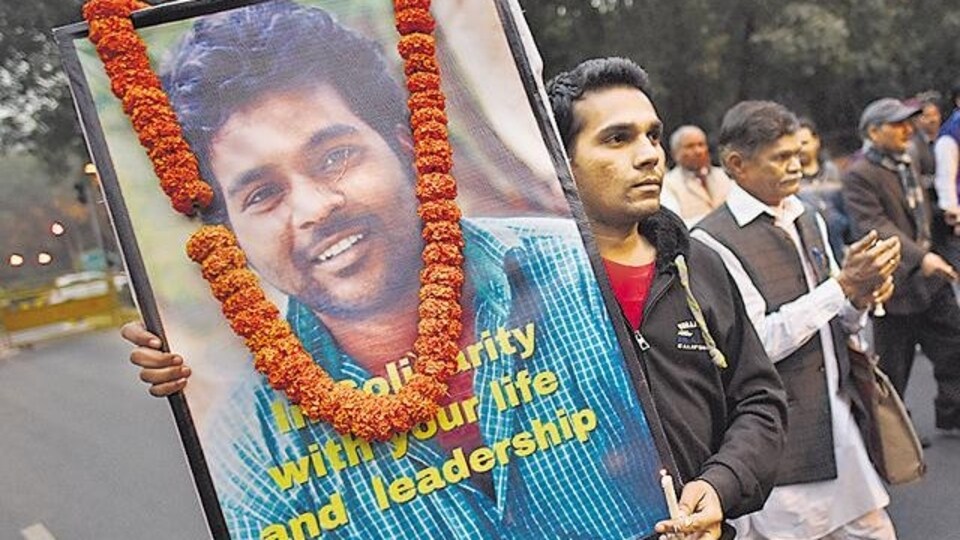
The probe report is remarkable for its insensitive approach to the caste question in the Rohith Vemula case. It has collated evidence to claim that Rohith Vemula, a PhD scholar at the Central University of Hyderabad, was not a Dalit since his father belonged to an OBC community. It ignores the social context in which Rohith Vemula grew up: Rohith’s mother, Radhika, was a Dalit who grew up in a non-Dalit household and, following the failure of her marriage, as a single mother, brought up her children in a Dalit environment. When the law is mindful of the social context in which caste identities are formed, it is appalling that there should be a debate about Rohith Vemula’s caste. The conclusions arrived at in the report, however, reveal the motive for this line of inquiry: The probe suggests that the challenge to Rohith’s caste identity was a trigger for suicide.
The report shows remarkable ignorance about how caste operates in institutional settings. It glosses over the enormous pressure Rohith Vemula faced from the university authorities and, instead, suggests he was “disappointed and unhappy over his childhood”, “unhappy with the organisations with which he worked” and “seemed to be under severe depression and disappointment”. Such facile and devious conclusions undermine the probe’s claim of fairness and diligence.


