E-Paper



Number Theory: Outliers within the constituencies in Lok Sabha elections
When there is a nationally dominant party, as there was in 2014 and 2019, assembly constituencies within a parliamentary constituencies largely vote similarly .

 Prefer HTon Google


Polling for the Lok Sabha elections is all but over. One of the narratives that has found traction from anecdotal accounts is that it is a seat-by-seat election. Whether or not this is true will only be known on June 4. Until then, past data can be used to answer a more interesting question: How coherent are parliamentary constituencies (PCs) when it comes to voting in Lok Sabha elections? Simply speaking, do parts of a PC vote differently from the overall result in the PC? The best way to answer this question is to break down PC-wise results at the assembly constituency (AC) level and see whether the winner in any constituent AC is different from that in the PC. HT has used AC-wise data on Lok Sabha elections from Trivedi Center for Political Data (TCPD) – it has this data from 1999 Lok Sabha elections onwards – to tackle this question. Here is what the data shows.

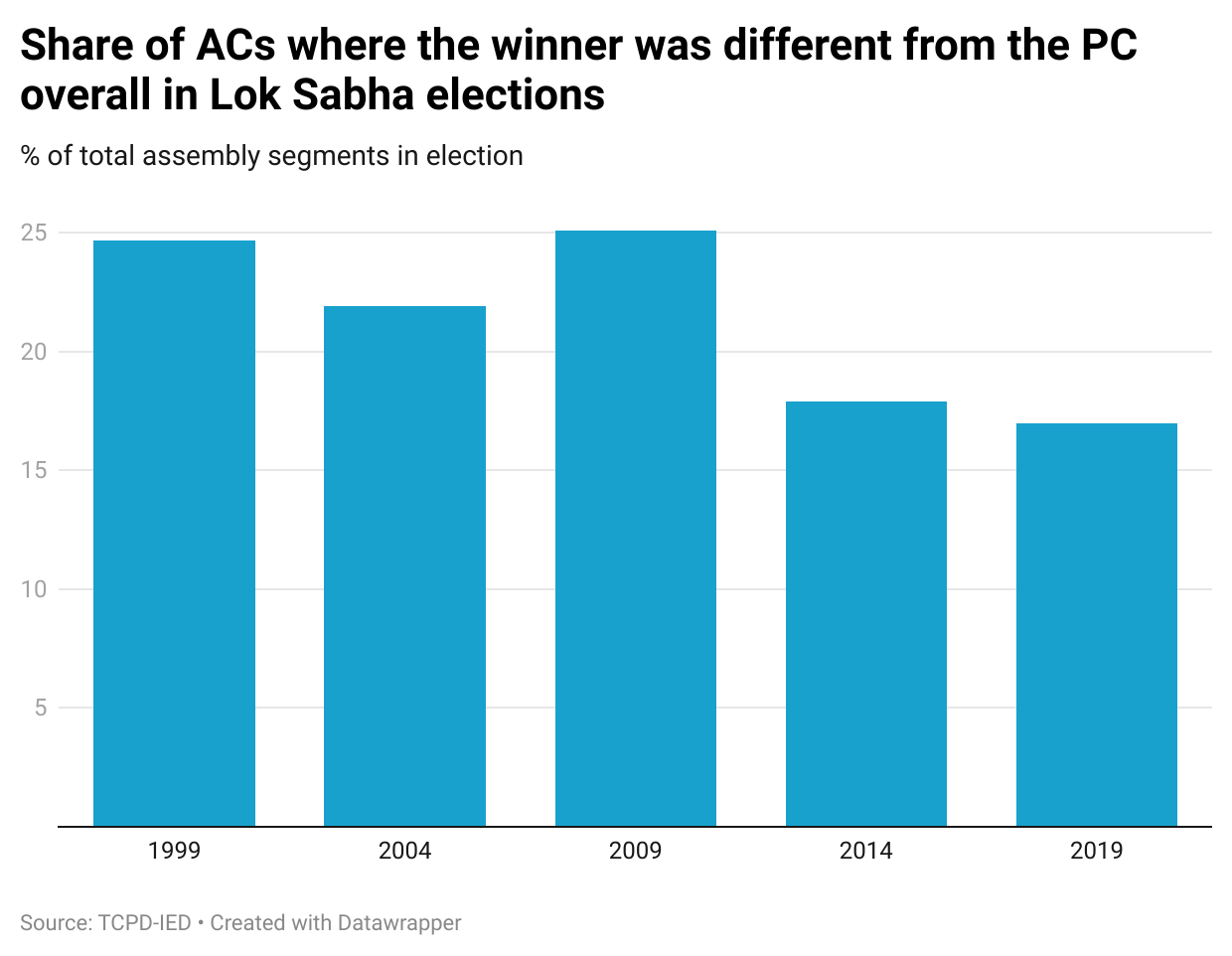
 Share of ACs that voted differently from the overall PC fell in 2014 and 2019From 1999 to 2009, when no single party won a majority at the national level, the winners in around 22%-25% ACs were different from the winner in the PC these ACs were a part of. This changed when the Bharatiya Janata Party (BJP) won a majority. Only 18% and 17% of ACs voted differently from the PC they were part of in 2014 and 2019 respectively. To be sure, the total number of AC-level results in Lok Sabha elections changed somewhat during this period for a couple of reasons. A lot of ACs overlapped with PCs until the 2008 delimitation. This happened because in some states, such as in Uttarakhand, the number of ACs was changed without any change in the number of PCs.
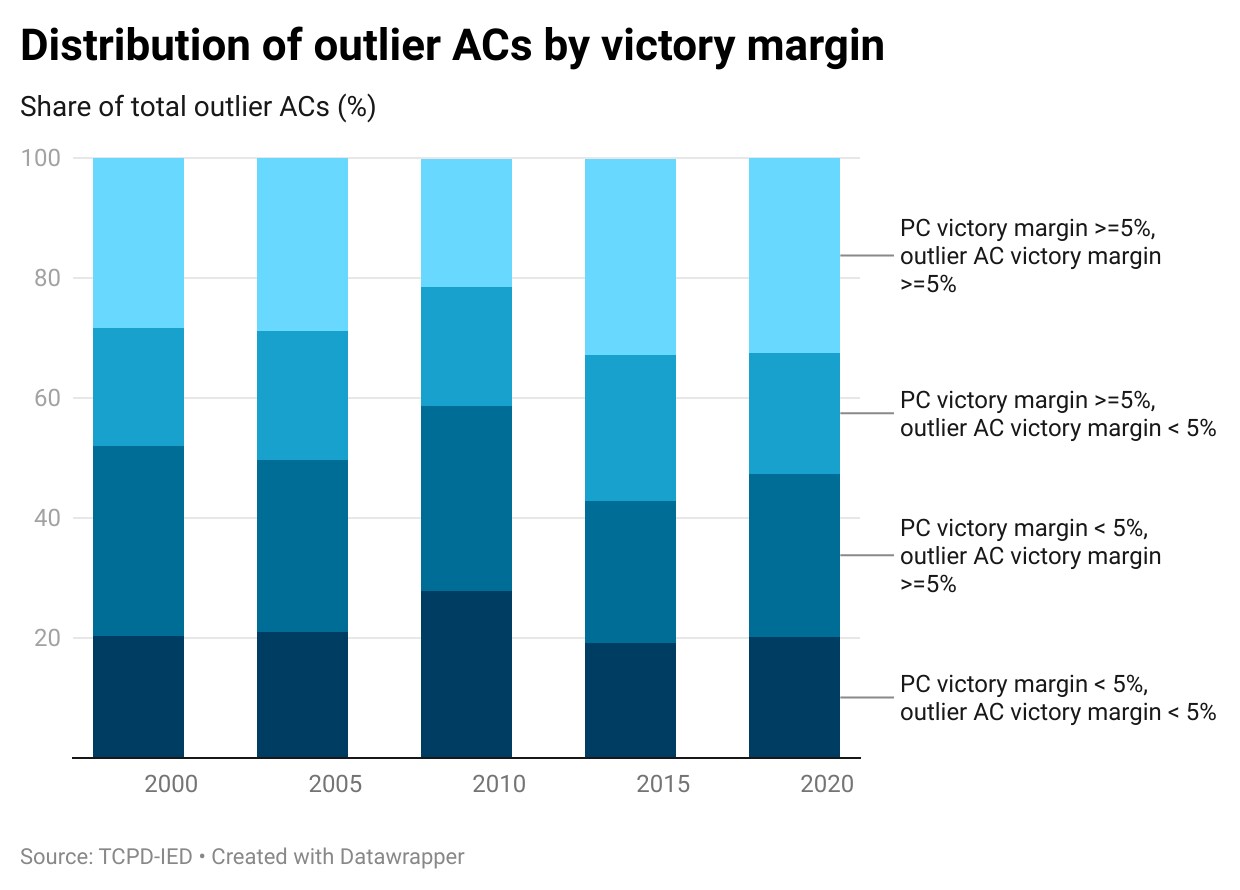
- What is the extent of variation in ACs that vote differently?Generally, ACs voting different from a PC did so overwhelmingly. In a majority of such ACs, the leading party was ahead by margins of 5% or more, irrespective of whether the PC’s overall winner led by a margin above or below 5%. This means that voting in a particular AC can be very different from that in the overall PC. An AC voting differently did not necessarily decrease the victory margin in the PC -- around half of the outlier ACs were part of PCs won by a margin of 5% or more in each of the five Lok Sabha elections analysed here.
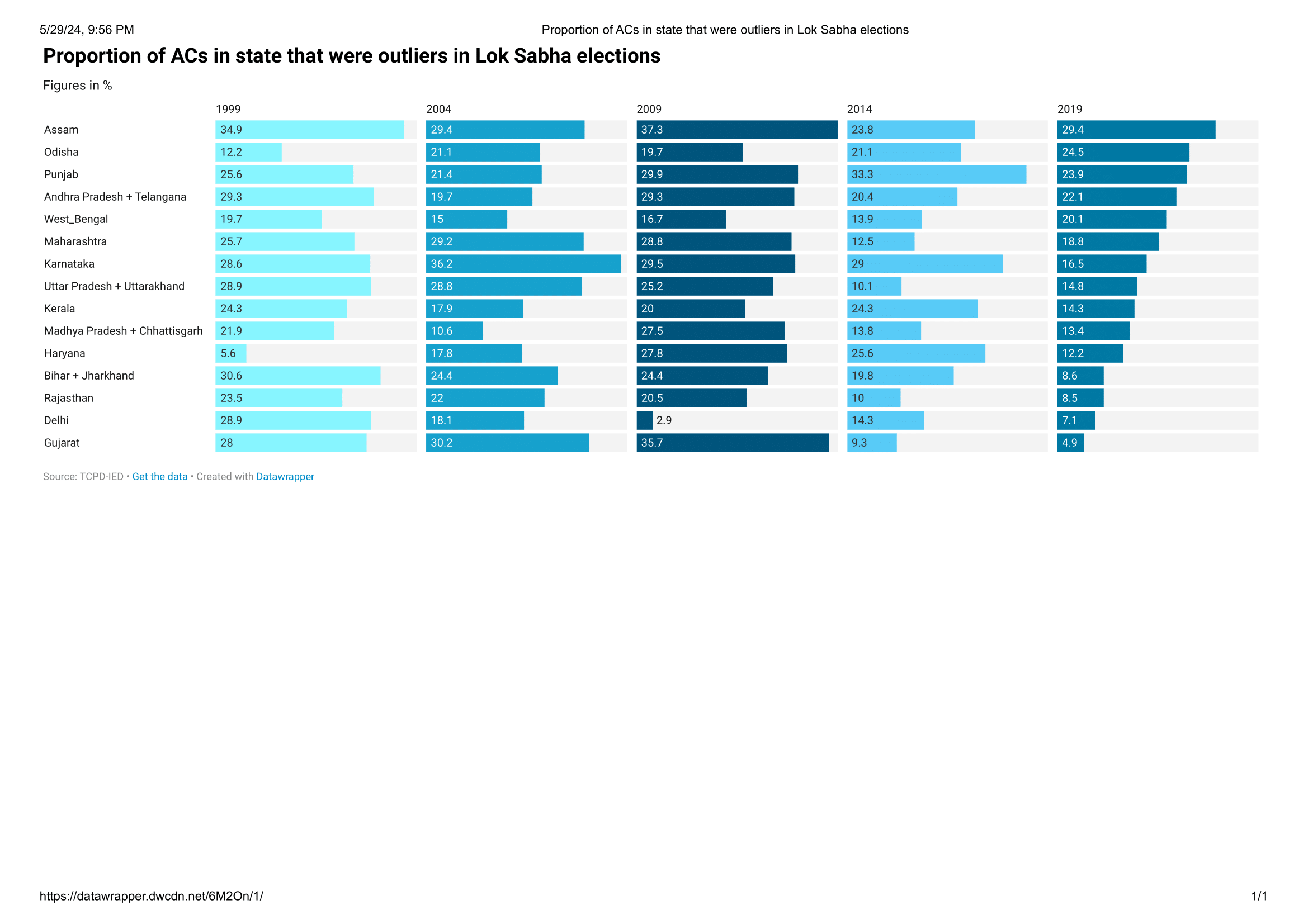
- Are there states which see a greater intra-PC divergence in results?Yes, there are. To track states where this phenomenon was seen consistently, HT merged new states created after 1999 with their parent states, and looked at states with at least 10 Lok Sabha seats. Among 14 such states, only Assam showed more intra-PC divergence than the national average in all five elections since 1999. Another four states – Punjab, Maharashtra, Karnataka, and Andhra Pradesh (taken together with Telangana) – did this in four elections. While Punjab and Andhra Pradesh scored slightly below the national average in 2004, Maharashtra and Karnataka did so in 2014 and 2019 respectively. Similarly, three states – Gujarat, Bihar (together with Jharkhand), Uttar Pradesh (together with Uttarakhand) – outdid the national average on this front in three elections. For Uttar Pradesh and Gujarat, all these three elections were before 2014, but Bihar showed greater intra-PC divergence even in 2014. The remaining six states showed relatively bigger intra-PC divergence in only one or two Lok Sabha elections since 1999. Interestingly, at least one of the elections in which they did so was either 2014 or 2019, except in Rajasthan and Madhya Pradesh (taken together with Chhattisgarh), where this last happened before 2014.
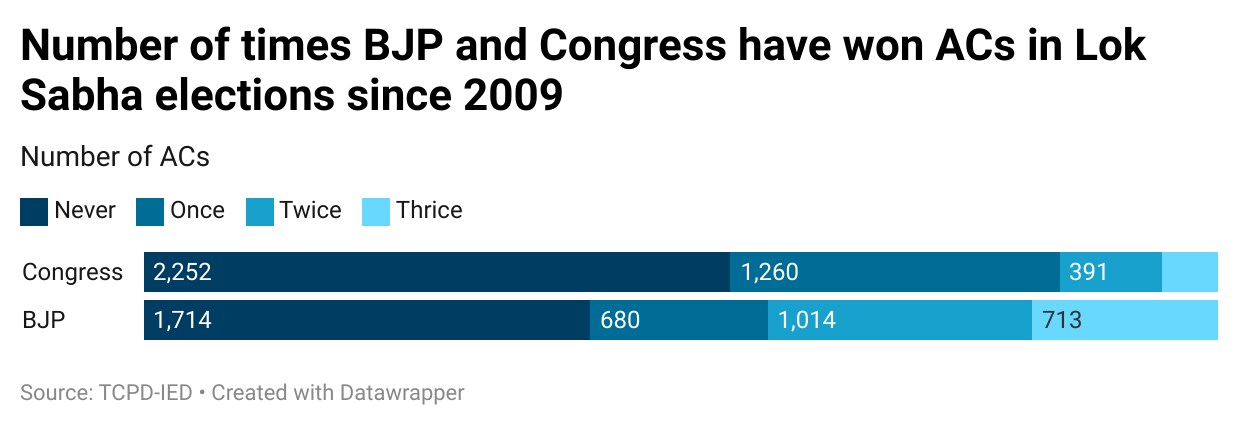
- 80% of unconquered ACs of BJP and Congress are not outliers in Lok Sabha electionsHT removed the duplicated ACs (as explained in the first section) to check how many ACs the BJP and the Congress have never won since 2009, the earliest election up to which ACs can be tracked because of the 2008 delimitation. This shows that of the 4,121 consistent ACs, the BJP has never won 1,714 or (41.6%) and always won 713 (17.3%). These numbers for the Congress are 2,252 (54.6%) and 218 (5.3%). As these numbers suggest, there are a considerable number of ACs where both the BJP and the Congress have no purchase, but the BJP has a winning streak in a proportionately larger number of ACs. To be sure, over 80% of the unconquered ACs of both the BJP (86%) and the Congress (82%) are located in PCs that they have never won since 2009, which means that over 80% such ACs only reflect the larger trend of the PC. Clearly, as the analysis shows, when there is a nationally dominant party, as there was in 2014 and 2019, ACs within a PC largely vote similarly