
 E-Paper



Karnataka Polls: Opposition watch in Karnataka
Congress banks on corruption charges against BJP amid outcry over AICC chief's 'venemous snake' comment; JDS hopes to retain its Vokkaliga hold

 Prefer HTon Google


Last week, the fret on the faces of the Congress workers at their party headquarters in Bengaluru was evident. The party, which had a smooth and confident election campaign, suffered one of the first setbacks when the All India Congress Committee chief Mallikarjun Kharge referred to Prime Minister Narendra Modi as “a venomous snake”, clarifying later that he was speaking of the PM’s party ideology, which he said was “divisive, disharmonious, full of hatred towards the poor and Dalits.”
The clarification didn’t do much to stem the damage: much of the air time on the Kannada channels, popular in the rural parts of the state, was dominated by a counter-attack by the Bharatiya Janata Party leaders; and it came a day before Modi began the second phase of the campaign, consisting of 19 rallies across the state.
“They are good at utilising every opportunity to gain momentum from something like this. This only gives the BJP a chance to make an election about Modi,” pointed out a Karnataka Pradesh Congress Committee office bearer, who was glued to his mobile screen for news.
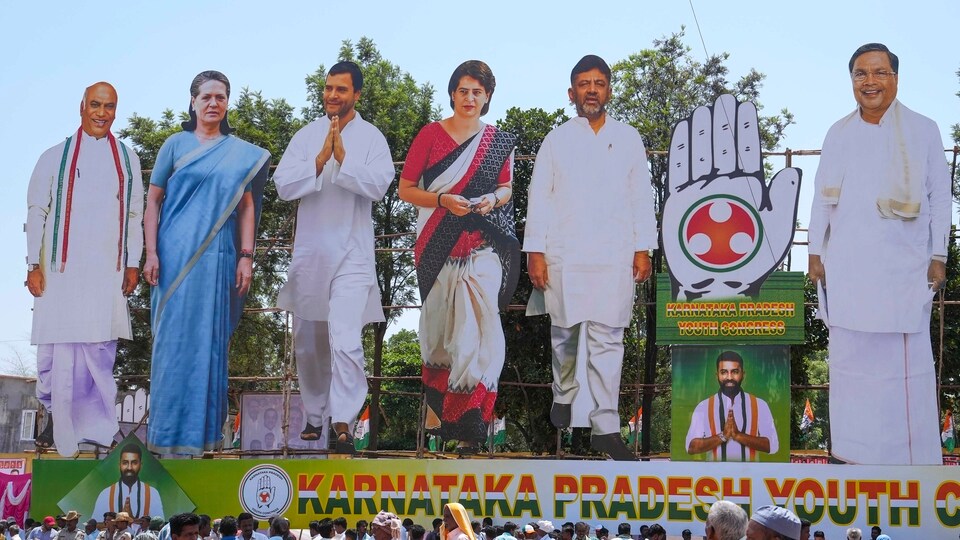
While the concern is real, Congress is betting on its year-long, carefully crafted election campaign and anti-incumbency wave to take them across the finish line. For Congress, four factors will play a crucial role in the election – anti-incumbency, welfare schemes, Ahinda and Vokkaliga voters.
The number game
The base vote of the Congress party is around 34%. Only once did the party’s vote share go below this mark — in 1994, it was 26%. Even though the BJP’s base vote is around 34%, as the vote banks are concentrated, it could win them up to 100 seats. However, the Congress relies on Ahinda (a Kannada acronym that stands for minorities, Backward Classes and Dalits) to win around 78-80 seats with this base vote spread across the state. This is one of the reasons why even though Congress got a 38% vote share in the 2018 election, the BJP with 36% emerged as the single largest party.
Since the late 1970s, the Congress has come to power in the state with a majority three times — 1989, 1999 and 2013. The common factor in these elections was that the Opposition in the state was divided between multiple parties; and in 1989 and 1999, the Congress had made a Lingayat (Veerendra Patil) and a Vokkaliga (SM Krishna) the CM candidates of the party.
In the first two elections, the Lingayat and Vokkaliga voters ensured that the Congress crossed the 40% vote share mark, while in 2013, even though Siddaramaiah, a Kuruba, was the chief ministerial candidate, it was Lingayat strongman Yediyurappa’s leaving BJP that increased the Congress’ vote share to 36%. The increased vote share and Yediyurappa splitting Lingayat votes ensured a Congress victory.
In this election, the ruling BJP faces severe anti-incumbency. Historically, the anti-incumbency votes generate approximately a 2-4% swing in the votes. However, for the Congress to get over 40% vote share they will have to get votes from the Vokkaliga community, which accounts for roughly 12% of the vote share in the state, electoral observers said.
The party is projecting DK Shivakumar as the tall Vokkaliga leader and potential chief minister in the hope of a big migration of Vokkaliga votes in the old Mysuru region. “The Lingayat vote bank is the largest in the state and with their leaders joining Congress, we will see some victories in north Karnataka, but we are hoping for the biggest shift from the Vokkaliga community. A substantial change would change our vote base. We have better chances with them,” said a senior KPCC office-bearer.
While Siddaramaiah is consolidating the Ahinda vote bank, the pressure in this election is on DK Shivakumar to move the Vokkaliga votes from the JD(S) to Congress. However, this would be a difficult challenge the JD(S) is consolidating, relying heavily on the former Prime Minister’s emotional pitch to see a JD(S) government before his death.
Reviving the cadre
It is crucial for Congress to revive its cadre to capitalise on anti-incumbency. The grand old party saw a lull in its cadre’s morale after its coalition government collapsed in 2019. A resurgence in party morale began as early as January 2023, when the party took out the Mekedattu Padayatra demanding implementation of the Mekedatu project across the Cauvery River in Karnataka. The event, spread over two months, managed to gather large numbers of people.
The Congress in Karnataka has strong local leadership, a wide social base and a robust organisation, all of which can pose a stiff challenge to the ruling BJP. The leaders were brought together during the 75th birthday celebration of Siddaramaiah. “That event really changed the momentum for us,” said the AICC secretary PC Vishnunadh. “One can even say that the campaign for the elections was kickstarted for the Congress. The Bharat Jodo Yatra further solidified our cadre morale,” he added.
The Congress party was able to reactivate its booth-level workers with both these large events, something which had proved to be a difficult task in 2018. However, reviving this base created a problem for the party after the ticket selection. “I’m not sure about other areas, but in the old Mysuru region, the party should have been more careful with ticket distribution because there is uneasiness among supporters of leaders who didn’t get tickets,” said a senior leader who didn’t want to be named.
A carefully constructed campaign
Anti-incumbency is the biggest thrust of their campaign. The Congress, which till last year was seen as a tired and unenthusiastic Opposition, launched the '40% Sarkara' campaign. The jibe is a reference to allegations by Karnataka Contractors’ Association, claiming that BJP leaders and officials take 40% of the tender amount as a bribe for state-funded infrastructure projects.
Congress also started the 'PayCM' campaign which is a wordplay on digital payments firm PayTM. The campaign visuals have CM Bommai's face in the middle of a QR code, which takes a reader to a page listing the corruption cases involving the BJP, including the death of a contractor who alleged that former minister KS Eshwarappa demanded a bribe from him in April 2020.
Other cases that form part of the Congress ammunition against the BJP’s clean image include the irregularities in the police sub-inspector recruitment reported (in 2021; 31 people including ADGP rank were charge-sheeted), the alleged bitcoin scam (in 2021; 18 people charge-sheeted), the arrest of MLA Virupakshappa (on March 27, 2023, for taking a bribe for sanctioning orders in the government corporation headed by him), the allegations against health minister of Karnataka Dr Sudhakar in the purchase of medical supplies during Covid, poor city management during Bengaluru floods in 2022.
Poll promises
Ahead of the elections, the Congress has also offered a series of welfare schemes, which they claim would provide temporary relief from increasing prices. The four promises so far include stipends for unemployed youth, ₹2,000 payments for women heads of families, 200 units of free electricity, and ten kilograms of rice for the poor.
Prime Minister Modi while addressing BJP workers on April 27 via video conferencing announced that the Congress’s warranty has expired and therefore its poll guarantees hold no meaning. He also attacked the opposition party for offering freebies or “revadi” to the voters for short-term electoral gains without thinking of the country’s future. However, Congress believes that these schemes, particularly ₹2,000 offered to women heads of families, will be their trump card.
Days after the Congress announced the ‘Gruha Lakshmi Scheme’ if it is voted to power in the next Assembly elections, the BJP government has announced a scheme to counter it. The BJP promised it would provide ₹2,000 to every BPL family in the state under the ‘Gruhini Shakti’ scheme.
But, things are still not smooth sailing for the Congress. The party is hoping for a shift of Vokkaliga and Lingayat votes for a majority, however, the JD(S) is consolidating strongly in old Mysuru, where Congress and JD(S) are fighting for the Vokkaliga votes. In North Karnataka, the party is still unclear about the impact of the Lingayat leaders, Jagadish Shettar and Laxman Savadi, who shifted from the BJP earlier in April.
As the party grapples with a thinly veiled leadership struggle between its two tallest leaders — Shivakumar and former CM Siddaramaiah — both of who aspire for the CM’s post, it remains unclear how much of the Vokkaliga vote Shivakumar can bring to the Congress. Though Shivakumar presented himself as the next Vokkaliaga chief minister from Congress, the JD(S) has attacked the party claiming that its chief, HD Kumaraswamy has a better chance of becoming the CM than Shivakumar.
 ABOUT THE AUTHORArun Dev
Arun Dev is an Assistant Editor with the Karnataka bureau of Hindustan Times. A journalist for over 10 years, he has written extensively on crime and politics.


