E-Paper



Ri review: Achal Mishra's sublime portrait of Ladakh is a box of contradictions
Ri finds director Achal Mishra at his most daring and experimental, completely erasing narrative and thematic framework.

 Prefer HTon Google


Achal Mishra's Ri, which had its world premiere at the recently concluded Dharamshala International Film Festival, is unlike anything else the director has made so far. In his debut feature film Gamak Ghar as well as the follow-up in Dhuin, the filmmaker allowed for a certain emphasis on the poetic realism of rural India, chained with inscrutable insights on endurance and legacy. In Ri, Mishra is trying to break free from the predictable categorizing with time, space and overarching narrative framework. The effect refuses to box itself into categorizing- its a fictional feature that walks closely beside documentary, poking at the limits of what photography as a medium of art can do. As it turns out, Ri is a box of contradictions- it is as stunning as it is frustrating, allowing itself to mould according to the indulgence of the viewer. (Also read: The Killer review: David Fincher crafts an intense yet distant assassin thriller with Michael Fassbender)
The premise
Ri, which is shot entirely in Ladakh, begins with a dazzling shot. A huge mountain top seen from afar, enveloped with the ravishing blue of the clouds. The colours slowly bleed into that tiny spotlight of sunlight at the tail end of the cliffs, creating a richly atmospheric canvas. Before you know it, the filmmaker is allowing for a very meta-reading of his film with the long, single sequence of actor Abhinav Jha walking across the road. He walks and walks, tired and deprived of an anchor. Is it the same Pankaj from Dhuin who has set foot away from Darbhanga for a new audition? Or is it a brief escapade into unfamiliar terrain? There are no straightforward answers, but who wants one in the first place is what Ri suggests.
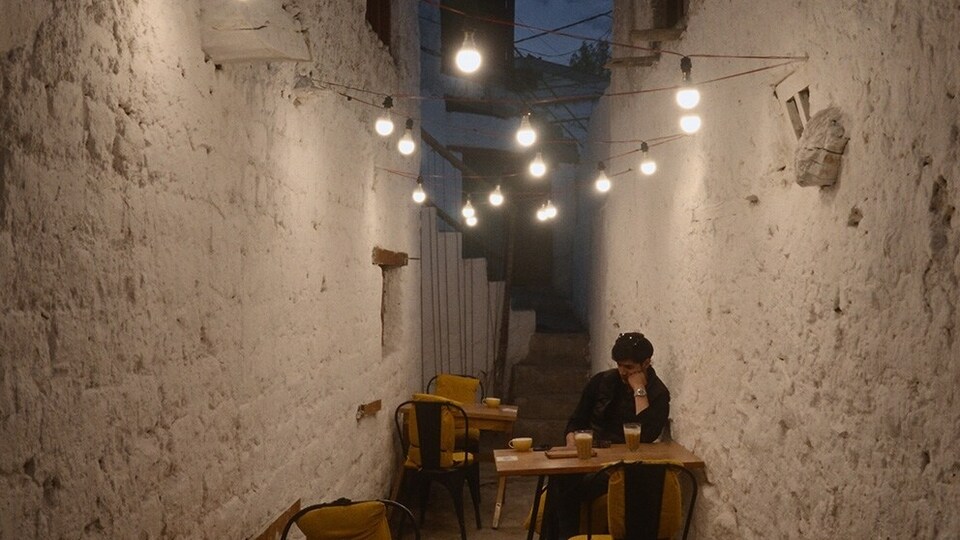
Ri is not even inclined to connect its viewers through a thematic connect between characters and their motives. It is designed as a tapestry of sights and sounds during the 'blue hour' in Ladakh, captured in Abhinandan Sharma and Achal Mishra's captivating eye for space and framing. In one scattered scene, Ri slows down to observe a small family gathered together at their home, preparing Thukpa. In another scene, two strangers talk about the language used to describe the colour in Ladakh. These are not characters who are given names or context. They exist as entities of nature, inhabiting a specific cultural perspective without having to underline their experiences.
Final thoughts
The opacity and decadence of Ri does not always register in the grand scheme of narrative aesthetic. It is certain to give rise to strong as well as polarized reactions, where viewers would feel the need to question the countless shots of mountains and alleys without any correlation to its people or their voices. To an extent, the interrogation rings true. Ri, which closes in with a beautiful composition by Tajdar Junaid, does feel indulgent and overbearing in parts, its perception on nature and privacy never less than a stubborn indulgence. What it lacks most is a voice- a sort of context in its formal daring. Ri is a slippery narrative experiment, that washes over its viewers like a dreamscape of images and colours. It is sublime, haunting and coldly distant.